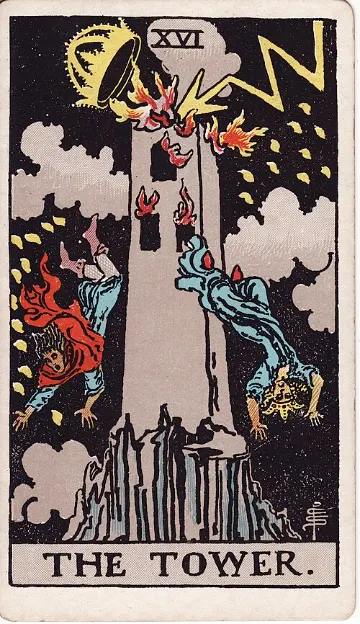
The Tower tarot card points to sudden change, a disclosure, or an idea that no longer holds up to the facts. In the Rider–Waite–Smith image, lightning strikes a tower, its crown flies off, and two people fall. Upright, the card can turn attention to what has changed and who needs support. Reversed, it may suggest a disruption being resisted, limited, or worked through privately. In love or work, The Tower does not guarantee a breakup, dismissal, or literal disaster. The useful question is what remains sound after a shock, and what needs a safer plan.
Look at the image
A jagged bolt meets the top of a tall tower perched on a rocky crag. A gold crown is knocked aside, flames emerge from the openings, and two figures fall in opposite directions. Small gold marks scatter across the dark sky. The picture catches the instant of impact, before we can know where anyone lands or what remains standing. That uncertainty matters: a reading should not invent the next scene. Notice how the crown draws attention to the top while the people bear the immediate cost. What had seemed secure, and who relied on it?
Upright: respond to what has changed
Upright, The Tower can mark a surprise, an uncomfortable truth, or a plan that fails its first serious test. It may be a dramatic event, but it can also be the moment you stop defending an assumption after contrary evidence arrives. Separate the shock from the response. What happened, what is still unknown, and who needs information or help now? Resist the urge to call every painful event a blessing in disguise. The card is more useful when it leads to a specific next action than when it becomes a prediction of catastrophe.
Reversed: disruption under the surface
Reversed, The Tower may describe a change being contained, postponed, or processed out of public view. It can also point to the exhausting work of holding up an arrangement that no longer feels reliable. Neither reading is automatic. A reversal does not promise that danger has passed, and an uneasy feeling alone is not evidence that a crisis is coming. Look at the question and neighboring cards, then check observable facts. Are people quietly repairing a problem, or avoiding a conversation because its consequences feel costly? The distinction changes what help is needed.
The Tower in love and relationships
In a relationship reading, The Tower may focus on a disclosure, a broken expectation, or a conversation that changes how two people understand their future. It does not prove betrayal or require a breakup. If trust has been shaken, ask what each person actually knows and what each agreed to, rather than filling the gaps with a tarot story. A couple might decide to rebuild an agreement, change its terms, or part ways; those choices depend on the people, not the card. If safety or coercion is involved, seek real support before treating a reading as a plan.
The Tower at work and in career
At work, a changed brief, a failed launch, or a sudden departure can expose how much a team relied on one person or untested assumption. The Tower does not predict a layoff or the collapse of a business. It asks what the evidence now demands. Which deadlines are still possible? Who is affected by the change, and who needs to hear about it promptly? If a role feels precarious, review the facts, your options, and practical safeguards. A backup plan is more useful than either panicking at the image or pretending the lightning missed.
Is The Tower a yes or no card?
The Tower resists a fixed yes or no because the question matters. For “Will this arrangement stay exactly as it is?” the image leans toward no: something is already being challenged. For “Can I respond honestly and make a better decision?” it may be an invitation to do so, without promising an easy result. Before answering, rewrite a vague question into one that names a real choice and a time frame. Then use the card to examine what the current plan depends on. No card can verify an event that has not happened.
Does The Tower always mean disaster?
No. The picture is violent, but a card in a reading is not proof that an accident, death, or other literal calamity will occur. Its force may fit a smaller realization: a cherished opinion changes when new information arrives. Equally, when a person is living through a serious loss, calling it “necessary growth” can erase the harm. The falling figures keep the human cost in view. Let the scale come from the situation, not from the drama of the illustration, and allow practical care to come before any lesson about rebuilding.
A Tower reading in practice
Suppose a partner accepts a job in another city before the two of you have discussed moving. You draw The Tower while asking, “What do I need to understand?” The sudden fact is the job offer; the uncertain part is what it means for the relationship. You might ask what decision has already been made, what is still open, and what each person needs to say clearly. The card cannot tell you whether your partner secretly wants to leave. It can help you prepare a direct conversation about trust, timing, and choices.
What can be rebuilt?
After an upsetting change, list what actually failed and what remains useful. A missed deadline may need a revised plan; a broken agreement may need a candid conversation and new boundaries. Start with immediate safety and information before imagining a new structure. If you discover that a belief was mistaken, name the evidence that changed your mind. Keep the people affected in the discussion about what comes next. The Tower can be constructive without making destruction the goal: sometimes a small repair begins with admitting where the old plan could not carry its weight.
Questions to ask
- What has actually changed, and what remains intact?
- Who needs immediate support or information?
- Which assumption deserves a closer structural check?