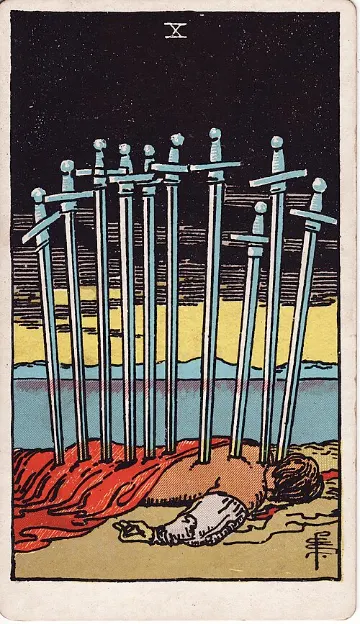
A figure lies face down beneath ten swords, red drapery over the lower body. The sky is almost black above a narrow yellow horizon and distant water. The Ten of Swords uses an extreme image for pain or an ending that cannot be ignored. Waite's upright account names sorrow and desolation while saying the card is not especially about violent death. His reversal is surprisingly different: advantage or success may arrive, but it may not last. A modern reading can ask what has ended, what remains to be handled, and whether a small improvement is stable enough to build on.
Look at the image
Pamela Colman Smith places a prone figure beneath all ten swords. Red fabric drapes the lower body, while a dark upper sky meets a thin yellow band over still water and far hills. The blades and the figure fill the foreground; the horizon is distant. No attacker or preceding scene appears, so the card shows an aftermath rather than a sequence of events. The yellow does not tell us whether this is sunrise or sunset. Its importance is the contrast with the heavy black sky. Read both parts: the severity of what is close and the possibility that the scene extends beyond the place where the figure lies.
Upright: name what has ended
Waite describes the upright Ten with pain, tears, sadness, and desolation, while explicitly resisting a simple violent-death reading. In a contemporary spread, the card may fit a plan that failed, a relationship whose terms have changed, or a way of working that cannot continue. State what has actually ended; it may be narrower than the first feeling of total defeat. A contract may be over while obligations remain. A proposal may be rejected while the underlying skill survives. Give the loss its proper size, then identify what still needs care today. The horizon need not erase the foreground for the next step to exist.
Reversed: a gain that may not last
Waite's reversed Ten is unexpectedly favorable: advantage, profit, success, or influence, but he says these gains are temporary. Modern readings often use reversal for a painful ending beginning to loosen its hold, or for an ending resisted. The older meaning asks a sharper practical question: if conditions improve briefly, what can be secured before they change? Confirm the terms of an offer, protect a useful opening, or put a short reprieve to work. If the underlying problem remains, do not build a long plan on a moment of relief alone. Reversal does not deny the hardship in the image; it asks whether the apparent turn has enough support to endure.
Ten of Swords in love and relationships
In love, the Ten can describe the point at which a familiar pattern has become unbearable or a relationship has ended under painful terms. Upright, ask what is finished and what responsibilities remain: shared plans, possessions, or a conversation needed for closure. Reversed, a brief improvement may be welcome without proving that the old pattern has changed. Look for a concrete difference in behavior before treating reconciliation as secure. If the issue is a harsh argument rather than an ending, name the words that crossed a line and what repair would require. The card's dramatic image can help acknowledge the hurt while the real relationship determines the next choice.
Ten of Swords as feelings
For your own feelings, the Ten may capture exhaustion, grief, or the sense that one more attempt at the same approach would cost too much. Give the feeling a specific object: what happened, what expectation broke, and what do you need now? If you ask how another person feels, the prone figure does not speak for them. Attend to their words and actions, especially after any promised change. Upright can fit a painful limit that deserves respect. Reversed may fit relief, renewed influence, or a short opening whose durability is not yet known. Naming the feeling can guide a conversation without deciding the entire future in advance.
Ten of Swords in career and money
At work, the Ten may appear after a project is cancelled, a role ends, or repeated effort on a failing process finally stops. Record what has been decided, protect necessary files, and tell the people whose work depends on the outcome. A clear ending can prevent resources from continuing down a closed path. Reversed, Waite's temporary profit or advantage suggests checking the duration of any reprieve: how long does a new budget last, and what happens afterward? In money matters, distinguish a one-time payment from recurring income and a delayed bill from a cancelled one. The first practical step is often ordinary accounting after an emotionally large event.
Ten of Swords versus Nine of Swords
The Nine shows a figure sitting awake in bed beneath repeated swords; the Ten places a figure on the ground under all ten. The Nine can emphasize private dread, doubt, and a situation not yet fully known. The Ten brings a more definite aftermath into view. If both appear, separate fear before the news from the facts after it. Some fears may have been justified; others may change shape once the decision is known. Do not force the cards into a story of inevitable decline. Use the Nine to identify what needs checking and the Ten to decide what has ended and what still needs attention.
Is the Ten of Swords a yes or no card?
For continuing the same costly course without any change, the Ten often leans no. It can be a yes to acknowledging an ending and handling the next necessary task. Reversed, a temporary advantage may justify a limited step, but check when the opening expires. Ask “Should I close this project and notify the clients now?” rather than “Is my future ruined?” The first question has a decision and a timetable. The second gives the image more authority than it can usefully bear. A clear no to one path may free time and resources for another, but the transition still needs practical work.
A reading example: a cancelled project
A small publisher loses funding for a planned series and draws the Ten of Swords. The editor confirms the cancellation in writing, lists contracts that still require payment, and tells the contributors what can and cannot be published. They preserve the research and artwork rights that the agreement allows. A temporary grant later covers one standalone issue; the editor checks its end date before making new promises. The card's upright face helps name the project that ended. Its reversed meaning helps them use a short advantage carefully. Neither interpretation requires pretending the loss was painless or that the yellow horizon has already become a new day.
Questions to ask
- What has actually ended, and what remains to be handled?
- If conditions improve briefly, what can be secured?
- Which next task matters before a larger plan can begin?