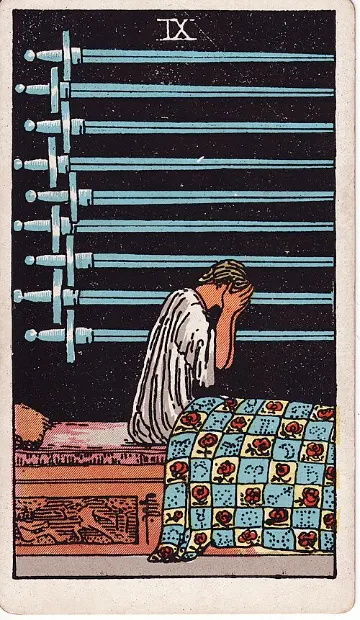
A figure sits upright in bed with their face in their hands. Nine swords cross the black background, while a patterned quilt covers the lower half of the scene. The Nine of Swords shows private distress without revealing its cause. Waite's upright account is severe, naming disappointment, delay, and despair; his reversal includes doubt, shame, and reasonable fear. Contemporary readers often see anxious rumination and sometimes, reversed, the first easing of it. The card is most useful when it separates a real issue to check from the exhausting repetition of worry, and when it asks what support or information can help with the next step.
Look at the image
Pamela Colman Smith seats a figure in bed with both hands covering the face. Nine swords run horizontally against a black field above and behind them. The quilt has bright small images, and the bedframe carries a carved scene, details easy to miss beside the large dark area. No intruder or source of the distress is visible. The swords do not show an event happening in the room; their repetition creates pressure around someone who is awake with sorrow. Begin with the posture and the setting before assigning a cause. The card depicts the experience of a difficult night while leaving the facts outside the bedchamber to be learned.
Upright: separate the event from the worry
Waite's upright Nine speaks in severe terms of loss, delay, disappointment, and despair. Contemporary readers often meet it as worry that repeats at night, guilt after a mistake, or dread before news arrives. The card's force is the figure's visible distress, not proof that every feared outcome will occur. Name the concern in one sentence and identify what can be checked. A missed deadline may call for a message tomorrow; a decision not yet made may require waiting for a real answer. If the worry has no useful action tonight, ask what would help you rest or feel less alone until morning. The dark field does not show the whole situation.
Reversed: doubt can have a basis
Waite's reversed Nine includes suspicion, doubt, shame, and reasonable fear. That last phrase matters: a fear can have evidence behind it and still be exhausting. Many modern readings use reversal for distress beginning to ease, or for worry that has been hidden too long. Look at what has changed. Has a real problem been addressed, or has reassurance merely quieted it for an hour? Is a suspicion supported by a specific fact that can be discussed? If shame is present, separate the action that needs repair from a judgment about the whole person. Reversal asks for a closer account of the worry, not an automatic promise of recovery or catastrophe.
Nine of Swords in love and relationships
In love, the Nine can appear when an unanswered question has grown louder in private than it has in conversation. Upright, choose one concrete concern and bring it into a discussion at a workable time. “I felt uncertain when our plan changed” offers more to answer than a broad accusation. Reversed, consider whether suspicion rests on a fact, an old experience, or both. A partner's reassurance is useful when it comes with consistent action; repeated checking without a clear question may leave the night unchanged. The figure in bed is alone in the image, but the next step may be to speak with someone who can hear the actual issue.
Nine of Swords as feelings
For your own feelings, this card may name dread, regret, sorrow, or the fatigue of turning the same thought over. Write the thought once, then ask whether it calls for information, an apology, a boundary, or simply a pause. If you are asking how another person feels, the hidden face does not let you read their mind. Attend to what they have shared and what they do when the concern is raised. Upright may fit an intense private burden; reversed may show doubt that needs checking or relief supported by changed circumstances. The card encourages a truthful account of feeling without treating feeling as the whole evidence.
Nine of Swords in career and money
At work, a mistake, pending decision, or silence after an important message can keep someone awake. List the actual deadline, the people involved, and the part you can correct. If an error occurred, report it with a proposed fix rather than rehearsing every possible consequence alone. Reversed, Waite's doubt and reasonable fear invite a factual check: is the concern supported by a document, or is the process itself unclear? In money matters, put the figures and dates on paper, then seek the missing term before agreeing to another obligation. The card does not make the problem small. It helps turn repeated worry into a defined question and next action.
Nine of Swords versus Eight of Swords
The Eight places a blindfolded, bound figure among blades on wet ground. The Nine moves to a bedchamber where a figure sits awake beneath nine repeated swords. The Eight asks what constrains action and what help could make a route possible. The Nine asks how distress is being experienced and what facts or support can interrupt its repetition. If both appear, identify the external obstacle before telling someone to change their thoughts. Then ask how the long worry is affecting decisions about that obstacle. A real limit and an exhausting response can coexist; each calls for a different kind of help.
Is the Nine of Swords a yes or no card?
The Nine rarely gives a useful flat yes or no to a broad future question. It points to a concern that needs a better account before a commitment is made. For a question about checking a fact, naming an error, or asking for support, it can lean yes. For an irreversible decision made during a sleepless worst-case spiral, pause until the terms are clearer. Reversed, do not assume the worry is baseless; Waite explicitly includes reasonable fear. Ask “Should I confirm the deadline before sending this?” instead of “Will everything go wrong?” The first question creates a possible action. The second gives the swords another circuit around the bed.
A reading example: the unanswered message
A freelancer sends a revised estimate to a long-time client and hears nothing for two days. They draw the Nine of Swords and start imagining the relationship is over. In daylight, they check the agreement: the client usually takes a week to review changes. The freelancer makes a note to follow up on the agreed date and asks a colleague to review the estimate for a real error. If the colleague finds one, they can correct it promptly; if not, they can wait without repeatedly rewriting the message. The card honors the worry while moving the question from an endless night to a specific check and time.
Questions to ask
- What fact would clarify the concern?
- What needs action now, and what can wait until morning?
- Who can help me check or carry the issue?