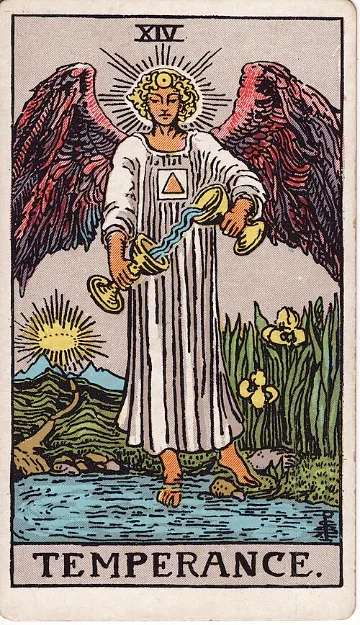
Temperance asks what combination or pace will actually work. Upright, it may favor patient adjustment, cooperation, and enough restraint to notice the effect of each change. Reversed, it may bring competing demands or an unfair compromise into view. Pamela Colman Smith shows a winged figure pouring between two cups, one foot on land and the other in water, with a path toward distant light. Balance here is an action, not a perfectly still state. The card does not require everyone to meet at the midpoint. It invites you to test a way of bringing things together without losing what each person needs.
Look at the cups and the path
Smith's winged figure pours a stream from one cup to another. One bare foot touches the water, while the other rests on land; irises rise beside the figure. A path travels between distant hills toward a bright, crown-like light. A triangle sits inside a square on the figure's chest. Waite also described a sun sign on the brow and explicitly said the angel is neither male nor female. He saw the card as a harmony of material and spiritual life, not merely a recipe for mixing ideas. In a reading, the visible action offers a grounded starting point: something is being transferred, tested, and held together. Which parts of your situation need contact, and which need their own place to stand?
Upright: find a workable rhythm
Upright, Temperance may favor small adjustments that can be observed and revised. Waite's older divinatory list includes moderation, management, and accommodation. That could mean changing a schedule so focused work and rest both have room, combining two methods after testing them, or giving a conversation enough time for each person to be understood. The card is not an order to split every difference exactly in half. Ask what the arrangement is meant to achieve, what each part contributes, and how you will know whether it works. A good rhythm lets people continue without draining one side to fill the other. Begin with a change small enough to assess, then keep or alter it based on the result.
Reversed: when the mixture does not hold
A modern reversed Temperance reading may suggest rushed decisions, incompatible demands, or a compromise that quietly costs one person more than another. Waite's historical reversed list is broader and includes disunion and competing interests, alongside references to religious institutions. Do not reduce it to a claim that someone has “lost balance.” Find the friction. Is the pace too fast, are two goals competing for the same resource, or are you trying to combine positions that cannot both be honored? Some tensions call for a slower experiment; others require a boundary or a clear choice. Reversed does not mean that a person facing exhaustion has failed at moderation. Look at the time, support, and authority available before asking them to adjust yet again.
Temperance in love and relationships
In love, Temperance can point to the daily work of fitting two lives together. Upright may favor a conversation about how much time, closeness, privacy, or help each person can genuinely offer. Reversed may expose a routine called “compromise” that only one partner maintains. The card is sometimes read as a sign of reconciliation, but it cannot promise that another person will return or agree. If repair is possible, both people need to name what happened, what would change, and whether they consent to trying again. Patience is useful when it gives a new arrangement room to develop. It is less useful when it asks someone to tolerate a repeated harm without evidence that anything is different.
Temperance in career and money
At work, Temperance can fit a collaboration between people with different strengths, or a project that needs a sustainable pace. Upright may favor a small pilot, a shared handoff, or a schedule that leaves time to test and correct the work. Reversed may point to conflicting priorities or a workload that is being “balanced” by expecting one person to absorb the overflow. Ask who owns each task, what capacity actually exists, and which deadline can move. In money questions, moderation may help you compare costs and keep room for essentials; the card does not forecast returns. A sensible plan survives ordinary variation, not just the best week. If two commitments cannot fit, naming that limit is better than calling overextension harmony.
Temperance as feelings or as a person
When you ask how someone feels, Temperance may suggest a theme of patience, adjustment, or a wish to keep a connection steady. It cannot disclose their private thoughts. They may be trying to make room for two priorities, or you may be the one hoping they will. As a person card, it can describe someone who listens, experiments, or helps people cooperate, regardless of gender. Observe what they actually do: do they make time for your needs, state their own, and change a plan when it fails? A peaceful manner alone does not prove mutual commitment. If the answer matters, ask directly what arrangement they want and whether they are willing to help build it.
Does Temperance mean healing?
The image's flowing water and measured movement can make Temperance feel like a card of recovery. As a symbolic prompt, it may invite you to notice habits, rest, support, and the pace at which you are asking yourself to change. It cannot diagnose a condition, predict recovery, or replace treatment. If a health concern is real, use qualified care and the facts of your situation. In everyday life, the card's useful lesson is narrower: make an adjustment you can sustain and notice what happens. Sometimes that means slowing down; sometimes it means asking for help or changing conditions that no amount of personal moderation can fix. Balance is not a reason to endure a harmful situation alone.
Is Temperance a yes or no card?
Temperance may lean toward yes when the question asks whether two workable parts can be brought together through a modest, testable change. It may lean toward wait when the terms are vague or one side is expected to give too much. Upright is not an automatic yes to reconciliation, and reversed is not an automatic no to cooperation. “Should we try a two-week schedule and review it?” is a choice you can make; “Will this relationship heal?” depends on another person and events still unknown. State what success would look like, what each person will contribute, and when you will review the result. If those conditions cannot be named, the wiser answer may be to clarify them before committing.
A reading example: a new evening service
Imagine a small café wants to open two evenings a week. Customers have asked for it, but the kitchen team is already stretched. You draw Temperance upright. The pouring cups suggest a trial rather than an immediate permanent change: choose one evening for four weeks, simplify the menu, confirm who is available, and track sales alongside overtime and fatigue. If the numbers work only because one cook gives up every day off, the mixture is not sustainable. A reversed Temperance might highlight that hidden cost or a clash between the owner's growth goal and the team's capacity. Neither orientation predicts revenue. It helps the café test a new rhythm while keeping the people who make it possible in view.
Questions to ask
- Which two needs am I trying to hold together?
- Who bears the cost of this compromise?
- What small trial would show whether the new rhythm works?