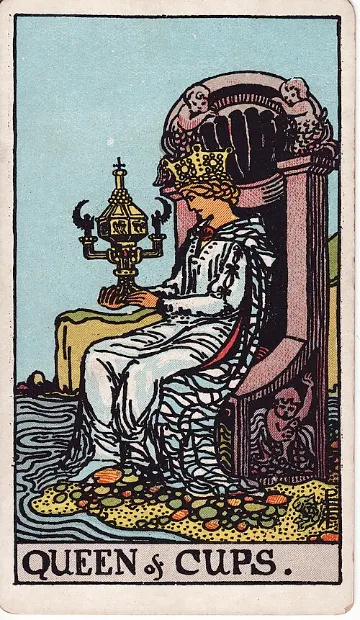
The Queen of Cups sits beside the sea and studies a covered, richly ornamented cup. She is often read as compassionate and perceptive, yet the image also asks what a thoughtful response looks like when another person's inner life remains private. Upright, the card can join attentive listening with action that actually helps. Waite described a Queen whose activity feeds her imagination; his reversed meanings are inconsistent, so the reversal deserves context rather than a verdict about someone's character. In love and work, the card is strongest when sensitivity is paired with clear words, consent, and care that can be sustained.
Look at the image
Pamela Colman Smith seats the Queen on a carved throne at the edge of the sea. Small figures ornament the stone, and water meets a pebbled shore below her feet. She looks closely at an unusually elaborate cup with a lid; its contents are hidden from us. Waite described her as dreamy, then added that she acts and that action feeds the dream. The image keeps both possibilities in view. Her still gaze suggests attention, while the solid throne gives that attention a place from which to respond. The covered vessel also marks a limit: someone else's experience cannot be seen simply because we look carefully at it.
Upright: turn attention into care
Upright, the Queen of Cups can describe listening that leads to a useful response. If a friend shares a difficult experience, reflect what you heard and ask what kind of help would be welcome. If you notice a subtle problem at work, check it with the people affected before designing a solution. Imagination can reveal possibilities, but care becomes visible in what you do next. Waite's account joins vision with action rather than leaving the Queen alone with her thoughts. The card may represent a person, a way of working, or a quality to practice. In each case, sensitivity is strongest when it respects the other person's answer.
Reversed: uncertain readings, visible behavior
Waite says the reversed accounts vary: one still describes a good woman, while another calls her untrustworthy and uses harsher moral labels. Those incompatible claims cannot identify a real person's character from a card. Many modern readers use the reversal for care stretched too thin, feelings confused with facts, or withdrawal after giving more than one can sustain. Ask what is observable. Has a promise been broken? Has support been requested, accepted, or refused? Is someone trying to know another person's feelings without asking? A clear boundary or a direct conversation can resolve more than assigning a motive to the Queen's closed cup.
Queen of Cups in love and relationships
In love, the Queen may fit a bond in which someone feels heard and can speak honestly without being rushed. A partner might remember what matters to you, make time after a hard day, or ask before offering advice. These actions matter more than a reputation for being intuitive. If you are dating, notice whether warmth is mutual and whether each person has room for their own pace. Reversed, care may become one-sided, or a quiet person may simply need space before talking. Ask for the kind of contact you need and listen to the reply. The lid on the cup makes privacy part of intimacy, not evidence of a secret.
Queen of Cups as feelings or as a person
If you draw the Queen about your own feelings, you may be taking time to understand an emotion before expressing it. That pause can be thoughtful; it can also become avoidance if a necessary conversation never happens. As a person card, the Queen may suggest someone whose listening and imagination stand out, regardless of gender. It does not certify that they know what others feel. If you ask about someone else's feelings, their choices and words remain the better evidence. Reversed, pay attention to whether you are carrying another person's distress as though it were yours, or assuming their silence has only one meaning.
Queen of Cups in career and creative work
At work, the Queen can point to skilled care in teaching, service, design, health-related roles, or any job where listening changes the result. A designer who watches how people use a product may see a need no specification captured. A colleague who hears a concern can bring it to the right decision maker instead of promising to solve it alone. In creative work, the lidded cup can represent an idea still taking shape; give it time, then make a draft that others can respond to. Reversed, emotional labor may be expected without time or credit. Define the work, its owner, and the support required to do it well.
Queen of Cups versus King of Cups
Both court cards sit close to water and hold a cup, yet their scenes focus attention differently. The Queen studies her covered cup on a shore; the King faces outward from a throne surrounded by water, with a cup and scepter in his hands. The Queen can bring a question about private attention and how it becomes care. The King can bring a question about decisions made while others depend on the result. These are not gendered abilities or a ranking of maturity. If both appear, ask what needs patient listening and what needs a clear, accountable decision. One does not replace the other.
Is the Queen of Cups a yes or no card?
For a question about listening, checking in, or making room for a thoughtful conversation, the upright Queen can lean yes. It favors a response that lets the other person tell you what they need. It gives no reliable yes to “Do I already know how they feel?” The covered cup makes that uncertainty visible. Reversed is not an automatic no, especially given Waite's conflicting reversed descriptions. It may suggest slowing down before taking on another person's problem or asking whether the help you plan is actually wanted. Frame the question around an action you can take and a response you can observe.
A reading example: a colleague asks for support
Imagine a colleague says they are struggling to keep up with a shared project, and you draw the Queen of Cups. You first ask whether they want help sorting priorities, a quiet conversation, or support raising the issue with the project lead. They ask you to review the next deadline together. You can spare an hour, so you look at the schedule and identify two tasks that need a decision from the lead. You do not promise to take over all their work or tell everyone what they privately shared. The Queen's attention becomes useful because it turns into one agreed action with a clear limit. Their needs, not your guess, shape the response.
Questions to ask
- What have I heard directly, and what am I assuming?
- What kind of care was requested?
- Which boundary would keep my attention honest?