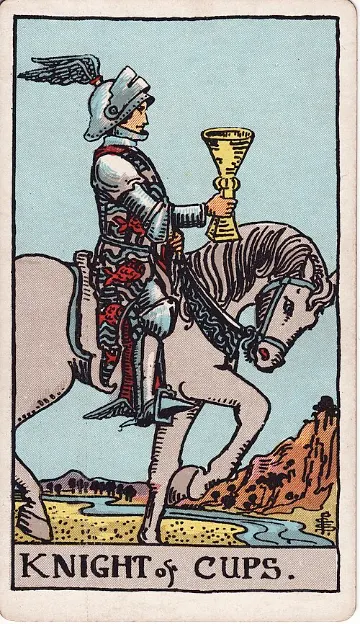
An armored rider carries a cup forward on a pale horse moving at a measured pace beside a stream. The Knight of Cups often appears when someone is approaching with an invitation, romantic gesture, or creative proposal. Upright, it favors an offer that can be made plainly and answered freely. Waite's reversed list warns of artifice and fraud; a modern reading may also describe a sincere but impractical promise. The picture shows a rider on the way, not an accepted offer or a guaranteed arrival. In love and work, the question is whether the gracious approach can become a clear agreement and sustained action.
Look at the image
Pamela Colman Smith sets an armored rider on a pale horse beside winding water and rocky ground. The horse lifts a foreleg carefully rather than charging. The rider holds a single cup ahead; small wings decorate helmet and boot. Waite described the Knight as graceful, riding quietly, and associated those wings with imagination. No recipient appears in the picture, and the cup has not been handed over. The distance between carrying an offer and having it accepted gives the scene its tension. It lets a reading examine both the beauty of an approach and the ordinary steps still required before anyone can say yes.
Upright: make an offer someone can answer
Upright, the Knight of Cups can mark an invitation, proposal, artistic pursuit, or a conversation that finally moves beyond hints. Waite's older list begins with approach and advances, not a completed union. If you are making the offer, state what you hope for and leave room for the other person to choose. If you are receiving it, listen for the concrete next step: when, where, what work or commitment is involved? The measured horse gives the gesture a pace. A sincere invitation need not solve everything at once, but it should be clear enough that an answer can shape what happens next.
Reversed: charm, doubt, and the real terms
Waite's reversed list is severe: trickery, artifice, duplicity, swindling, and fraud. A modern reading may also describe a gentler failure, such as an attractive offer made before its author knows how to deliver it. These are very different situations. The card alone cannot establish that a person is dishonest. Compare the invitation with evidence: are the terms consistent, are costs disclosed, and does promised action follow? If you are the one making an uncertain offer, reduce its scope rather than decorating it with certainty you do not have. The question is whether the cup is being carried with care or used to hide what lies behind it.
Knight of Cups in love and relationships
In love, the Knight can fit someone asking for a date, proposing a new level of commitment, or making a tender gesture after a difficult period. The offer can be welcome without proving a lasting relationship. Ask what each person is ready to give and what pace feels fair. Romance becomes more persuasive when it survives ordinary commitments: showing up, listening, and respecting a declined invitation. Reversed, a beautiful declaration may be out of step with behavior, or a sincere person may be promising more than they can currently sustain. Look at the pattern over time rather than deciding from the charm of one moment.
Knight of Cups as feelings and intentions
If you ask about your own feelings, the Knight may capture the desire to bring affection or an idea into the open. You may be ready to move from imagining a conversation to having it. If the question is about someone else's intentions, the rider's raised cup cannot reveal their private plan. A direct invitation is more informative than a cryptic sign, and follow-through says more than a first flourish. Reversed could fit mixed motives, hesitation, or an offer whose appeal has outgrown its practical basis. The useful question is what they have actually proposed, what they have done since, and whether that matches what you want.
Knight of Cups in career and creative work
At work, this Knight might be a commission, collaboration, job approach, or pitch for a project with emotional appeal. Welcome the vision, then ask for terms that let you evaluate it: scope, budget, decision maker, timeline, and ownership of the result. If you are pitching, show a sample and name the resources you need. If you are approached, a warm conversation is not yet a contract. Reversed, an offer may be deliberately misleading, or simply underplanned. Written details and a modest first milestone help distinguish the two. The cup's contents matter less than what can be delivered once the rider reaches another person.
Knight of Cups versus Page of Cups
The Page stands and studies the fish that has appeared in a cup. The Knight carries a cup forward on horseback. That change in posture offers a useful distinction: the Page receives, notices, and begins to form a message; the Knight chooses to approach someone with it. Neither card shows the other person's response. If both appear in a reading, ask whether a feeling or idea is still being understood, or whether it is ready to be offered in a way someone can accept or decline. Moving from Page to Knight calls for clearer words and a practical next step, not just greater confidence.
Is the Knight of Cups a yes or no card?
For a question within your control, the upright Knight can lean yes: make the invitation, send the proposal, or ask for a meeting. The rider's careful pace favors a specific offer over an extravagant promise. For “Will they accept?” the card shows no recipient and cannot settle the answer. Reversed asks for scrutiny before agreeing, especially if terms are vague or unusually attractive. A better question might be, “Can I offer this honestly at the price and time I have named?” or “What would I need in writing before accepting?” The answer then depends on a real exchange, not the rider's charm alone.
A reading example: an appealing commission
Imagine a gallery asks an illustrator to design a set of posters for a new exhibition. The invitation is warm, the theme is exciting, and the illustrator draws the Knight of Cups upright. They respond with interest and ask for the number of posters, fee, deadlines, and rights. The gallery has not decided the budget yet, so both agree to one paid concept sketch before discussing the full series. If the Knight later appears reversed, it could flag the gap between the original excitement and the unfinished terms; it would not prove the gallery meant to deceive. The first sketch and written agreement show whether this proposal has a route beyond its graceful arrival.
Questions to ask
- What am I offering, in specific terms?
- What would respectful pacing look like?
- Which practical step would show that the invitation is real?