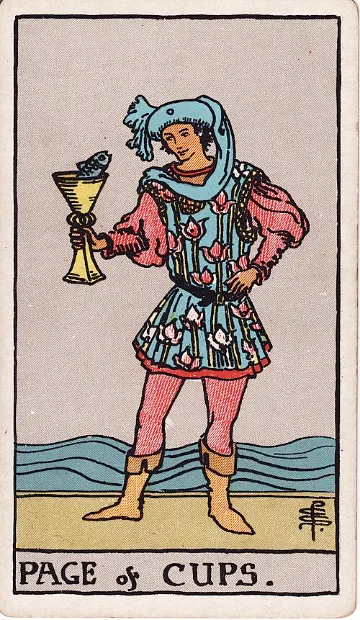
A richly dressed Page lifts a cup, and a fish rises from it to meet their gaze. The Page of Cups can describe a surprising message, a new feeling, or an image that has only just begun to take form. Upright, it rewards attention to the actual words or idea before building a larger story around them. Waite's reversed list ranges from attachment to deception; modern readers may also see a message withheld or misunderstood. In love and creative work, this is a card of early exchanges rather than finished promises. The small fish invites curiosity, but the response is what reveals where the encounter can go.
Look at the image
Pamela Colman Smith puts the Page on dry yellow ground with waves behind them. Their flowered tunic, large blue hat, and easy stance make the scene playful, while their gaze stays fixed on a fish rising from the held cup. The fish looks back. Waite described this encounter as an image of the mind taking form, and associated the Page with news, reflection, and study. There is no letter in the picture and no second person to receive it. What we see is an unexpected presence being noticed. The card's interest lies in that pause between surprise and response: what happens after the Page gives the strange detail full attention?
Upright: answer the message in front of you
Upright, the Page of Cups can fit a tentative invitation, an apology, an early creative idea, or a feeling you are only beginning to name. Waite's older meanings include a message and thoughtful application, even in business. Notice the scale of the event. A kind text may be worth answering without becoming proof of a relationship; an unusual sketch may deserve a draft without becoming a finished project. Ask one clear question or try one small version. The Page's strength is not certainty about where the fish came from. It is the willingness to see what is actually offered and respond without pretending the whole story is already known.
Reversed: attraction, artifice, or a missed signal
Waite's reversed list includes taste, inclination, attachment, seduction, deception, and artifice. Those meanings range from ordinary attraction to a crafted appearance that conceals the truth. A modern reading may instead point to imagination outrunning communication, or to a sincere message held back for fear of embarrassment. The reversal alone cannot tell you which is present. If a promise seems appealing, ask what was actually said and what the sender can follow through on. If you are the one hesitating, send a modest, honest version rather than an elaborate hint. Either way, clarify the exchange before treating a surprising fish as a settled answer.
Page of Cups in love and relationships
In love, this Page often suits an early exchange: a warm invitation, a thoughtful apology, or a playful way of showing interest. It can also describe learning how to speak about affection without assuming the other person feels exactly the same. If you are dating, welcome curiosity and let the next conversation establish pace. In an existing relationship, a small gesture may reopen a topic that has felt difficult, but it needs listening and follow-through. Reversed, charm could mask unclear intentions, or an earnest approach could be misread. Name the question you want answered instead of trying to solve the entire bond from one text or symbol.
Page of Cups as feelings and messages
For your own feelings, the Page can be the moment interest becomes noticeable but not yet well understood. You may want to reach out, make art, or admit that an encounter affected you. If the question is how someone else feels, a card cannot disclose their private intention. Read the message they actually sent, ask what they mean when appropriate, and see whether their actions continue in the same direction. Reversed, attachment may make an ambiguous gesture look larger than it is; alternatively, fear may make a clear invitation easy to dismiss. A direct reply gives both people more to work with than a long private interpretation.
Page of Cups in career and creative work
At work, the fish can resemble a proposal no one expected: a new visual approach, a client question that opens another market, or a colleague's unusual solution. Waite included news and application directed toward business, so the Page need not be limited to romance. The useful next step is small and testable. Draft the idea, ask what problem it solves, and show it to someone who can respond to the work itself. Reversed, an attractive concept may lack a feasible schedule, or a team may dismiss a good idea because its first form is awkward. A prototype can separate novelty from value without demanding a large commitment.
Page of Cups versus Knight of Cups
Both figures hold a single cup, but they are doing different things. The Page stands by the sea and studies a fish that has appeared in the cup. The Knight travels with a cup held forward across a landscape. In a reading, the Page can focus on receiving, noticing, or forming a message; the Knight can focus on carrying an invitation toward someone else. Neither image guarantees acceptance. If both cards appear, ask whether the idea has been understood well enough to present, and whether the person making the offer is ready to follow through. The movement from Page to Knight is a change in action, not a promise that the story will end romantically.
Is the Page of Cups a yes or no card?
For a small exploratory action, the upright Page can lean yes: reply to a friendly note, show a draft, or ask a sincere question. These steps invite information and leave room for a real answer. It is a weaker yes to “Will this person fall in love with me?” or “Will my idea succeed?” because the fish appears before any outcome is shown. Reversed may suggest clarifying the message or checking an appealing claim before committing time or money. Choose a question you can act on. “Should I send the first sketch for feedback?” is closer to the Page's scene than asking it to guarantee a whole future.
A reading example: an unexpected concept
Imagine a collaborator sends a rough illustration for a community poster. It uses a talking fish, a detail no one requested, and the organizer draws the Page of Cups. The first impulse might be to call the idea too strange or to make the fish the center of an entire campaign. Instead, the organizer asks what the fish is meant to communicate and requests one version with it and one without. A few viewers understand the playful image immediately; others miss the event details. The team keeps the fish but gives the date and place more space. The Page did not decide whether the picture was good. It helped them stay curious long enough to test its first form.
Questions to ask
- What has surprised me enough to deserve a closer look?
- What is the message as given, rather than as imagined?
- How can I respond with curiosity and clear boundaries?