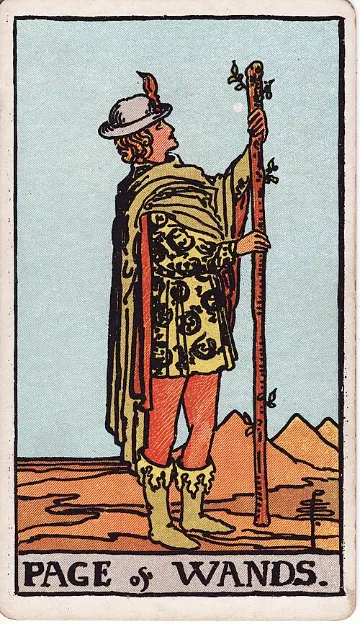
The Page of Wands stands in a sandy landscape, studying a tall staff with small green shoots. Waite described the figure as making a proclamation and linked the upright card with an envoy, a lover, and news; his reversed meanings include unwelcome news and indecision. Modern readings often turn the Page toward creative curiosity and the first steps of learning. Both approaches ask what has actually been offered, who is speaking, and what would make an exciting beginning worth pursuing.
Look at the image
Pamela Colman Smith places the Page in profile on sandy ground beneath a broad pale sky. Small green shoots grow from the tall staff held in both hands; no flowers are shown. The figure looks upward toward its top, while low hills sit in the distance and salamander-like patterns cover the tunic. Waite saw a person in the act of proclamation, although the picture shows no listener or written message. The still pose allows two readings: a messenger poised to speak and a curious person examining what they hold. Neither image alone tells us whether the news is welcome or whether the idea will succeed.
Upright: notice the message and the opening
Waite's upright Page may be an envoy, a postman, a faithful lover, or family news. These are historical associations with a person or message, not a guarantee that good news is coming. Modern readers also use the Page for an early creative spark, a course, or an invitation to try unfamiliar work. Read the actual question to decide which layer fits. If an offer has arrived, identify its sender, terms, and reply date. If the Page describes your own interest, choose one small test that will teach you something. Enthusiasm becomes more useful when it has a first step and a way to learn from it.
Reversed: unclear news or uncertain direction
Waite's reversed Page includes anecdotes, announcements, bad news, indecision, and instability. A reversal therefore cannot be reduced to a bored beginner. Modern readings may also notice scattered starts or a message whose exciting tone lacks practical details. If news is involved, check what was actually said before treating delay as rejection. If the issue is indecision, compare two workable options and choose a short trial rather than waiting for complete certainty. Reversed does not identify a liar or predict a specific disappointment. It asks whether the message is sound and whether the next action has enough shape to begin.
Page of Wands in love and relationships
In love, the Page may fit a lively first message, a new invitation, or curiosity returning to an established relationship. Waite's lover and envoy meanings make communication central. Upright, enjoy the spark while asking what each person is actually seeking. A playful exchange need not promise commitment, and a long-term couple can still make room for a new shared interest. Reversed, an unclear reply or changing plan may disappoint, but one missed message does not prove indifference. State the invitation plainly and notice whether the other person responds with a real time, place, or conversation. Interest is easiest to read through follow-through.
Page of Wands as feelings
For your own feelings, the Page may describe excitement, curiosity, or the uncertainty that comes before trying something new. You can be interested without already knowing where it will lead. If asking about another person's feelings, the Page's upward gaze cannot reveal a private emotion. Look for how that person communicates: do they ask questions, remember the answer, and make a plan they keep? Waite's messenger association suggests contact, but not a verdict about devotion. Reversed, indecision may belong to the person, the opportunity, or simply an incomplete conversation. A direct question is more reliable than filling the silence with a story.
Page of Wands in career and money
At work, the Page can fit a job inquiry, a new brief, a training opportunity, or a project idea that has not yet been tested. The message matters: check the role, pay, deadline, and authority of the person offering it. If you are the beginner, ask what a first useful deliverable would look like. A short prototype can reveal the cost of a larger commitment. Waite's reversed bad news or indecision may describe a reply that changes the plan; it is not a prediction that every application will fail. For money, keep an exploratory budget separate from funds needed for settled obligations.
Ace, Page, and Knight of Wands
The Ace of Wands shows a staff offered from a cloud, a striking image of possibility. The Page stands still with a staff, attending to what it might mean or preparing to announce something. The Knight is mounted and already moving. These are not fixed stages that every project must pass through, but they help distinguish an opening, a message or inquiry, and action in motion. If the Page appears beside the Knight, ask whether the plan has enough detail for the speed being proposed. If it appears beside the Ace, ask who will carry the new idea into an actual conversation.
Is the Page of Wands a yes or no card?
For a low-cost exploration or a clear invitation, the upright Page can lean yes: ask, apply, test, or start learning. It does not promise the final outcome or another person's commitment. Reversed, check the message and resolve the immediate uncertainty before making a larger promise. Ask “Should I attend the introductory workshop before paying for the full course?” That choice has a small cost and a useful way to learn. “Will this idea become a successful business?” asks the Page to supply evidence that has not yet been gathered. Let the first step answer the question it can actually answer.
A reading example: an unexpected commission
An illustrator receives a message inviting them to paint a mural and draws the Page of Wands. The idea is exciting, but the note says nothing about wall preparation, budget, or who approves the design. Instead of accepting or dismissing it on the spot, they ask for dimensions, a site visit, a fee range, and the decision date. They sketch one concept only after the organizer confirms those basics. The message turns into a workable brief, and the illustrator can decide whether to submit a full proposal. The Page's spark survives the questions because the questions give it a real place to grow.
Questions to ask
- Who is bringing this news, and what is actually being offered?
- What small test would make the idea clearer?
- Which detail must be settled before I commit?