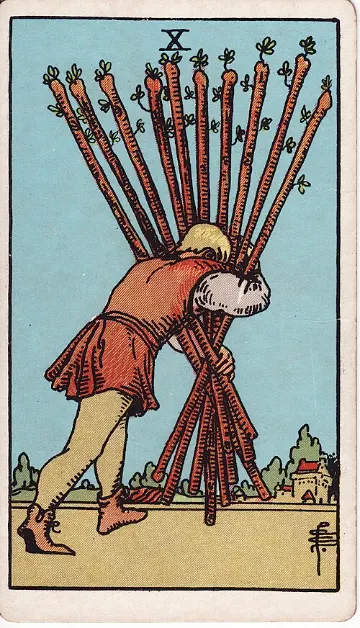
A stooped figure carries ten leafy staffs across open ground with buildings in the distance. The bundle fills the carrier's view. Waite gave the upright Ten a double edge: oppression, but also fortune or success and the burden those can bring. His reversed meanings concern difficulties and intrigues, while modern readers sometimes see a load being shared or released. The card asks which responsibility matters, who agreed to carry it, and whether the current way of finishing is sustainable.
Look at the image
Pamela Colman Smith bends the carrier under ten long staffs gathered in both hands and splayed above the head. The face is obscured by the bundle. Small buildings appear to the right, but no marked path or arrival is shown. The figure is still moving across open ground, so the image holds effort and possibility together. The blocked view is as striking as the weight: carrying everything at once makes it harder to judge what lies ahead. Ask which staffs actually need to reach the destination and whether the bundle has become a poor way to transport them.
Upright: success with a heavy cost
Waite calls the upright Ten oppression, yet also associates it with fortune, gain, and success that become oppressive. A desirable project can grow into an unmanageable role after it succeeds. His list also includes false appearances and perfidy, so do not assume every promised share of the work will materialize. In a present reading, identify the work created by the achievement and the terms under which it was accepted. Which duty is essential, which was added later, and who has authority to change the plan? Completion may be possible, but carrying the whole bundle alone is not the only measure of commitment.
Reversed: difficulty or a lighter load?
Waite's reversed Ten names contrarieties, difficulties, and intrigues. That is different from the modern reading of setting down a burden or finally asking for help. Both can be useful if the circumstances support them. Has a handoff actually reduced the work, or has it introduced confusion about who owns the remaining tasks? Are conflicting requests making a simple delivery harder? Put the obstacle in concrete terms before deciding that the reversal is relief or collapse. A revised agreement, clear recipient, or smaller scope may change the load. Turning the card does not automatically remove all ten staffs.
Ten of Wands in love and relationships
In love, the Ten can appear when one person handles most of the planning, care, household tasks, or emotional repair. That imbalance can exist even in a relationship both people value. Upright, name the recurring work and agree on ownership rather than asking for vague help. Reversed, the load may be redistributing, or conflict may have surfaced because expectations were never stated. Waite's intrigues are one historical possibility, not evidence of betrayal by a particular partner. Notice who follows through after the conversation. Affection matters, but a fair arrangement has to show up in ordinary tasks as well.
Ten of Wands as feelings
For your own feelings, the Ten may describe pride in what you have achieved alongside pressure to keep everything going. Those feelings do not cancel each other. If asking about another person's feelings, a hidden face cannot tell you whether they love you, resent you, or simply have too much on their schedule. Listen to what they say about capacity and watch what commitments they can keep. If the relationship feels heavy, ask which part is emotional and which part is a practical task that can be shared. Pressure is a condition to discuss, not proof of someone's private intentions.
Ten of Wands in career and money
At work, success may bring more clients, a promotion, or a deadline without enough staff to support it. List the deliverables, hours, and dependencies before accepting another assignment. A handoff needs a named owner, access to the relevant files, and a date, not only a promise that someone will help. For money, compare the gain with the cost of keeping it: fees, extra labor, and a buffer if payment arrives late. Reversed, investigate conflicting instructions or disputed ownership before assuming the job is nearly over. A profitable opportunity can still have terms worth renegotiating.
Nine versus Ten of Wands
The Nine of Wands stands guard before eight planted staffs, ready for a possible challenge. The Ten is already carrying the full bundle. The Nine asks what should remain defended during a delay; the Ten asks how actual responsibilities are being moved and by whom. If both cards appear, a team may have endured review and then won an award that creates more work than its original plan covered. Keep the earlier lesson about boundaries, but update the schedule and staffing for the new load. Readiness is useful; it cannot carry ten staffs by itself.
Is the Ten of Wands a yes or no card?
If the question is whether to add another obligation, the upright Ten often leans no until capacity and ownership are clear. That does not make the underlying goal worthless. A defined short-term finish with adequate help could be a conditional yes. Reversed, check whether the difficulty is easing or whether a new complication needs agreement first. Ask “Should I accept the extra event if another coordinator owns registration and the fee covers the added hours?” That question can be answered from real terms. “Will success make everything easier?” ignores the card's central tension: gain can create work.
A reading example: a festival that grew
A neighborhood organizer draws the Ten after a small festival wins a larger grant. The funding is good news, but the new agreement adds two stages, more vendors, and detailed reporting. Instead of accepting every task personally, the organizer lists the grant requirements and assigns vendor contact to a paid coordinator. They move one optional performance to a later event and ask the funder to confirm the reporting deadline in writing. The festival can still expand, but its success no longer depends on one person carrying the booking, budget, and permits at once. The card points to the cost of the gain and a workable way to share it.
Questions to ask
- Which part of this load came with success?
- Who has agreed to own each remaining task?
- What is the smallest complete delivery?