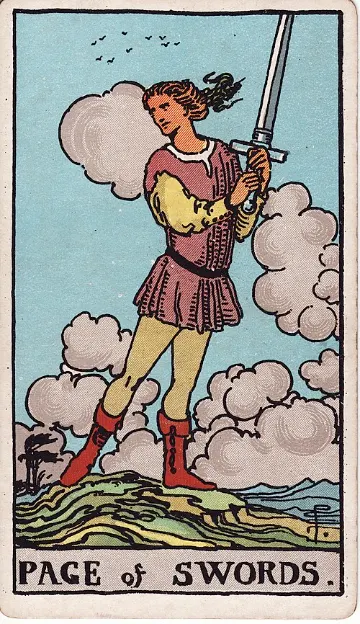
A young figure strides across a windy ridge with a sword held in both hands, looking back while birds and clouds move overhead. The Page of Swords is watchful, curious, and ready to question what appears. Waite's older meaning includes vigilance and examination, but also oversight and spying; his reversal warns of darker uses of those powers and being unprepared for the unexpected. Modern readings often emphasize research, quick messages, and the beginning of intellectual skill. In love or work, the card asks what is worth investigating, how to verify it, and when a sharp question will be more useful than a quick accusation.
Look at the image
Pamela Colman Smith sets the Page on uneven high ground, holding a long upright sword with both hands. The body moves one way while the face turns back, as if checking more than one direction at once. Wind lifts the hair and clothing; birds and restless clouds cross the sky. No opponent appears, yet the posture is ready for one. The scene gives the Page a lookout and a task that has not been fully revealed. Notice the distance between alertness and certainty. A watchful person can gather an important fact, or spend that energy reacting to every movement in the clouds.
Upright: observe and examine
Waite associates the upright Page with vigilance, examination, oversight, and even spying. Those meanings give the card more edge than a simple symbol of curiosity. A modern reading may fit research, a message needing verification, or the first serious challenge to an accepted claim. Use the Page's alertness to ask a question precise enough to answer. Find the original source, compare accounts, and keep track of what remains unknown. In a group, a junior voice may notice what experienced people have stopped checking. The useful stance is prepared inquiry, not a performance of suspicion. The sword is raised, but the card has not shown a target that deserves a strike.
Reversed: caught unprepared
Waite's reversed Page includes a darker use of watchfulness and an unprepared state when something unforeseen arrives. Modern readers may also see scattered research, rumor, or a sharp message sent before the facts are ready. Ask what preparation is missing. Is there a source that has not been read, a question no one has asked, or a contingency the plan ignored? If the problem is invasive scrutiny, consider whether the information being sought is yours to demand. Reversed does not make every curious person malicious. It asks whether observation is serving understanding or turning into a habit of surveillance and quick judgment.
Page of Swords in love and relationships
In relationships, the Page can point to a needed question, a new conversation, or the urge to check a story that does not quite fit. Upright, ask directly about the specific event rather than collecting hints and building a case in private. Reversed, notice when watchfulness has become constant testing or when a real concern is being brushed aside as “overthinking.” The difference lies in the evidence and the way the conversation is held. A clear request for context gives the other person room to answer. The figure's backward glance can remind you to look twice, but it cannot tell you what a partner has done outside the frame.
Page of Swords as feelings
For your own feelings, the Page may capture curiosity, mental excitement, or the nervous readiness that comes before asking something important. Name the question beneath the alertness. If you are asking about someone else's feelings, their messages and behavior matter more than a card's watchful pose. A person may ask many questions because they care, because they are uncertain, or because the situation is new. Upright can favor an open exchange that learns something. Reversed may show suspicion or an unexpected fact that needs time to understand. A direct question can turn the Page's restless scanning into a conversation where both people can respond.
Page of Swords in career and money
At work, the Page can suit due diligence, a new assignment, fact-checking, or a colleague who raises an uncomfortable but useful question. Give inquiry a scope: what decision will this information support, and when is enough known to act? Waite's oversight meaning can fit a review of quality or compliance, while his spying meaning asks whether the method respects appropriate boundaries. Reversed, plan for an unforeseen change by checking assumptions and keeping essential records current. In money matters, read the terms before repeating a claim about returns or fees. An informed question can save more than a confident answer that was never tested.
Page of Swords versus Knight of Swords
The Page stands on a ridge with a sword ready, looking around. The Knight charges on horseback with a raised blade and a clear sense of speed. One gathers information and forms the question; the other acts on a conclusion. If both appear, ask whether the Knight's urgency has outrun the Page's examination. A real deadline may still require action, but knowing the central fact can keep that action pointed at the right problem. Use the Page to verify the claim or identify the missing detail, then let the Knight move on a defined aim. Alertness and courage can support each other when their order is right.
Is the Page of Swords a yes or no card?
For asking a question, checking a source, or preparing a draft, the upright Page often leans yes. It is less comfortable as a yes to a decision that depends on unverified rumor. Reversed suggests revisiting the premise or preparing for an unexpected answer. Try asking “Should I request the original report before sharing this claim?” instead of “Is everyone hiding something?” The first question creates a useful next step. The second turns vigilance into a conclusion before inquiry begins. A Page-style yes is permission to learn, compare, and speak carefully, not an award of certainty about what another person intends.
A reading example: a rumor at work
A new analyst hears that a project will be cancelled and draws the Page of Swords. They do not repeat the rumor in the team chat. Instead, they check the latest project brief and ask the lead whether the budget or schedule has changed. The lead confirms a review is planned but no decision has been made. The analyst prepares a short list of questions about possible outcomes and shares the confirmed review date with colleagues. If the project does change, the team will have a better basis for responding. The Page's vigilance becomes useful because it turns a passing claim into a source, a question, and a clear answer.
Questions to ask
- Which source or observation would answer this question?
- What preparation is missing before I act?
- Am I asking for information I genuinely need?