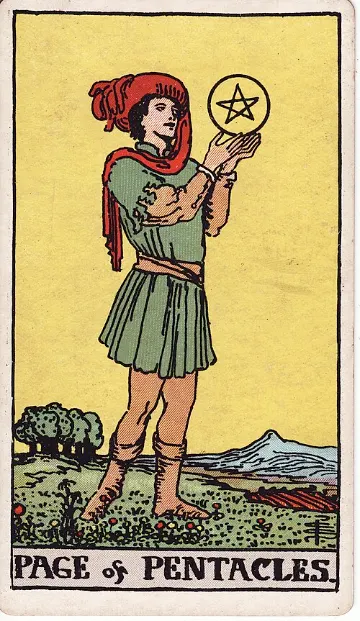
A young figure stands among flowers, absorbed in a pentacle that seems to hover above raised hands. The Page of Pentacles turns material life into something to study before trying to possess or use it. Waite's upright meanings include application, scholarship, reflection, and news; his reversal includes wasteful spending and unfavorable news. Modern readings often focus on an early opportunity or a learner's follow-through. In love, work, or money, the card asks what information is available, what still needs practice, and which small action would test the promise of the pentacle.
Look at the image
Pamela Colman Smith places the Page in a flowered landscape with trees and hills beyond. The figure's raised hands sit beneath a pentacle that seems to hover, and the gaze stays fixed on it. Waite describes slow movement and deep attention, not a completed exchange. The red cap and green tunic give the Page a vivid presence, but little else in the scene demands attention. Nothing shows a finished purchase, course, or job. The coin is an object of study before it is a usable resource. Ask what the Page has learned by looking closely and what would happen when that attention turns into a small test.
Upright: study before the commitment
Waite's upright Page is linked with application, scholarship, reflection, messages, and rule or management. An upright reading can fit the first serious look at a course, job offer, tool, or plan to earn money. Read the terms, ask a basic question, and try one manageable exercise. A learner need not perform mastery at the start; curiosity becomes useful when it changes what they can do. If news has arrived, separate the announcement from the commitment it might invite. A training place offered is not yet a skill learned, and an appealing coin is not yet income. The Page's close attention is a strong beginning when it leads to informed action.
Reversed: cost, news, and follow-through
Waite's reversed account includes prodigality, dissipation, luxury, and unfavorable news. Those terms point to spending or information that changes the value of an apparent opportunity. Contemporary readers may also see a student who buys a course but never starts, or keeps researching without a first trial. The stories call for different responses. If money is involved, total the fee and recurring costs. If a message disappoints, find out which condition changed. If practice has stalled, choose a small task that can be finished this week. The reversal is clearer when it names the missed detail or next action rather than dismissing the Page as unmotivated.
Page of Pentacles in love and relationships
In love, the Page can show sincere curiosity expressed through practical attention: remembering a plan, learning what matters to someone, or making time to see them. It is an early stage, not a pledge of permanence. Upright, two people may enjoy discovering how their routines and priorities fit. Reversed, interest may be real while timing, money, or follow-through is poor. Ask for a concrete plan instead of trying to measure affection by the size of a gesture. The Page's one pentacle can represent an offer of attention; what makes it valuable is whether that attention continues after the first bright impression.
Page of Pentacles as feelings
When the question concerns your feelings, the Page may reflect curiosity and a wish to understand a connection before making a larger promise. That can be thoughtful rather than hesitant. If you ask what another person feels, the hovering pentacle does not disclose their private thoughts. Notice whether they ask questions, make and keep small plans, and respond to what you tell them. Reversed, a delayed reply or changed plan might reflect limited capacity, disappointing news, or fading interest; a conversation can distinguish these better than the image. The card supports a small, honest step toward clarity rather than a story about feelings that no one has spoken aloud.
Page of Pentacles in career and money
For career questions, the Page can point to an entry-level assignment, apprenticeship, application, or skill you are ready to study seriously. Ask what the role teaches, who provides feedback, and what a successful first month would look like. With money, check the full cost of a tool or course and the date when payment is due. Waite's association with messages makes written details especially relevant: an offer email may contain limits absent from the headline. Reversed, unfavorable news can require a revised plan rather than a verdict on your ability. A practical first test gives you evidence before a large outlay or promise.
Page versus Knight of Pentacles
The Page stands absorbed by one pentacle; the Knight holds a pentacle while sitting on a still horse in a worked landscape. The Page asks how to understand a resource or skill. The Knight asks how to carry a responsibility through repeated days. If both appear, a promising lesson may be ready for a routine: set the first practice session, deadline, or payment plan. Do not demand the Knight's consistency from someone who has just received the Page's news, but do not let study become endless admiration either. The movement between the cards is from informed curiosity to dependable execution.
Is the Page of Pentacles a yes or no card?
For a small, affordable trial that teaches you something useful, the upright Page can lean yes. It supports applying, asking for the syllabus, making a sample, or requesting written terms. It does not guarantee admission, profit, or another person's commitment. Reversed suggests checking cost and new information before paying or promising more. Ask “Should I take this short course at the stated price to test the skill?” and decide what result would justify further study. “Will this coin make everything work?” skips the Page's central task: looking closely enough to know what is actually in front of you.
A reading example: a paid certification
A worker sees a paid certificate advertised as a route into a new role and draws the Page of Pentacles. The headline salary is attractive, but they first ask employers whether the certificate is recognized and speak with a recent graduate about the coursework. They calculate tuition, required materials, study hours, and the date of the next available class. Before enrolling, they try a free introductory exercise and discover which part of the work interests them. If the course fits their budget and builds a skill employers actually request, they can commit with a clearer purpose. If not, the careful study has still saved a costly guess.
Questions to ask
- Which detail of this opportunity do I still need to check?
- What small task would test my interest or skill?
- What cost or new message could change the decision?