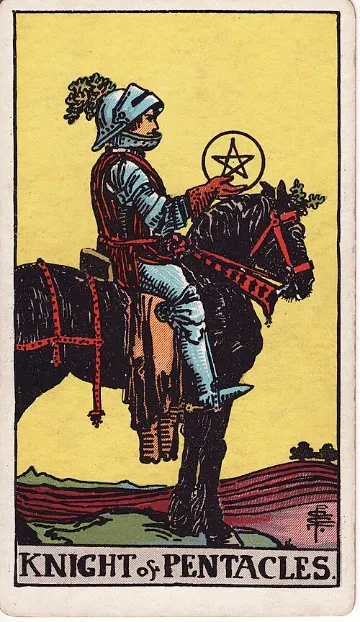
An armored rider presents a pentacle from a still dark horse above worked fields. The Knight of Pentacles carries a resource with patience and responsibility rather than speed. Waite's upright meanings include usefulness, service, and integrity; his reversal includes inertia, stagnation, and carelessness. A modern reading may ask whether a careful routine is delivering what it promises or has become a reason to delay. In love or work, the Knight is best understood through repeated actions, a realistic pace, and a destination clear enough to know when progress is happening.
Look at the image
Pamela Colman Smith shows an armored rider on a dark horse whose feet are planted. The Knight holds out a pentacle but does not gaze at it; fields stretch behind the pair. Armor suggests readiness for a journey, while the horse gives no sign of rushing. No opponent appears in the landscape. The contrast makes pace the central visual question. Is the Knight pausing to carry something valuable with care, or has a journey failed to begin? The worked ground suggests that material results take repeated attention. The card invites a comparison between the resource displayed in the hand and the work required to put it to use.
Upright: useful consistency
Waite associated the upright Knight with utility, service, responsibility, and rectitude. An upright reading can fit a person or plan that does what it says week after week. Reliability may look plain: keeping appointments, finishing a recurring task, paying on schedule, or checking work before it goes out. Set a pace that can be repeated and a result that can be seen. If others depend on the outcome, tell them when the next stage will be complete and what might delay it. The still horse is not a promise of quick arrival. The card favors work that reaches its destination intact because someone cared enough to keep showing up.
Reversed: pause or stagnation?
Waite's reversed meanings include inertia, idle repose, stagnation, discouragement, and carelessness. A modern reader may also see a routine that has become so rigid it no longer serves the goal. Not every pause is failure: rest can preserve the ability to carry a long responsibility. The question is whether the pause has a purpose and an end. Has a task missed several agreed dates? Has new information made the original plan obsolete? Or has the worker been given too much to do without support? Reversed, measure the actual progress before asking for more speed or accepting an indefinite delay.
Knight of Pentacles in love and relationships
In love, the Knight may show care through kept promises and ordinary presence rather than dramatic declarations. Upright, a plan to visit, share a task, or build a home routine can matter because it is repeated. Slow commitment can be thoughtful if both people know what it is moving toward. Reversed, reliability may turn into a pattern that leaves little room for affection, or plans may be postponed so often that one person cannot make their own choices. Talk about the pace and the destination together. A stable relationship needs more than a full calendar, but it also needs the everyday actions that allow trust to form.
Knight of Pentacles as feelings
When asking about your own feelings, the Knight can reflect a willingness to invest in someone patiently and make affection practical. That is different from deciding the future before the other person has answered. If you ask what someone else feels, the rider's stillness does not reveal private intent. Look at whether they make and keep plans, acknowledge delays, and respond when you explain what you need. Reversed, a person may feel discouraged or unable to move the connection forward, but a repeated lack of action can also be a clear fact in itself. Ask what kind of commitment is possible now rather than waiting for a card to supply an unspoken promise.
Knight of Pentacles in career and money
For career questions, the Knight can favor a role with recurring responsibilities, a long contract, or a project that succeeds through careful stages. Define the deliverable, schedule, and check-in before praising someone as dependable. A plan that asks for daily effort without a finish condition can consume more time than expected. With money, the card may suit regular saving or repayment when the amount and dates fit actual income. Reversed, examine whether the process is stalled, the scope has changed, or a payment has been missed. The answer may be a better routine, a revised agreement, or a necessary pause; the figures will show which.
Knight versus Page of Pentacles
The Page of Pentacles studies a hovering coin in a flowered landscape. The Knight holds a coin from a planted horse amid worked fields. The Page asks what a new resource means and what can be learned from a first trial. The Knight asks how to carry that learning into a routine others can count on. If both appear, set the first small lesson and then decide when it becomes a recurring practice. Interest is valuable, but it does not complete the work by itself. Equally, a routine can keep running long after the question that gave it purpose has changed. The cards need curiosity and follow-through together.
Is the Knight of Pentacles a yes or no card?
For a task with a clear purpose and a repeatable method, the upright Knight can lean yes. It favors a commitment you can sustain, not a quick result promised by enthusiasm alone. Reversed suggests reviewing the schedule and obstacles before agreeing, especially when a project has already stopped moving. A useful question is “Can I deliver this work each Friday for the next two months at the agreed rate?” The hours, payment, and existing duties can be checked. “Will it happen soon?” asks for a date the still horse cannot provide. The Knight's answer depends on a workable route and the willingness to follow it.
A reading example: a twelve-week project
A shop manager needs to move inventory records into a new system over twelve weeks. The Knight of Pentacles appears when they are deciding whether to take the lead. Instead of promising to finish “as soon as possible,” they count the records, agree on a weekly batch, and reserve time to check errors before each handoff. They arrange a short review every Friday, with a larger review after the first month to adjust the batch size. The manager also names the person who will cover daily orders while records are transferred. Progress can now be measured without pretending the horse must sprint. The slow pace has a route, a purpose, and a chance to change if conditions do.
Questions to ask
- What result is this routine meant to deliver?
- What progress can I verify at the current pace?
- Which change would justify revising the route?