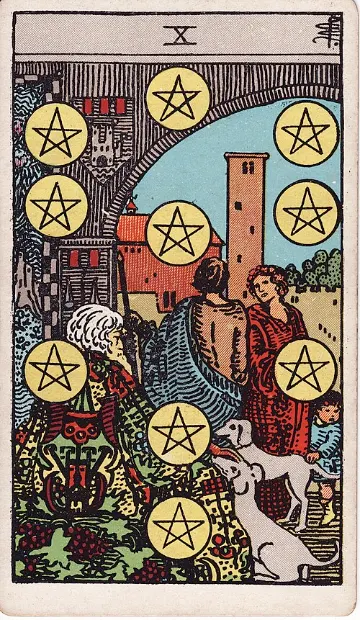
An elder sits with two dogs near an arch while a couple and child occupy the space beyond; ten pentacles overlay the scene. The Ten of Pentacles broadens the suit from one person's comfort to the people, property, records, and habits that carry resources over time. Waite's upright meanings include wealth, family matters, archives, and the family home. His reversal ranges from chance and loss to a gift or pension. A modern reading may ask whether a shared arrangement is durable and fair. The card invites a concrete look at who benefits, who maintains the structure, and who can help decide its future.
Look at the image
Pamela Colman Smith sets an elder and two dogs in the foreground, with a couple beneath an arch and a child visible to the right. Buildings stand beyond them. Ten pentacles form a pattern over the whole scene rather than sitting in one person's hand. The picture gathers different ages and kinds of attachment in a built place, but it does not explain their relationships or agreements. The arch creates a threshold between the foreground and the people farther in. Ask what can pass through that threshold: property, memory, care, work, or a role in decisions. The card's wealth is spread across a scene, not confined to a purse.
Upright: resources that endure
Waite's upright meanings include gain, riches, family matters, archives, and the family abode. The Ten can suit a household, long-running enterprise, or community practice that needs to serve people beyond one immediate decision. Money is part of that continuity, but so are records, maintenance, and knowledge of how things work. Who can use the shared resource now, and who pays to keep it available? If a plan depends on one person remembering every detail, write down the process while they can still explain it. A durable arrangement gives the next person more than an impressive building; it gives them a clear way to care for what has been built.
Reversed: what might not carry forward?
Waite's reversed list is mixed: chance, loss, robbery, and gambling appear alongside a gift, dowry, or pension. It does not simply mean a family is fighting. Modern readers may use the reversal for an unequal inheritance, an expensive property no one can maintain, or a tradition that excludes someone it affects. Check which issue is present in the actual question. Is a transfer uncertain, are the terms unclear, or has upkeep been neglected? A gift can still arrive under complicated conditions. The reversed Ten is most useful when it reveals a weak point in the arrangement before people rely on its promise of continuity.
Ten of Pentacles in love and relationships
In love, the Ten can describe a shared future with practical shape: a home, chosen family, care for relatives, or routines that make several people feel they belong. It need not prescribe marriage, children, or one kind of household. Upright, partners may be ready to discuss how their resources and obligations fit together over time. Reversed, a family expectation or existing arrangement may leave someone without a voice. Name the decision rather than treating “legacy” as a warm feeling. Who will live where, contribute what, and decide when circumstances change? Those answers make a shared future more real than the appearance of a stable household.
Ten of Pentacles as feelings
When the question concerns your own feelings, the Ten may reflect a desire for belonging and a connection that can become part of ordinary life. It can also show gratitude for people who have made a place for you. If you ask what another person feels, the many figures in the picture cannot speak for them. Notice whether they include you in plans, discuss shared responsibilities, and make room for your choices. Reversed, uncertainty about belonging may come from an unspoken family rule or a practical obstacle. Ask what participation would mean to each person before interpreting a house, arch, or group as proof of lasting commitment.
Ten of Pentacles in career and money
For career and money, the Ten can point to a family business, property, long-term savings, an archive of valuable work, or an organization preparing for succession. Look at the system, not only the headline value. Who owns each asset, who operates it, what costs recur, and who has authority when the usual decision-maker is absent? Waite's mention of archives makes records especially relevant: a resource is harder to pass on when no one can locate its history or terms. Reversed, a proposed transfer may depend on chance or carry obligations that reduce its value. Listing the people, documents, and upkeep can turn a vague legacy into a workable plan.
Nine versus Ten of Pentacles
The Nine of Pentacles places one figure in a cultivated garden, able to enjoy a stable setting. The Ten brings several figures, dogs, buildings, and an arch into the frame. The Nine asks how an individual uses and maintains comfort; the Ten asks how resources and responsibilities continue among people. If both appear, a personally successful arrangement may be ready for wider use, but sharing it changes the terms. Decide what can be offered, what remains private, and who takes on the work of upkeep. The cards describe different scales of care, not a command to trade independence for family approval.
Is the Ten of Pentacles a yes or no card?
For a plan with clear roles, affordable upkeep, and willing participants, the upright Ten can lean yes. It favors choices that still make sense after the first celebration or purchase. Reversed suggests examining uncertainty in the transfer or the costs that others will inherit; Waite's mixed reversal does not make it a universal no. Ask “Should we take over this space under the stated costs and responsibilities?” and list who has agreed to what. “Will this family always support me?” asks for a promise no card can make. The Ten is strongest when the proposed future has names, dates, records, and a way to adapt.
A reading example: joining a family business
Two siblings are offered a chance to take over a small family shop and draw the Ten of Pentacles. The shop has loyal customers and valuable equipment, but one parent has handled orders and repairs without written instructions. The siblings ask for recent accounts, a list of suppliers, the building costs, and a clear description of each person's role. They spend a month learning the routine before agreeing on when decisions will transfer. One sibling wants to manage sales; the other can handle operations only part time, so they adjust the plan. The business's history remains an asset, while the new agreement gives it a realistic path beyond the person who built it.
Questions to ask
- What resource or practice should continue, and for whom?
- Who will maintain it when circumstances change?
- Which decision or record needs to be made clear now?