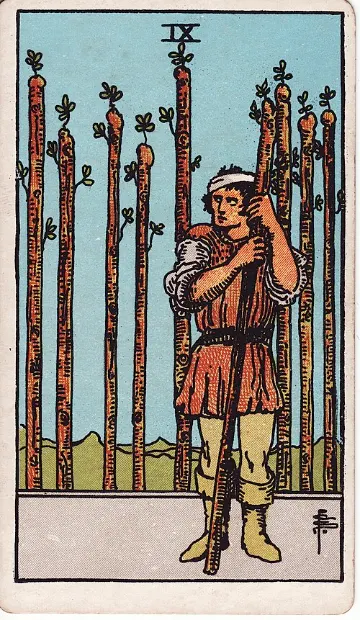
A bandaged figure holds one wand before a row of eight upright staffs and looks to the side. Waite read the Nine of Wands as strength in opposition, with delay or adjournment among its upright possibilities; his reversal names obstacles and adversity. Modern readings also notice how exhausting constant vigilance can become. The card does not show an approaching enemy or guarantee a final victory. It asks what still needs protecting, whether the present challenge is real, and how to keep enough capacity for a considered response.
Look at the image
Pamela Colman Smith shows a figure with a white bandage around the head, holding one leafy staff close while eight others stand behind. The figure looks sideways rather than at a visible opponent. Waite likened the row to a palisade and described someone expecting an enemy, but the picture does not show one arriving. The bandage suggests an earlier encounter without telling us what happened or who caused it. This is a scene of readiness, not a picture of victory. Notice the difference between a defense built from experience and an alarm that has not yet met a present threat.
Upright: strength under opposition
Waite gives the upright Nine strength in opposition and adds delay, suspension, and adjournment. Holding a position may require patience before the next decision or challenge is even clear. An upright reading can fit a grant under review, a boundary that has been tested, or a project waiting for a final response. Name what you are prepared to defend and what new evidence would change your plan. The person has eight staffs behind them: past work and preparation are visible resources. Strength here is not endless endurance. It includes choosing when to answer, who can help, and which delay is outside your control.
Reversed: obstacles or exhausted defenses
Waite's reversed meanings are obstacles, adversity, and calamity. He does not describe the reversal as relief from a long struggle. A modern reading may also notice depleted energy, rigidity, or the habit of expecting the previous problem to recur. Keep those possibilities separate. Is a real barrier blocking the work, or is the guard too tired to assess a new situation fairly? If the obstacle is external, document it and seek a workable route. If vigilance is consuming more than it protects, change the schedule or ask for support. Neither interpretation requires pretending that persistence alone will solve every problem.
Nine of Wands in love and relationships
In love, the Nine can describe someone who still wants connection but protects a boundary after conflict. That boundary may be necessary; the card does not say that caution is a flaw. It also cannot prove that a present partner will repeat an earlier person's behavior. Upright, say what would help rebuild trust and give the other person a fair chance to respond. Reversed, a real obstacle may need attention, or old defenses may be making every conversation feel like another test. Compare what is happening now with what happened before. Trust grows through consistent actions, not through an order to lower the guard on demand.
Nine of Wands as feelings
For your own feelings, the Nine may name alertness, resolve, or the fatigue of being ready for one more difficult exchange. Those feelings can coexist. If the question is what someone else feels, a sideways glance is not access to their private thoughts. Look instead at what they say, whether they keep a stated agreement, and whether they can explain a boundary without turning every question into a threat. Reversed, guarded behavior could reflect a current obstacle or depleted capacity. Ask directly what is needed for the next conversation. The card can frame that question; it cannot answer it for another person.
Nine of Wands in career and money
At work, the Nine can fit a delayed approval, repeated revision request, or negotiation after a difficult round of feedback. Waite's upright delay matters: waiting is part of the card's older meaning, not automatically a sign of failure. Keep a record of what has been submitted, the next decision date, and who owns the response. For money, preserve a buffer before committing more resources to a contested plan. Reversed, identify the actual barrier rather than calling every delay burnout. If one person is carrying every contingency, redistribute the work before another setback makes the process fragile.
Seven versus Nine of Wands
The Seven of Wands shows a figure actively defending high ground against staffs rising from below. The Nine shows a guard before eight planted staffs, looking sideways for what might come next. The Seven asks which challenge deserves an answer now; the Nine asks how past opposition shapes readiness for a possible next one. If both appear, separate the live objection from the expected one. A team may have defended its plan in a meeting and then spend weeks awaiting review. Prepare the evidence and a backup route, but do not treat the waiting period itself as another attack.
Is the Nine of Wands a yes or no card?
For a cause that still matters and has a realistic plan, the upright Nine can lean yes to continuing with support and clear limits. It is a conditional answer, not a promise of quick approval. Waite includes delay even upright. Reversed, inspect the obstacle before deciding whether to persist, revise, or stop. Ask “Should I submit one final response to the review panel if I can get the figures checked first?” That question has an action and a condition you can assess. “Will every objection disappear?” asks the card to settle decisions made by people outside the image.
A reading example: a grant under review
A community arts organizer draws the Nine while waiting for a grant decision. The panel has asked for a revised budget after two earlier rounds, and the organizer feels braced for another rejection. They separate the present request from the old disappointments. A finance volunteer checks the new figures, the organizer asks the panel which cost categories need detail, and they set a date to send one complete revision. They also plan what the program can do if the award is delayed. The card's guarded figure becomes a prompt for preparation and shared work, not a command to keep watch alone.
Questions to ask
- What present challenge needs an answer, and what am I only expecting?
- Which earlier lesson still applies here?
- What support makes the next response sustainable?