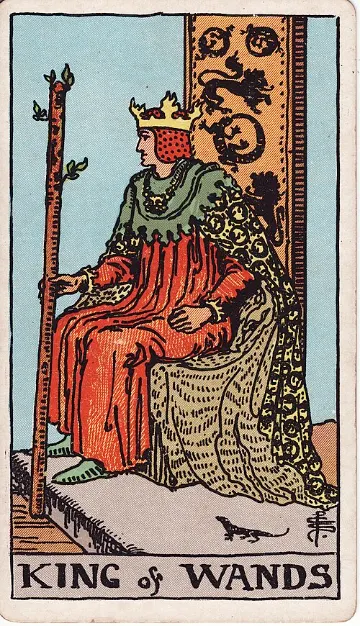
The King of Wands sits beside a leafy staff on a throne marked with lions and salamanders. Waite associated the upright card with a friendly, honest, conscientious figure; his reversed King can still be good, though severe and austere. Modern readings often use the card for vision and leadership. The distinction matters: authority is not proof of either wisdom or tyranny. This card asks what direction is being set, which promises have resources behind them, and how the people affected can question or improve the plan.
Look at the image
Pamela Colman Smith seats the crowned King in profile beside an upright staff with small green leaves. A lion appears on the throne back, and salamander forms repeat across the fabric and throne; a small lizard-like figure rests near the platform. The King is still, unlike the mounted Knight, but the living staff keeps the scene from feeling finished. Waite described the wand as flowering, while the local image most clearly shows leaves or buds. Neither throne nor crown tells us how this ruler treats others. Look for the contrast between a fixed seat of authority and a living project that still needs attention.
Upright: honesty gives direction weight
Waite's upright King is friendly, honest, and conscientious; he even treats honesty as a central signification. He also lists possible news about an unexpected heritage, a historical fortune-telling detail rather than a promise of inheritance. Modern readers often translate this figure into leadership and long-range vision. In a real question, connect those ideas through conduct. Does the person state an aim clearly, disclose costs, keep a decision open to evidence, and take responsibility when a plan changes? If you hold authority, give the work owners, resources, and a first milestone. An inspiring direction becomes credible when people can see how it will be carried out.
Reversed: severe can still be fair
Waite's reversed King is good but severe, austere yet tolerant. That is more nuanced than the modern shorthand of an overbearing leader. A reversal may ask whether firm standards are fair, whether authority has hardened into control, or whether a capable person is reluctant to decide. Test the behavior. Are objections heard, are rules applied consistently, and can a promised change actually be funded? A difficult conversation is not proof of tyranny, but charisma is no defense for ignoring a team's limits. The card invites scrutiny of decisions and their consequences, not a fixed character judgment from a single symbol.
King of Wands in love and relationships
In love, the King can describe someone who speaks about a shared future and has the steadiness to help build it. Upright, notice whether that future includes both people's priorities and whether agreements survive ordinary scheduling and money decisions. Reversed, severity may appear as rigid expectations, but it could also be a fair boundary expressed without much softness. Waite's reversed King is not automatically cruel. Ask how each person makes decisions, responds to disagreement, and repairs a broken promise. A strong vision for a relationship matters only when both people have a real place in it.
King of Wands as feelings
For your own feelings, the King may describe conviction, protectiveness, or the wish to turn an idea into something durable. It may also reveal discomfort with uncertainty when other people have a say. If asking what someone else feels, the seated figure cannot disclose private intentions. Look at whether they communicate a plan, make room for your response, and follow through after the exciting speech. Reversed, a stern tone could reflect pressure, a boundary, or a disagreement still unresolved. Ask about the specific concern rather than declaring from the card that someone is controlling or secretly devoted.
King of Wands in career and money
At work, the King can fit a founder, manager, or project owner deciding where effort and funding should go. Waite's honesty and conscientiousness offer a useful test: are the costs, risks, and decision rights visible to the people doing the work? Set a priority, an owner, a budget, and a review date. When a proposal changes, say who benefits and who carries the new task. Reversed, examine whether strict standards are paired with adequate resources or whether someone is using confidence to hide a gap. For money, judge the written commitments and cash flow rather than the force of a pitch.
Queen versus King of Wands
Smith seats both figures with living staffs and lion imagery, but gives the Queen a sunflower and black cat while the King is surrounded by more throne and fabric motifs. Waite calls the Queen more magnetic; his King emphasizes honesty and conscientiousness. In a reading, the Queen may draw people into a project through warmth and presence, while the King may focus on the direction and obligations that hold it together. These are possible roles, not fixed genders or ranks. If both cards appear, ask who sets the goal, who builds participation, and whether both forms of work receive authority and credit.
Is the King of Wands a yes or no card?
For a plan with clear ownership, resources, and room for feedback, the upright King can lean yes: make the proposal or take responsibility for its next stage. It is not a guarantee that everyone will agree. Reversed, pause if the plan depends on unilateral promises or standards no one has the means to meet; a firm but fair decision can still be right. Ask “Should I lead the expansion if the board approves the budget and each workstream has an owner?” Those conditions can be checked. “Will my idea succeed because I believe in it?” asks confidence to replace evidence.
A reading example: expanding a community garden
A volunteer coordinator draws the King of Wands while proposing to expand a community garden. The new plot could serve more families, but the plan needs water access, a maintenance schedule, and agreement from nearby residents. The coordinator brings a costed proposal, asks a grower to review the soil plan, and invites residents to a meeting before the vote. They name who will manage each bed and set a date to review the first season. The proposal may still change, but its direction is honest and workable. The card's authority lies in taking responsibility for the vision, not in getting the last word.
Questions to ask
- What direction am I asking others to trust?
- Which promise has an owner, budget, and review date?
- How can people affected by the plan improve it?