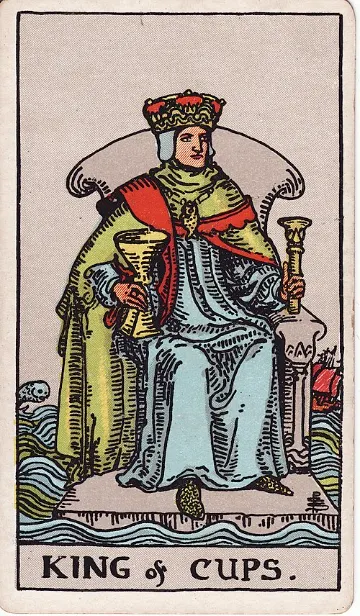
A crowned figure sits on a stone throne amid waves, with a cup in one hand and a short sceptre in the other. A ship and a leaping dolphin animate the water beyond. The King of Cups can bring feeling into a decision that affects other people. Waite associated the card with responsibility, equity, and creative intelligence; modern readings often add emotional composure. Upright, the question is whether care becomes fair and accountable action. Waite's reversed list warns of dishonesty and injustice, while contemporary readers may also examine avoidance or a calm manner that conceals a problem. The scene asks what the King does with authority, not just how serene he looks.
Look at the image
Pamela Colman Smith places the King on a stone throne with waves around its base. He holds a cup in his right hand and a short sceptre in his left. A ship appears on one side of the scene, a dolphin on the other. Waite drew attention to these details and linked the figure to responsibility and equity. The throne looks steady, yet the sea and its travelers are not still. The cup and sceptre let us ask how receptivity and authority meet when other people depend on a decision. Nothing in the image tells us that the King has mastered every feeling; his conduct must supply that part of the reading.
Upright: responsibility with a human face
Upright, the King of Cups can describe someone who listens to the emotional stakes of a problem and still makes a fair decision. Waite's older meanings include a responsible, obliging person, equity, art, science, and creative intelligence. A modern reading may call this emotional steadiness, but steadiness has value only when it serves people. If you lead a team or care for a family member, ask what each person has said, which facts are missing, and who will bear the result. Explain your choice in words they can understand. The cup matters because people have feelings; the sceptre matters because someone must answer for the action taken.
Reversed: power without accountability?
Waite's reversed list names dishonesty, double dealing, injustice, scandal, and loss. Those are serious claims, not a diagnosis that a drawn card can make about a particular person. A modern reading may also see a quieter failure: composure used to avoid a difficult conversation or to keep others from questioning a decision. Look at repeated conduct. Are promises kept? Can affected people ask for reasons and correct errors? Does the person holding authority disclose the terms that matter? Reversed may also fit someone overwhelmed by responsibility rather than acting with bad intent. The distinction lies in evidence and response, not in a calm face or the card's orientation alone.
King of Cups in love and relationships
In love, the King may describe care that remains dependable through disagreement. A partner listens, names their own feelings, and follows through on the practical promises that sustain a relationship. That is more useful than assuming the card predicts a mature lover who will arrive and solve everything. If you are considering a shared decision, ask how each person can disagree safely and how you will repair a mistake. Reversed, a gentle tone might coexist with repeated avoidance, or someone may need help expressing what they feel. Judge the pattern of conversation and action. Affection is stronger when neither person has to hide a problem to keep the peace.
King of Cups as feelings or as a person
If the card speaks to your own feelings, it may be time to hold a strong emotion without handing it the whole decision. Name what you want, then consider who else is affected. As a person card, the King can suggest someone with responsibility and a capacity for thoughtful judgment, regardless of gender. It does not reveal what a third party secretly feels. Their words, choices, and willingness to be answerable give you better evidence. Reversed, notice whether a composed presentation matches private conduct. A person who can revise a decision and acknowledge harm shows more emotional skill than one who merely appears untroubled.
King of Cups in career and leadership
At work, the cup and sceptre can stand for a leader who hears a concern and has the power to change conditions. If a team member reports an unfair workload, taking the feeling seriously is only the start. Check assignments, deadlines, and who can approve a change; then communicate what will happen and when. A creative leader may also protect an unusual idea long enough to test it, matching Waite's link to art and creative intelligence. Reversed, investigate opaque decisions or promises that never reach the schedule. Trust grows when judgment can be explained, reviewed, and corrected by the people affected.
King of Cups versus Queen of Cups
The Queen sits on a shore, studying a covered cup. The King faces outward on a throne surrounded by water, holding both a cup and a sceptre. The Queen's image can focus on private attention and the care that follows; the King's adds public judgment and responsibility for a decision. Neither role belongs to one gender, and neither card is more emotionally advanced. If both appear, ask what needs patient listening before a choice is made and who has the authority to carry it out. Empathy without action can leave a problem unchanged; action without listening can miss the problem entirely.
Is the King of Cups a yes or no card?
For an action that joins care with clear responsibility, the upright King can lean yes: hold the meeting, explain the decision, or take a measured step after hearing those affected. It is less useful as a yes to “Will this person always be fair?” A single image cannot promise future conduct. Reversed may be a reason to pause before trusting a vague assurance, particularly where money or power is involved. Ask what evidence would justify the choice: written terms, a record of follow-through, or a way to review the result. The answer becomes stronger when the people bearing the outcome can see how it was reached.
A reading example: a difficult schedule decision
Imagine a team lead must assign weekend shifts after two colleagues request the same Saturday off. The lead draws the King of Cups upright. Each request has a personal reason, so they listen privately and check the existing rota, prior swaps, and coverage rules. They explain the constraints without sharing either person's private details. One colleague can swap with a trained volunteer; the other takes the day off as requested. The lead confirms the changes in writing and invites both to flag an error. The card's steady throne is useful because the decision stays open to evidence and correction, not because the lead pretends no one is disappointed.
Questions to ask
- Who is affected by this decision?
- Am I listening to feelings without treating them as the only evidence?
- How will I explain and review my choice?