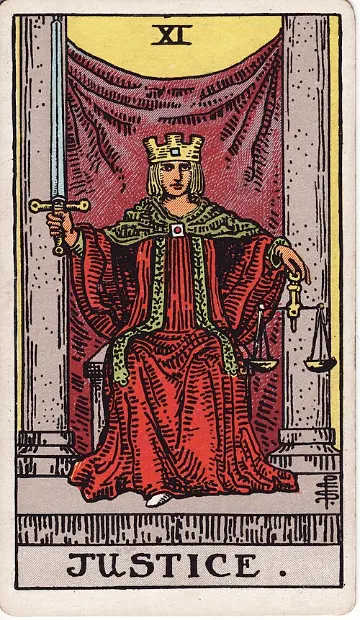
The Justice tarot card asks how a decision is made, whose account is heard, and who lives with the result. Upright, it can favor clear evidence, fair criteria, and responsibility for your part. Reversed, it may draw attention to bias, missing information, or a rule applied unevenly. Pamela Colman Smith shows an unblindfolded crowned figure with scales and an upright sword between two pillars. The image does not promise that a court, employer, or partner will act fairly. It asks you to examine both the facts and the process before reaching a verdict of your own.
Look at the scales and sword
Smith's Justice faces the viewer from a seat between two pillars. Red drapery hangs behind the crowned figure, who holds scales in one hand and an upright sword in the other. Unlike the familiar blindfolded courthouse statue, this figure's eyes are visible. A. E. Waite noted the pillars' resemblance to those beside The High Priestess, but treated Justice as a distinct moral principle. The scales invite you to weigh accounts; the sword suggests a decision must eventually be made. Neither object shows what evidence is present or what verdict will follow. That missing material is the point of a useful reading: before asking whether an outcome is fair, ask what was considered, who could speak, and which rule was used.
Upright: make the reasons visible
Upright, Justice can favor a decision whose reasons can be explained to the people affected. Waite's older divinatory list includes equity, rightness, and probity. In practice, start by separating what you know from what you assume. Read the agreement, name the criteria, invite a reply, and acknowledge your own part without taking responsibility for another person's actions. A fair process does not mean every participant will like the result. It means the relevant facts and consequences receive serious attention, and similar cases are treated consistently. If you hold the sword, say when the decision will be made and whether it can be reviewed. If someone else holds it, ask how your account can be included before the choice is final.
Reversed: bias, missing facts, or a harsh rule?
Reversed, Justice may point to a process that looks orderly but leaves out a person, a fact, or a cost. It can also reflect fear of being judged before you know what anyone has decided. Those are different situations. Waite's reversed list includes legal complications, bias, bigotry, and excessive severity; it does not prove that the person drawing the card is at fault. Look for observable signs: were the criteria changed midway, did one party have access to information the other did not, or is a rule being enforced without regard to its effect? Sometimes the repair is better evidence; sometimes it is an appeal, an apology, or a different decision maker. Do not call a harmful outcome “deserved” simply because Justice appeared in a spread.
Justice in love and relationships
In love, Justice can bring reciprocity and shared responsibility into focus. Upright may favor an honest account of a recurring disagreement: what each person promised, what happened, and what each now needs. A couple deciding how to divide care work, money, or time may benefit from putting assumptions into words. Reversed may ask whether one person's mistakes are remembered while the other's are excused, or whether a rule that once helped has become unfair. The card does not reveal a partner's private feelings or prove who is right in a dispute. Invite their account and listen to it. A workable agreement should allow both people to say what they can give, where the limits are, and how to revisit the arrangement when circumstances change.
Justice in career and money
At work, Justice can fit an evaluation, a contract, a pay discussion, or a decision about who receives credit. Upright may favor clear requirements and a record of the work actually done. Reversed may call attention to inconsistent standards, missing documentation, or a burden that falls repeatedly on the same person. A card cannot promise a promotion or tell you a manager's motives. Ask for the written criteria, check dates and deliverables, and compare how the policy has been applied. For money, read the amounts, fees, and obligations rather than assuming a fair-looking offer is affordable. If the stakes are substantial, use the appropriate professional advice. The scales are a prompt to count real costs as well as appealing claims.
What if the question is legal?
Justice often appears in questions about cases, contracts, and official decisions because the image resembles a court. Waite's historical list even mentions the deserving side prevailing in law. That phrase is part of an old divinatory tradition, not evidence about a present case. If a legal matter is at stake, collect the actual documents, identify deadlines, preserve relevant messages, and ask a qualified local professional what options exist. Do not infer that a loss would be deserved or that an upright card guarantees a win. A useful tarot question is “What should I examine before I respond?” The answer must come from the facts, applicable rules, and people with authority in the matter, not from the card's position.
Justice as feelings or as a person
Asked about feelings, Justice may suggest that fairness, a past choice, or a need for clarity matters to the question. It cannot tell you whether someone is secretly remorseful or certain to commit. As a person card, it can describe someone who values stated rules, weighs evidence, or has responsibility for a decision, regardless of gender or job title. The figure's direct gaze can encourage an equally direct conversation. What do they say they want? Do their actions match their stated principles? Are they willing to hear a perspective that changes their view? Those answers require contact and observation. Treating the card as a verdict on a person's character would skip the careful weighing that its scales suggest.
Is Justice a yes or no card?
Justice can lean toward yes when the proposed action is to seek the facts, apply a fair rule, or correct an imbalance you can name. It is not a reliable yes to “Will I win?” or “Will they admit I was right?” because those answers depend on other people and evidence outside the spread. Upright may favor proceeding with a transparent process. Reversed may suggest pausing to check a hidden cost, an omitted voice, or criteria that keep shifting; it need not mean no forever. Turn the binary question into one you can act on: “Should I request the decision criteria in writing?” or “What fact would change my view?” Make the choice after those questions have real answers.
A reading example: credit for a shared project
Imagine two colleagues finish a presentation, but a manager praises only one of them in a company meeting. The overlooked colleague draws Justice upright. The scales do not reveal whether the omission was deliberate. They suggest gathering the project brief, noting each person's contributions, and asking for a correction in the next written update. If the manager accepts the account, the repair can be simple. If the same pattern keeps recurring, a clearer credit policy or a further conversation may be needed. A reversed Justice could highlight inconsistent treatment or the temptation to accuse before checking what the manager knew. Neither orientation appoints the reader as judge. It helps them seek a fair record and a proportionate response.
Questions to ask
- Which facts can I verify, and which are assumptions?
- Who has had a chance to be heard?
- What would make the decision fair and reviewable?