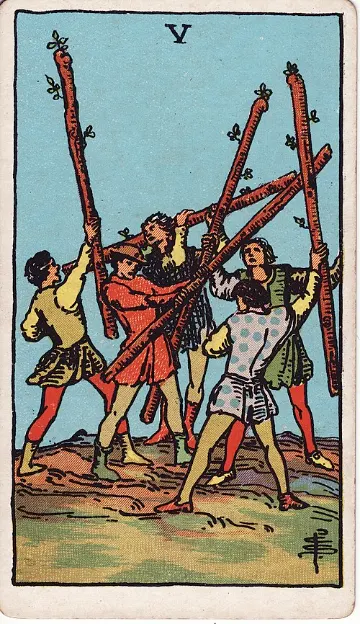
Five differently dressed people raise sprouting staffs that cross above uneven ground. No one is visibly injured or declared the winner. Waite described the scene as sport or strife and linked the upright card to strenuous competition; his reversal turns toward disputes, trickery, and contradiction. The Five of Wands can therefore describe a contest that sharpens ideas or one whose rules and costs are being ignored. In love or work, the reading depends on what the people are trying to achieve, how the disagreement is conducted, and whether anyone can name a fair way forward.
Look at the image
Pamela Colman Smith crowds five figures into an outdoor scene, each with a leafy staff raised among the others. Their clothing and positions differ, and the wands cross without forming a tidy structure. No one is visibly injured and no referee or winner appears. Waite called the action sport or strife, even mimic warfare, which leaves the purpose of the contest open. The figures could be testing strength, competing for advantage, or failing to coordinate. That uncertainty is useful: describe the rules and stakes in the question before deciding whether this is healthy practice or an expensive quarrel.
Upright: a contest with a purpose
Waite's upright Five includes strenuous competition and a struggle for fortune, with some traditions also connecting it to gain. The card can suit an audition, debate, bid, or creative workshop where several people want to be heard. Competition can expose a stronger idea if everyone knows the goal and how a choice will be made. Without that agreement, energy goes into crossing staffs rather than finishing anything. State the criterion, time limit, and decision-maker. In a personal question, the five figures might also resemble priorities competing for one person's attention. Name the few that can be acted on now instead of promising each the same hour.
Reversed: when the dispute changes form
Waite's reversed meanings are litigation, disputes, trickery, and contradiction. That is not an automatic end to the conflict. A modern reading may instead describe tension pushed out of sight, a quarrel that has cooled, or rules finally agreed after noise. Check what changed in the real situation. Did someone misstate terms, did the disagreement move into a formal complaint, or has the group found a fair process? If the facts are disputed, get the issue and evidence into clear words before adding another round of argument. Reversed Five asks whether the contest can still be conducted honestly, and what it would cost if it cannot.
Five of Wands in love and relationships
In love, the Five can show two people with different preferences, crowded schedules, or a recurring argument about how a shared decision is made. It does not by itself imply cheating or a rival partner. Upright, disagreement can reveal what each person values if both can speak and listen without turning the conversation into a score. Reversed, an unresolved issue may be avoided until it returns, or a clearer rule may finally lower the heat. Name the actual decision: where to live, how to spend a weekend, or who handles a task. A relationship needs room for difference and a way to decide what happens after both views are heard.
Five of Wands as feelings
When asking about your own feelings, the Five may capture excitement mixed with irritation: another person challenges you, and you are not sure whether the friction is energizing or draining. If you ask about someone else's feelings, the crossed staffs cannot disclose their private motive. Notice how they behave when you disagree. Do they stay with the issue, repair a sharp exchange, and accept a fair result? Reversed, less visible conflict might mean relief or avoidance; their actions after the conversation will distinguish the two. Ask what kind of discussion each person can have without making every difference a contest for control.
Five of Wands in career and money
At work, the Five can fit competing pitches, bids, overlapping roles, or a team whose members were given different goals. Clarify what is being won and who pays for the contest. A lively debate can improve a product; five people duplicating the same work can waste a budget. Waite's struggle for fortune does not promise that every participant profits. If money is involved, compare the cost of preparing a bid with its likely value and check whether the selection rules are known. Reversed, contradictory instructions or hidden terms may turn ordinary competition into a dispute. Record the agreed scope before more effort is spent.
Five versus Seven of Wands
The Five of Wands puts five visible figures on similar ground, their staffs crossing in the middle. The Seven of Wands raises one figure above six staffs coming from below. The Five often asks whether a contest among peers has fair rules or a shared aim. The Seven asks what one person is defending and whether that position can be held. If both appear, a group disagreement may leave one person responsible for a choice everyone debated. Decide when the open contest ends, who owns the decision, and what support that person will have afterward. Debate and defense are related stages, but they require different kinds of preparation.
Is the Five of Wands a yes or no card?
For a fair contest whose stakes and time cost are understood, the upright Five can be a conditional yes to participating. It is a weaker yes when the rules keep changing or winning would consume more than the prize is worth. Reversed is not simply no; it asks whether a dispute, contradiction, or misleading term needs resolution first. “Should I submit a proposal under these published criteria?” gives you something to assess. “Will I defeat everyone?” asks for a verdict the crowded picture does not provide. The card is most useful when it exposes the conditions under which competition helps rather than harms the aim.
A reading example: two teams, one launch slot
Two teams want the same launch slot for different projects, and a coordinator draws the Five of Wands. The first meeting becomes a contest of confident speeches, with neither team answering what the launch is meant to achieve. The coordinator pauses the debate and asks both teams for the same short proposal: audience, cost, readiness, and one measurable result. Each gets equal time to present, and the person who will approve the slot is named in advance. One project is ready for the current date; the other receives a later trial with a clear milestone. The disagreement produces a decision instead of another round of crossed staffs.
Questions to ask
- What is this contest meant to decide?
- Which rule or fact would make it fair?
- When should debate end and a decision begin?