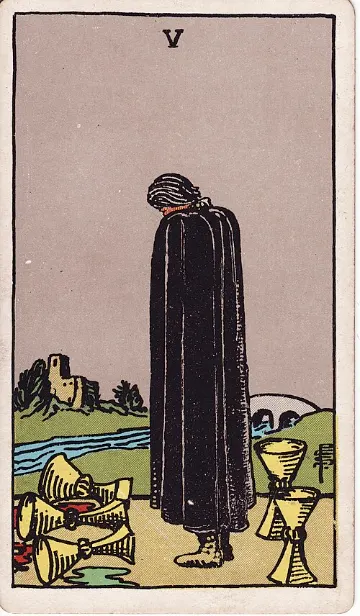
A dark-cloaked figure faces three overturned cups. Two cups still stand nearby, and a bridge crosses the river toward a distant building. The Five of Cups gives loss its proper place in the scene without making it the only thing there. Upright, the card can meet disappointment, regret, or an ending that needs to be named before any next step. Reversed, the question may shift toward what can be repaired or approached again, though nothing in the image guarantees a return. In love and work, the standing cups suggest resources still available, not replacements for what spilled. The bridge offers a route when the figure is ready to move.
Look at the image
Pamela Colman Smith gives the dark-cloaked figure a striking posture: turned toward three cups that have fallen, with two upright cups close by. The river cuts across the background, but a bridge reaches a building on the far bank. A. E. Waite described the card as loss with something remaining; the two standing cups are part of his account, not a later addition. Yet the figure has not turned toward them or crossed the bridge. That matters. The picture allows disappointment to occupy the foreground while showing another route in the same frame. It does not tell us what was lost, whether the building is home, or when the person will move.
Upright: name the loss before the next step
Upright, the Five can fit a failed plan, a relationship change, an apology that cannot undo harm, or a small disappointment that still matters. Name the fallen cups as precisely as possible: which expectation broke, and what trust, work, or time went with it? Waite also associated the card with an inheritance or transmission that fails to match expectations, a reminder that the problem may be the gap between what arrived and what was hoped for. The two standing cups can prompt a second inventory of people, skills, or commitments still available. Make that inventory later if necessary. It is a way to plan, not a demand to feel grateful.
Reversed: return, repair, or pressure to recover?
Reversed, the figure may be ready to look beyond the spill, but an upside-down card does not promise that grief is finished. Waite's historical reversed list includes news, alliances, affinity, return, and false projects; it does not give a single modern rule of “recovery.” In a present-day reading, ask what has actually changed. Has someone offered a concrete repair, or only repeated the same promise? Are you choosing to revisit an old connection, or being pressed to do so before trust returns? A reversed Five may open a conversation, and it may equally expose a return that is not workable. Context determines which possibility deserves attention.
Five of Cups in love and relationships
In love, the three overturned cups may stand for a breakup, a broken promise, or a hoped-for closeness that did not grow. The two standing cups are not proof that the same relationship will resume or that a new partner must replace the old one. They may represent friendships, self-respect, or practical support while a person works out what happened. For partners trying to repair a rupture, name the hurt before asking for reassurance. Reversed, a message or meeting can reopen contact, but reconciliation requires both people to choose it and to address the cause of the loss. The card cannot make that agreement on their behalf.
Five of Cups as feelings
If you are reading your own feelings, the Five may help distinguish regret from sadness. Regret asks whether a different action was possible; sadness can remain even when no one could have prevented the outcome. Both deserve an honest name. If the question is how someone else feels, the cloaked figure cannot reveal their private thoughts. Look at what they have said and done instead of treating silence as a confession of love or remorse. Reversed can fit a person who wants to reconnect, but it can also fit someone returning to ordinary life without returning to a particular relationship. Let their actual words define the difference.
Five of Cups in career and work
At work, the fallen cups can be a lost client, a project that failed, a role you did not get, or credit that went elsewhere. Acknowledge the specific cost before turning the setback into a lesson. What was spent, what can be recovered, and which commitments still stand? Two colleagues who trust your work, reusable research, or time released by a cancelled plan may be the upright cups. Reversed, a former collaborator may write again or a revised proposal may arrive. Read its terms as they are now; familiar names do not guarantee a better outcome. The bridge is a route to consider, not an order to cross immediately.
Five of Cups versus Eight of Cups
The Five shows a person facing cups that have already fallen. The Eight shows a figure walking away from eight upright cups under a moonlit sky. Both can involve sadness, but the sequence of action differs. In the Five, something has been lost or disappointed an expectation, and the question is how to acknowledge it while seeing what remains. In the Eight, the image centers a departure from an arrangement still standing. If both appear in a reading, ask whether you are responding to a loss, choosing to leave, or doing both at different stages. One card need not be translated into the other to make the decision clear.
Is the Five of Cups a yes or no card?
A simple yes or no can flatten the situation pictured here. If the question is whether an old plan will return exactly as it was, the fallen cups make that unlikely without new facts. If the question is whether to use a remaining resource, the answer may depend on its real cost and availability. Reversed is no automatic yes to reconciliation or a fresh start. Ask a question within your control: should you request a meeting, revise the plan, or accept that one part has ended? Then identify what response would change your decision. The card is strongest when it separates what has spilled from what can still be chosen.
A reading example: an ended collaboration
Imagine a neighborhood event loses its venue after months of planning. A partner withdraws, and you draw the Five of Cups. The three fallen cups might be the booked date, the promised publicity, and the trust damaged by a late change. You first tell the volunteers what happened and return any payments that cannot be used. Two cups remain: a committed group and the materials already prepared. You could ask for a smaller venue, but only after checking whether the volunteers have the time and energy to continue. The bridge in the picture does not erase the cancelled event. It gives you a possible crossing once the loss has been accounted for.
Questions to ask
- Which expectation or commitment was actually lost?
- What remains available without replacing what mattered?
- Would a repair, a new route, or more time be the honest next step?