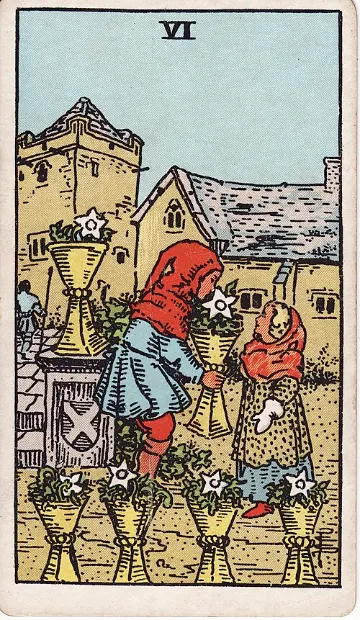
In a walled garden, one child gives another a cup filled with flowers. Five more flower-filled cups stand around them, while a distant figure passes through the background. The Six of Cups can call up childhood, an old friendship, or a kind gesture that still matters. Upright, it asks what a memory can offer the present without making the past perfect. Reversed, Waite's older account points toward the future and renewal; a new connection may also grow from something familiar. In love and work, returning to a person or place requires present-day attention. The card shows a gift being offered, not a promise that any former relationship will come back.
Look at the image
Pamela Colman Smith sets the scene among walls and buildings. A larger child leans forward to offer a flower-filled cup to a smaller child; five other cups hold flowers around them. A distant person appears at the left, but the image does not tell us that person's role. The cups contain something given rather than something drunk, shifting attention toward the exchange itself. A. E. Waite described children in an old garden and read the card through memory and childhood, while also recording a different reading of new relations and a new environment. The picture can support both: a familiar gesture taking place in a scene we do not fully know.
Upright: let memory inform the present
Upright, the Six of Cups may bring back an early pleasure, a person who once helped, or a way of showing kindness you have nearly forgotten. Waite associated it with past happiness, but his alternative reading of new relations keeps the card from being only a backward glance. Ask which detail of the memory is useful now. Was it the person, the shared activity, or the feeling of being welcomed? You can renew one of those qualities without recreating the whole situation. If the memory is mixed, let it stay mixed. A childhood scene can be meaningful without having been safe or simple in every respect.
Reversed: future and renewal
Waite's reversed meaning points explicitly toward the future and renewal. In a present-day reading, that may mean taking a familiar skill into a new setting, making room for a new friendship, or recognizing that an old relationship has changed. The reversal can also expose how a polished memory blocks attention to the person or place in front of you. Which reading fits depends on what is actually happening. You may need to release an old expectation, or you may be ready to carry forward a kindness that still works. Neither path requires contacting someone from the past, especially where contact would reopen harm.
Six of Cups in love and relationships
In love, the offered cup can suggest warmth, generosity, and the ease of feeling known. Someone from the past may come to mind, but the card does not predict that an ex will return or that a reunion would be healthy. If an old partner does contact you, meet the person they are now, not the remembered version. For an existing relationship, recall a small act of care that once helped and ask whether it would still be welcome. Reversed, one or both people may be ready for a different pattern rather than a replay of the early days. Mutual consent and current behavior matter more than nostalgia.
Six of Cups as feelings
If you ask about your own feelings, the Six may name affection, gratitude, or a longing for a time when care seemed easy. Separate missing a person from missing the circumstances around them. You might want a friendship back, or you might want the freedom and routine you had then. If the question is how someone else feels, the picture cannot disclose their thoughts. A remembered bond can matter to them without becoming a current invitation. Reversed may fit interest in rebuilding contact on new terms, but it can also mark a decision to value the memory and move forward. Let actual conversation settle what the card cannot.
Six of Cups in career and work
At work, the Six can point to a former mentor, an old project worth revisiting, or a skill learned before the current role. Think of the cup as something useful being passed on: a technique, an introduction, or patient encouragement. If you return to a previous employer, compare its present conditions with the reasons you left. If you revive an old idea, ask what tools and audience have changed. Reversed, a fresh setting may give an earlier lesson new life, while a habit that once served you may need revision. Respect the past as a source of knowledge without making it the standard every new opportunity must meet.
Five of Cups versus Six of Cups
The Five of Cups puts three spilled cups before a figure who has not yet turned toward the two still standing. The Six shows a cup being offered between children in a garden. Read together, the images move from accounting for loss toward an exchange that is possible now. That does not mean everyone must become generous immediately after disappointment, or that a gift repairs what was lost. In a relationship spread, the Five might name a broken expectation while the Six asks whether a kind present-day gesture is possible. In work, a cancelled plan may leave knowledge that someone can pass along. Keep the loss and the new offer distinct.
Is the Six of Cups a yes or no card?
For a small, welcome gesture—thanking a mentor, inviting a friend to catch up, or returning to a hobby—the upright Six can lean yes. Check that the offer suits the recipient now. It is a much weaker answer to “Will my ex come back?” because no card controls another person's choice. Reversed may still support a yes to trying something new with an old skill, while questioning a plan built only on how things used to be. Turn the question toward an action you can take: should you send a respectful invitation, revisit the project, or let the memory remain a memory? Leave space for a no in the answer you receive.
A reading example: an old friend writes
Imagine a friend from school writes after many years. You remember how easily you once talked and draw the Six of Cups. The picture fits the pleasure of being remembered, so you answer warmly and suggest a short meeting. You do not assume that the old friendship can resume unchanged. At lunch, you learn that both your lives and interests have shifted; one shared hobby remains, but neither has time for weekly plans. You agree to try a monthly walk. The gift in the card becomes a current invitation rather than a demand to recover an earlier life. If the meeting had felt uncomfortable, gratitude for the memory would still have been enough.
Questions to ask
- Which part of this memory is useful in my life now?
- What has changed for the people involved since then?
- What gesture would be welcome without asking anyone to recreate the past?