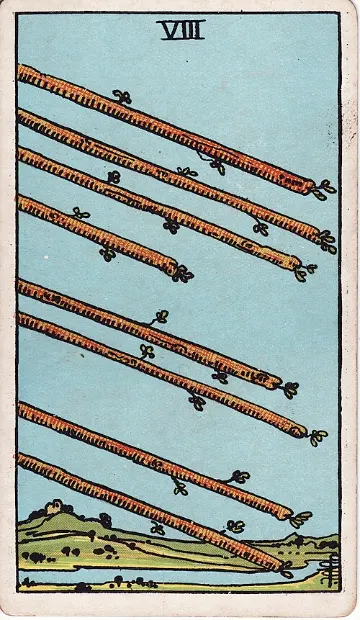
Eight leafy wands fly diagonally across an open sky above a river and low hills. No sender, recipient, or landing place appears. Waite describes the wands near the end of their course and links the upright card with swift undertakings, messengers, and even arrows of love. His reversed meanings turn toward jealousy, conscience, and domestic quarrels, while modern readings often emphasize delay or crossed messages. The card can mark a fast-moving moment, but its useful question is what is actually approaching, which terms are clear, and whether the people involved can respond at the right pace.
Look at the image
Pamela Colman Smith sends eight leafy staffs across a pale sky at a steep diagonal. Below them lie a river, low green hills, and a few distant trees. No person appears to launch or receive the wands, and the image does not show where they land. Their almost parallel movement makes the card feel coordinated, though each staff has its own space. Waite described them as nearing the end of their course; the picture gives the same sense of momentum near arrival without providing an outcome. Ask what is already underway in the question and what will need attention when it reaches the ground.
Upright: be ready for the approaching result
Waite's upright Eight includes activity, swiftness, a messenger, great haste, and the approach of an undertaking's end. He also calls the wands arrows of love. An upright reading can fit a reply, delivery, decision, or rapid sequence of tasks after a quiet interval. Speed helps when the destination and responsibilities are known. Before responding, confirm dates, recipients, and any condition that could change the choice. If several messages arrive together, sort what requires action now from what only needs acknowledgment. The wands may be close to landing, but their movement alone does not tell you whether the news will be favorable.
Reversed: conflict is part of the old meaning
Waite's reversed meanings include jealousy, inward dispute, conscience, quarrels, and domestic conflict. They are not simply a slow version of the upright card. Modern readers may use the reversal for delayed travel, crossed messages, or rushing into avoidable mistakes. Read the actual circumstances before choosing among those possibilities. Has a promised message missed its date, or has a fast exchange stirred suspicion and argument? If the problem is timing, confirm the next step and owner. If it is conflict, slow the conversation enough to name the claim and evidence. Turning the card does not prove that every moving wand has stopped.
Eight of Wands in love and relationships
In love, the Eight may fit quick contact, a planned visit, or an attraction that suddenly becomes easier to act on. Waite's arrows of love capture the force of that moment, but pace still belongs to both people. Upright, clarify whether a lively exchange is leading to a date, a conversation, or only enjoyable messages. Reversed in Waite's account, jealousy or a domestic quarrel may be the issue; a modern reading might instead focus on replies that miss each other. Ask about the concern directly rather than using response speed as proof of devotion. A useful connection can move quickly without asking anyone to surrender choice.
Eight of Wands as feelings
When asking about your own feelings, the Eight may describe urgency, excitement, or relief that a long-awaited conversation is finally moving. Those sensations are real without deciding what the relationship will become. If you ask about someone else's feelings, a staff in flight cannot speak for them. Notice whether their messages are clear, whether they make plans they can keep, and how they handle a change in pace. Reversed, a rapid exchange may have brought anxiety or jealousy to the surface, or communication may simply have stalled. A direct question can separate an emotional disagreement from a scheduling problem.
Eight of Wands in career and money
At work, the Eight can appear when an application advances, orders arrive together, or a project receives a tight decision window. Be ready to act without treating urgency as permission to skip the terms. Confirm scope, pay, deadline, and the person who can approve a change. A fast offer may be useful, but a missing detail can become expensive after acceptance. Waite's swift messenger does not guarantee good news or profit. Reversed, check whether a formal disagreement has emerged or whether the handoff has simply been delayed. If several tasks are in motion, identify their dependencies before sending all eight onward at once.
Seven versus Eight of Wands
The Seven of Wands shows one figure holding a position against staffs rising from below. The Eight has no visible figure; the staffs are already moving through open air. The Seven asks what must be defended and which challenge deserves an answer. The Eight asks what happens once a decision, message, or effort is in motion. If both appear, a defended proposal may have moved toward approval or delivery, but this is not an automatic sequence. Check what has actually been sent and what response is due. A strong stance matters, and so does a clear handoff after the argument ends.
Is the Eight of Wands a yes or no card?
For a timely, reversible action with clear terms, the upright Eight can lean yes: send the response or prepare for the next stage. It does not supply an exact arrival date merely because the wands look fast. Reversed suggests checking whether the obstacle is a delayed message or a quarrel that needs attention before action. Ask “Should I reply to this offer by Friday after confirming the stated pay and scope?” and use the real deadline. “Will they message me today?” asks for a prediction the image cannot verify. The card is strongest as a prompt to match speed with clarity.
A reading example: a quick job offer
A designer receives a job offer with a forty-eight-hour reply deadline and draws the Eight of Wands. The role looks promising, but the email omits whether evening events are part of the schedule. The designer responds promptly with three questions about pay, event hours, and the first month's responsibilities, then asks when written terms will arrive. They also decide in advance which answer would make the role workable. The employer clarifies the schedule before the deadline, and the designer can accept or decline on real information. The card's speed becomes a reason for precise communication, not a reason to let the offer pass unchecked.
Questions to ask
- What is already in motion and nearing a response?
- Which term needs checking before I answer?
- Is the problem speed, delay, or an actual disagreement?