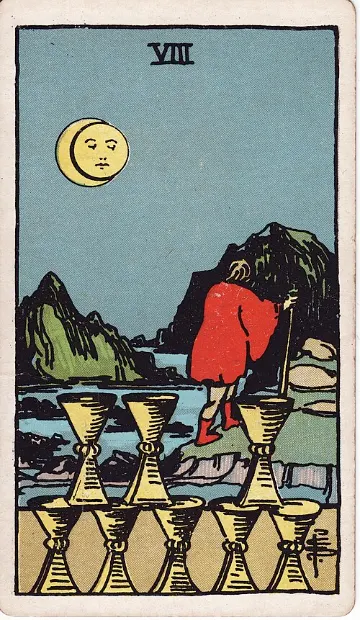
A cloaked traveler walks away from eight upright cups beside the water and heads toward rocky hills beneath the moon. Nothing in the arrangement has been smashed. The Eight of Cups often raises the harder question of leaving something that once held value but no longer meets a need. Upright, it can point to an honest departure or a search whose destination is still unclear. Waite's older reversed meaning is unexpectedly joyful; modern reversed readings may instead ask why a departure has stalled. In love and work, the useful distinction is between a difficulty that can be repaired and a mismatch that remains after repair has been tried.
Look at the image
Pamela Colman Smith sets five cups in a lower row and three above them, all upright. Beyond the water, a cloaked figure uses a staff to make a way toward uneven hills. The moon has a face and a bright crescent edge; the picture does not require us to name an astronomical event. A. E. Waite described the figure as leaving the cups of an earlier happiness or undertaking and associated the card with the decline of a matter. The intact cups complicate a simple story of failure. Something can still exist, and can even have been good, when a person discovers that remaining with it asks too much or gives too little.
Upright: when leaving becomes a real option
Upright, the Eight of Cups can fit a relationship, job, or habit in which effort has continued after the reason for staying has weakened. Ask what changed. Is the problem a single disappointing event, an unmet need you have never voiced, or a pattern that persists despite clear attempts to address it? The figure is already walking, but a reading need not force an immediate exit. If you are considering one, account for money, shared responsibilities, timing, and the people who need a direct explanation. The cups can stand for what was valuable; walking away does not require you to declare every earlier moment a mistake.
Reversed: Waite’s joy and a modern pause
Waite's reversed gloss is strikingly different from the departing figure: great joy, happiness, and feasting. In that older reading, the situation may be less lost than it appears, or there may be something worth celebrating after a change of course. Many present-day readers instead turn the traveler's movement inward and read hesitation, a return, or difficulty releasing sunk effort. These possibilities lead to different questions. Has new evidence made staying attractive? Has the old arrangement genuinely improved? Or has fear alone delayed a necessary choice? Look for the change that has actually occurred before deciding which reading fits.
Eight of Cups in love and relationships
In love, the Eight may describe affection that remains while a relationship no longer offers the trust, closeness, or shared direction someone needs. It does not automatically call for a breakup. Before making a lasting decision, name the need in ordinary words and find out whether the other person wants and is able to work on it. A repair requires changed behavior, not just a warm promise. If separation is already decided, the upright cups allow a more accurate account than saying the whole bond was empty. Reversed can describe renewed pleasure together, as in Waite's older gloss, or uncertainty about leaving. The next conversation and its follow-through distinguish them.
Eight of Cups as feelings and reconciliation
For your own feelings, the traveler can express sadness and resolve at the same time. You may miss a person yet know that the old arrangement is not workable. If you ask how someone else feels, the turned back is no access to their private mind. Notice what they have communicated, whether they are available for a conversation, and whether either of you wants the same kind of relationship now. A reversed Eight is not a guaranteed return. Reconciliation is possible only when both people choose it and the problem that prompted distance can be addressed. Otherwise, the useful movement may be toward a clear, respectful ending.
Eight of Cups in career and money
At work, leaving eight standing cups can resemble departing a stable role that no longer has room for growth, abandoning an exhausted project, or changing a business model that once succeeded. Stability is a real asset, so compare the costs of staying with the costs of moving. What have you tried to change, and what response did you receive? Check savings, notice periods, contractual duties, and a plausible next step before treating dissatisfaction as a resignation plan. Reversed may fit a renewed opportunity in the same workplace or a delay caused by uncertainty. Written terms and actual changes reveal which one is happening.
Eight of Cups versus Five of Cups
The Five of Cups shows three overturned vessels and a figure facing a loss, with two cups still standing behind. The Eight shows all eight cups upright while the traveler chooses to move away. Both scenes can be sad, but they begin at different points. The Five asks how to acknowledge something that has already fallen without overlooking what remains. The Eight asks whether continuing with an intact arrangement still serves the person living in it. When both appear, distinguish the loss you did not choose from the departure you may now choose. That difference can turn a vague feeling of regret into a clearer next step.
Is the Eight of Cups a yes or no card?
The answer changes with the verb in the question. If you ask, “Should I examine a new path?” the traveler can favor exploration, especially when the current arrangement has been tested and remains unsatisfying. If you ask, “Will this relationship continue exactly as it is?” the image leans against assuming that it will. Neither is a command to leave today. A reversed Eight might indicate a reason to reconsider, or simply that the departure has not happened yet. Set a decision threshold: what specific change would make staying worthwhile, and by when? Without that detail, yes and no conceal the choice you actually face.
A reading example: a role that still works on paper
Imagine someone in a well-paid job whose team has changed. They once enjoyed mentoring new colleagues, but that work has been replaced by constant reporting. The Eight of Cups appears upright. Instead of resigning on the spot, they ask their manager whether mentoring can return to the role and set a date for an answer. They also calculate how long their savings would cover a search and speak with two people in other teams. If the promised change happens, the cups may still offer something worth keeping. If the same terms remain, leaving becomes a considered choice rather than a reaction to one bad week. The card clarifies what must be tested before the walk begins.
Questions to ask
- What have I already tried to improve?
- What would I need to carry if I leave?
- What would make staying a conscious choice?