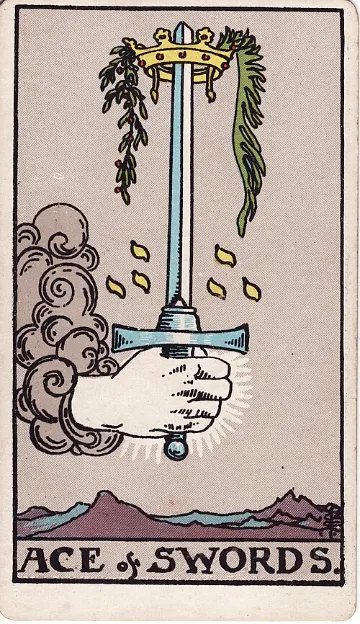
A hand emerges from a cloud and raises a sword through a crown. Greenery hangs from the crown, and a bare mountain range lies far below. The Ace of Swords can describe a striking idea, decisive words, or the power to separate one claim from another. Yet a sharp conclusion can also be pushed too far. Waite's older meaning stresses triumph, conquest, and force, including its potential for excess; many current readings emphasize mental clarity and a new perspective. In love or work, the useful question is whether the insight is sound and how to act on it without turning certainty into a weapon.
Look at the image
Pamela Colman Smith places the sword in the foreground, upright in a hand emerging from a cloud. Its point passes through a crown, with greenery hanging from either side. Small golden marks surround the blade; a thin line of mountains sits low beneath it. No opponent, speaker, or listener appears. The image gives the sword authority and reach without showing how it will be used. Even its two edges matter: the same clear words can open a discussion or close it. Look at the gap between the raised blade and the distant landscape. A powerful idea has arrived, but its consequences are still out of view.
Upright: clarity with force behind it
Waite associates the upright Ace with triumph, conquest, and an excessive degree of force, even in love or hatred. That is stronger than the familiar modern shorthand of a good idea or mental clarity. In a current reading, the card may mark the moment a confusing issue becomes possible to name: a fact emerges, a question sharpens, or a decision takes shape. State the central claim in one sentence, then ask what supports it. If the evidence holds, act with enough precision to solve the problem. The crown suggests power; it does not make every first conclusion correct. The challenge is to use a strong insight without letting the pleasure of being right take over.
Reversed: when force goes wrong
Waite describes the reversed Ace as the same force with disastrous results; he also records a separate older account involving conception, childbirth, and increase. Neither account is simply a lack of focus. A modern reversed reading might instead point to a conclusion delivered too harshly, an argument built on weak evidence, or a necessary conversation avoided until pressure builds. Decide which interpretation fits the actual question. Has a forceful action caused harm, or is the difficulty still a draft, assumption, or poorly timed message? If there is damage, acknowledge it and change the approach. If the facts are incomplete, slow the decision long enough to find the missing piece.
Ace of Swords in love and relationships
In love, the Ace can favor an honest conversation about what each person wants, especially when guesswork has become tiring. Upright, name a specific need or boundary and ask for a direct response. Waite's association with force in love is a useful reminder that intensity can press another person instead of making room for them. Reversed, an ultimatum, cutting remark, or private conclusion may outrun what has actually been said. If a relationship question is high stakes, choose a time when both people can speak and listen. A clear sentence may change the relationship, but clarity also includes hearing an answer you did not expect.
Ace of Swords as feelings
If this card appears for your own feelings, it may reflect the relief of finally understanding what you want, along with a strong urge to say it aloud. The urge can be valuable; give it words that identify your experience rather than assigning motives to someone else. If you are asking about another person's feelings, the image shows one hand and no second figure. Look at what they actually say, ask, and follow through on. Upright may support a frank exchange; reversed may describe a conversation that feels defensive or rushed. A card can prompt the question, but the other person's words and behavior supply the answer.
Ace of Swords in career and money
At work, the Ace may be a useful proposal, a new standard, or evidence that changes a decision. Put the finding where colleagues can inspect it: a short brief, a sample calculation, or a clear account of the problem and the proposed fix. Waite's forceful upright meaning can fit a hard-won decision, but winning a meeting is different from improving the work. Reversed, check whether the argument has become more aggressive than accurate or whether a key assumption is still untested. In money matters, compare the actual figures before cutting an expense, changing a contract, or making a commitment. A sharp plan should survive a second look.
Ace of Swords versus Two of Swords
The Ace presents one sword raised high; the Two shows a blindfolded figure holding two crossed swords in a still pose. The Ace can be the statement or insight that breaks through confusion. The Two asks what happens when a choice must be held open because the options, costs, or facts are not yet clear. If both appear, the first insight may be useful without settling the entire decision. Write down what the Ace has revealed, then use the Two to test the alternatives and identify any missing information. A good question can cut through noise while still leaving a real choice to make.
Is the Ace of Swords a yes or no card?
For a narrow question about seeking facts, speaking plainly, or trying a reversible step, the upright Ace may lean yes. It favors a clean question and a response you can check. That is different from a blanket yes to winning a dispute or making an irreversible decision. Reversed may be a reason to revise the wording, verify the premise, or wait until a heated exchange cools. Try asking, “Should I request the written terms before I agree?” rather than “Will I be proven right?” The first question gives the sword a useful task. The second asks it to award the crown before anyone has tested the case.
A reading example: choosing a proposal
A designer learns that two versions of a project brief contain different deadlines and draws the Ace of Swords. Instead of arguing from memory, they place the dated messages side by side, mark the conflict, and ask the client which deadline governs the current work. They explain how each date affects scope and propose a short written decision that everyone can use. If the client confirms the earlier date, they narrow the deliverables before promising the rest. If the later date stands, they update the schedule. The card's clarity is not a dramatic verdict. It is the exact question and documented answer that let the work move forward.
Questions to ask
- What fact makes this conclusion stronger or weaker?
- Where would direct words help more than another assumption?
- How can I use a strong idea without forcing the outcome?