BOLINE · ATHAME · MATERIAL CHANGE
The Boline in Witchcraft: The White-Handled Blade That Makes Ritual Real
The boline is the knife that admits ritual has matter in it. Stems resist, wax curls, cord parts, and the hand must answer for every mark the edge leaves behind.

STAR & SIGIL
Make the cut answer to a real release
Carry the boline's material logic into a severance working where the symbol costs a changed habit and the edge remains safely bounded.
Open the disciplined severance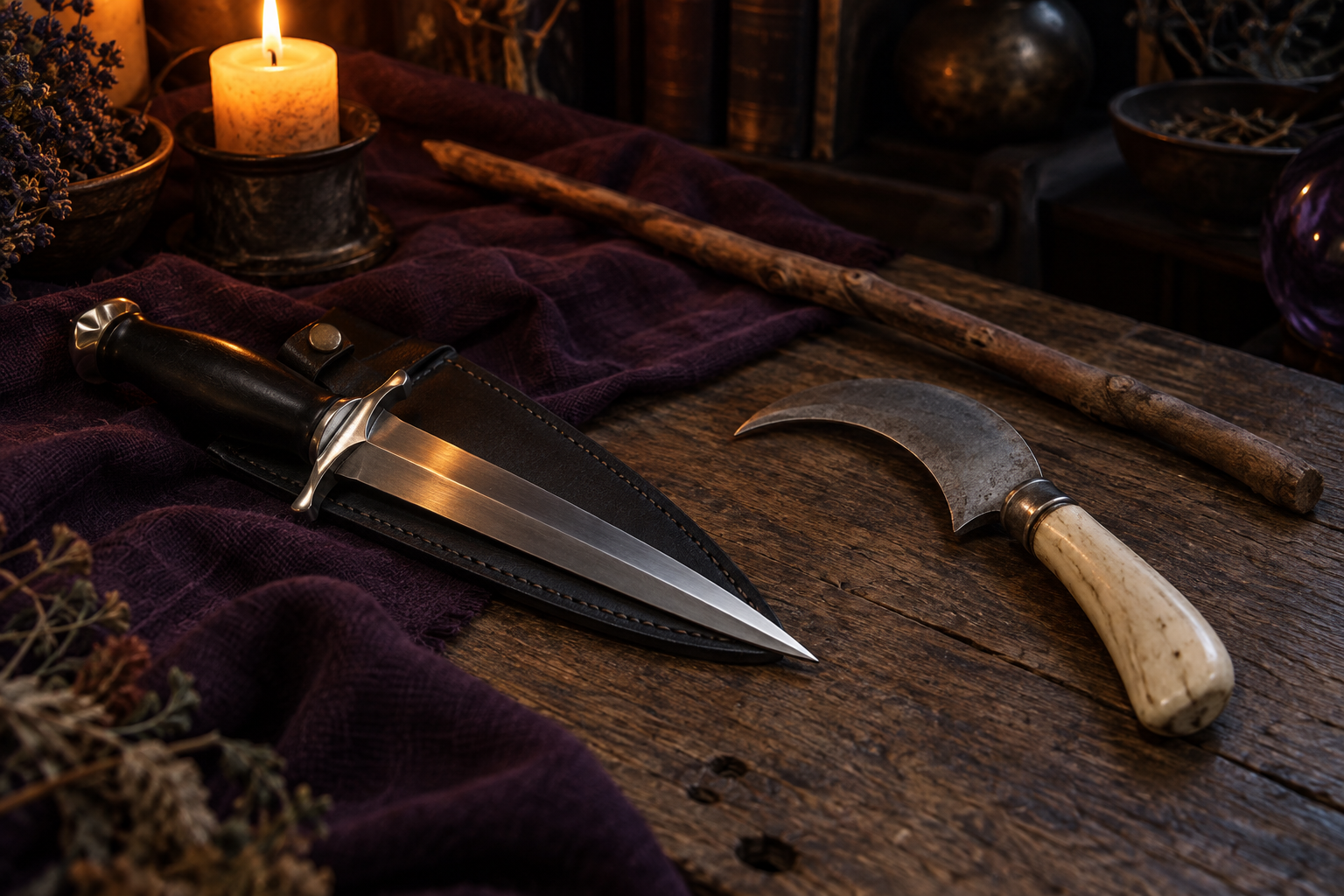
A boline is a knife asked to do what many ritual blades only signify. It severs cord, pares bark, cuts a stem, scores wax, and shapes the other objects that enter a rite. The edge meets resistance. A curl of candle falls away. Green sap darkens the steel. What had been intention becomes an irreversible change in matter.
In much modern Wiccan writing, the boline is identified as a white-handled working knife and contrasted with the black-handled athame, whose office is symbolic direction rather than ordinary cutting. That distinction is influential, useful, and specifically modern. It is not evidence that one identical pair of color-coded knives passed intact from ancient witches into the twentieth century.
01 / TWO EDGES, TWO OFFICES
The boline changes the object; the athame changes the relation
The familiar pairing gives each blade a clean jurisdiction. An athame traces a circle without slicing the floor, points toward a quarter without stabbing it, and directs ritual force without needing a sharpened edge. A boline performs the physical labor: cutting plant material, trimming wood, dividing thread, or inscribing a candle. Black and white handles make the offices legible at a glance, but color is a convention, not the cause of either knife’s power.
This division solves a ritual problem. A blade associated with boundary and directed will can remain reserved, while a second blade accumulates the scratches, stains, sharpening marks, and repairs of craft. The boline’s biography is visible. Its edge says which materials it has encountered; its handle records grip and weather; its sheath keeps the sharpened tool from becoming an accidental act.
Not every witchcraft tradition uses this pair. Some practitioners use one knife for symbolic and material tasks; some distinguish an athame from a white-handled knife but reserve the name boline for a curved harvesting tool; others own neither. These are differences of ritual grammar, not grades of authenticity. The question is always what office the practitioner has actually assigned.
| Tool office | What the hand does | What changes |
|---|---|---|
| Athame | Points, traces, presents, directs | Ritual relation, orientation, or boundary |
| Boline | Cuts, carves, trims, harvests | The material itself |
| Sickle form | Draws an inner edge around stems | A gathered plant separates from its growth |
| Utility knife | Performs a declared practical task | Matter, without inherited ritual status |
02 / A NAME WITH A PAPER TRAIL
Grimoire knives are ancestors of the conversation, not proof of one unbroken tool
Ritual manuals circulating before modern Wicca describe multiple cutting instruments: swords, knives of differently colored handles, lancets, needles, hooks, and sickles. The Key of Solomon tradition is especially important to the later occult vocabulary because its instructions distinguish tools by fabrication, consecration, inscription, timing, and task. Arthur Edward Waite’s early twentieth-century synthesis likewise lists the bolline or sickle among a crowded armory. The archive gives us families of specialist blades, not one stable modern product description.
That difference matters. A manuscript diagram, a Victorian editor’s normalized term, a ceremonial magician’s consecrated knife, and a contemporary shop’s crescent boline occupy related but nonidentical worlds. Spellings drift. Translators reconcile objects differently. Illustrations that appear definitive may belong to one witness or editorial choice. Even the often-repeated opposition of black athame and white boline becomes tidier in later explanation than the older tool lists actually are.
The responsible historical claim is modest and more interesting: modern witchcraft inherited names, images, and specialist-tool logic from ceremonial magic, then made them practical within new ritual systems. The boline’s present office can be real without being prehistoric. A handmade twentieth-century athame in the Museum of Witchcraft and Magic, cut from aluminium sheet and wrapped with string, makes the point materially. Modern sacred tools can be improvised, personal, and historically situated rather than relics of a vanished universal craft.
Do not let resemblance become descent.
A curved
blade can resemble a harvest sickle. Similar shape supports a functional
comparison; it does not by itself demonstrate that every modern boline
descends through a secret continuous lineage.
03 / THE EDGE IS AN ARGUMENT
Blade geometry decides which ritual metaphors the tool can honestly carry
A straight edge is suited to controlled slicing and scoring on a stable surface. A pronounced inward curve gathers fibrous stems toward the cutting edge, but it can be awkward against a broad candle or flat board. A sharp point can begin an inscription precisely; a rounded tip changes that behavior. Thickness, bevel, balance, handle texture, and the user’s dominant hand all affect the gesture long before symbolism begins.
This is why “use the boline” is incomplete ritual language. Cutting rosemary in a garden, shaving a wand blank, dividing knotted cord, and marking beeswax are four different material events. Fresh stems flex and carry moisture. Seasoned wood follows grain and may split beyond the intended line. Cord frays according to its twist and fiber. Cold wax chips while warmer wax receives a groove. An expert practice notices those differences rather than treating resistance as failed intention.
Severance also has more than one magical object. A practitioner might cut a token that represents a bond, cut away the written name of an influence, or divide one cord into two separately kept histories. Where the attachment was imposed by another caster, Cut the Caster's Forced Attachment can carry that severance beyond the token. Cast it to Sever a forced attachment between a target and its caster. The cord then marks a release aimed at the caster’s imposed bond, rather than treating every difficult attachment as foreign magic.
WORKED COMPARISON THE THORN-BOUND CANDLE
One rite requires a boundary, an inscription, and a severance
The tool choice becomes clear only when each gesture is named by its actual effect.
A practitioner has a beeswax candle, a red cord tied around it, and a fallen hawthorn twig. The rite calls for a protected boundary, a carved word, a separated knot, and a pointer that will remain on the altar. An athame, a straight-edged boline, and a small pruning tool lie beside them.
Trace
The athame describes the boundary in air. Nothing physical is cut.
Score
The boline’s point incises the word in wax with shallow, controlled strokes.
Sever
The cord is removed from the candle before cutting so the blade never slips toward the hand.
Shape
The pruning tool shortens the hawthorn; the boline pares only a small rough edge.
READ THE VERBS, NOT THE PRESTIGE
Using one sacred blade for every action would blur four offices and make two tasks clumsier. The athame establishes relation. The boline leaves deliberate marks. The pruning tool handles the woody cut for which it was built. The wand-to-be is not less magical because an ordinary tool made the soundest first cut.
04 / HARVEST IS A RELATION
A white handle cannot make an extraction reciprocal
Descriptions of the boline often begin in the herb garden, where a crescent edge appears perfectly at home. Yet “harvesting herbs” compresses several judgments: correct plant identification, permission to gather, season and life stage, ownership of the land, contamination, population health, and what portion of the organism is taken. A ritual tool does not answer those questions.
Cutting an aerial stem may leave a perennial root alive; taking bark all the way around a branch can interrupt its living tissues; uprooting makes a different claim from gathering seed. The magical meaning should follow the botanical act actually performed. “Sacrifice” is not an elegant synonym for waste, and a whispered thanks does not restore a damaged population.
The boline is most compelling here as an instrument of accountable transformation. The practitioner sees what was removed, knows where it came from, and can preserve, compost, plant, or return the remainder with intention. Its white handle is not purity made visible. It is a conspicuous reminder that this is the blade assigned to touch the world.
05 / MARK, MAINTENANCE, MEMORY
Consecration continues at the sharpening stone
A working knife becomes safer and more exact through maintenance. Resin and wax alter the edge; moisture invites corrosion on susceptible steel; a loose handle changes control. Cleaning, drying, sharpening, oiling when the material requires it, and storing the blade in a sound sheath are not interruptions of magic. They are how a material covenant survives use.
Marks deserve interpretation too. A nick may commemorate a difficult object, but it also changes the next cut. Patina can be beautiful while active rust consumes the surface. A cracked handle may carry ancestry yet no longer provide reliable grip. Repair does not erase ritual history; it writes another chapter in which custody matters more than untouched appearance.
If a blade has become implicated in harmful work, the answer need not be denial or theatrical destruction. Its history can be named, its office retired, and the broader enchantment confronted. The Curse Turned Inside Out can carry the blade’s hostile history back through the larger working. Cast it to Send a curse back to its maker with every hidden strand revealed. Reversal exposes and returns every hidden strand of the curse, while cleaning alone addresses only the steel.