TOOLS · OFFICE · TRANSFORMATION
Witchcraft Tools: What Each Object Actually Does
A cup is not powerful because a catalog calls it a chalice. It becomes a magical tool when material, gesture, and consequence meet in one unmistakable office.

STAR & SIGIL
Let function choose the first tool
Open a beginner spellbook after each object has earned its verb, its safety rule, and its place in the sequence.
Enter with the lean working set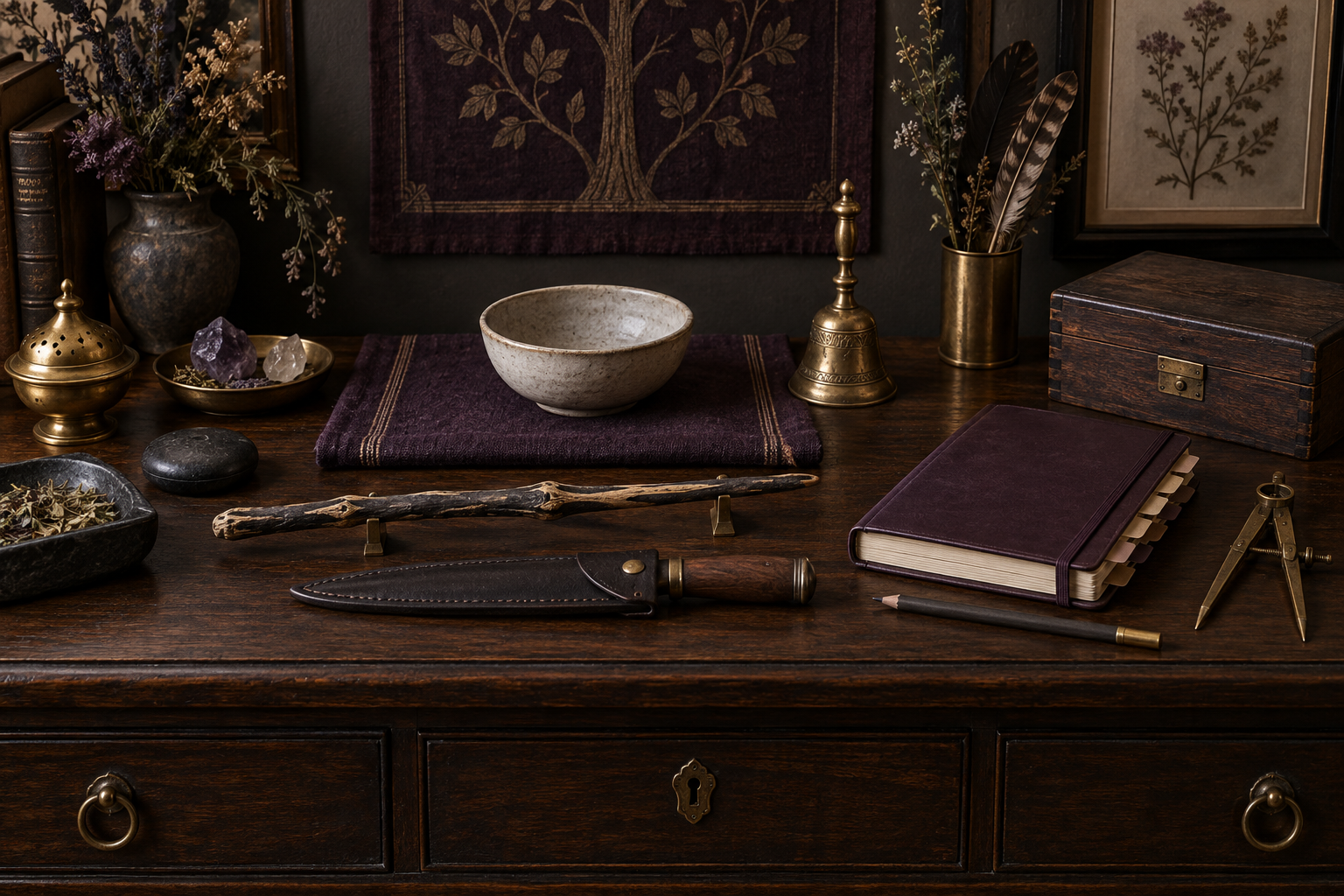
The beginner’s kit arrives in a velvet-lined box: wand, cup, pentacle, bell, knife, incense holder, tiny cauldron. Nothing in it explains why the wand should point, why the cup should receive, or why a bell might close one rite and begin another. The objects look complete together, yet their glittering completeness conceals the essential question: what change can each one make?
Witchcraft tools are material verbs. They direct, contain, mark, measure, reveal, record, transform, or release. A specialized implement can carry tradition, memory, and exquisite symbolic precision. An ordinary bowl can also receive perfectly well. The difference is not price or theatrical beauty. It is whether the object’s material behavior, ritual history, and assigned office agree.
The useful witchcraft tools list is therefore not a shopping list. It is an anatomy of operations. Once the jobs are visible, an inherited cup can be distinguished from an offering vessel, a kitchen knife from an athame, and a notebook from the book that has become the memory of a practice.
01 / BEFORE THE KIT
Historical magical equipment came as systems, not universal essentials
Older ritual texts do not hand us one timeless witch’s toolkit. The Key of Solomon, as presented through early modern manuscript witnesses and a nineteenth-century English edition, describes knives with different handles, sword, sickle, lance, wand, staff, burin, needle, censer, book, inks, perfumes, cords, and clothing. Their manufacture, inscription, planetary timing, purification, and storage matter because each belongs to the text’s larger ritual machine.
The black-handled knife can mark a circle; another knife performs other operations; a burin incises characters. These are not interchangeable props assigned the four elements merely because a modern diagram wants symmetry. They divide labor. Likewise, ceremonial systems of the nineteenth and early twentieth centuries made wand, cup, sword or dagger, and pentacle into an elemental and psychological ensemble. In Aleister Crowley’s account, the wand can signify will, the cup understanding, the sword analytical reason, and the pentacle the magician’s material field. That is a particular argument about the practitioner, not an archaeological inventory of village witchcraft.
Modern Wicca assembled and transformed several such inheritances. Gerald Gardner’s writing and ritual culture helped establish the black-handled athame, white-handled knife, wand, cup, pentacle, cords, scourge, and other implements in a new religious synthesis. That history makes the tools meaningful without making them immemorial. A living tradition need not pretend it arrived untouched from antiquity.
02 / DIRECTION AND DISTINCTION
Wand, blade, and finger can point—but do not say the same thing
A wand extends a line from hand into space. Wood brings grain, growth, flexibility, and a remembered source; metal brings weight, conduction, and a different visual authority. In some rites the wand invites or conducts. In others it rules. The gesture alone does not settle the theology. A practitioner must know whether the point opens a route, addresses a presence, traces a figure, or focuses attention.
A ritual blade introduces distinction. Its edge says this side is not that side, even when it touches nothing. A finger is intimate and always available; a staff changes scale and posture. Substitution works when it preserves the office and acknowledges what changes. Replacing a long staff with a finger keeps pointing but loses height, reach, and the sensation of planting authority into the ground.
This is why collecting “one of everything” can weaken rather than enlarge a rite. Three directing tools used without differentiated offices create three competing voices. One well-understood gesture can command the entire scene.
03 / CONTAINMENT IS AN ACTION
Cups, bowls, and cauldrons govern interiors
A vessel creates an inside, and therefore a politics of admission. What may enter? What can mingle? Who receives it? How does it leave? A chalice held and raised makes a different ritual sentence from a heavy cauldron placed at the center. A shallow dish displays; a lidded box conceals; a porous clay bowl breathes and stains; a glass cup reveals its contents. Material is not decoration added after symbolism. It determines the action available.
Books are vessels too, but for sequence and memory. A grimoire may preserve instructions; a Book of Shadows may transmit liturgy, record experience, or gather a practitioner’s developing work. The fantasy of total disclosure reaches magnificent consequence in The Archive Made to Scream. perform it to make sealed letters, locked books, and buried records speak their secrets aloud. Its power clarifies why a book is never merely paper: whoever opens the record claims authority over what was deliberately closed.
The expert question is not “Which vessel corresponds to water?” but “What kind of interior does this operation need?” A temporary mixture, an enduring offering, a secret, and a memory require different rules of reception and release.
04 / WORKED CASE
The seven-object kit that cannot complete one operation
Suppose Inez wants a compact kit for a recurring rite that names a difficult decision, separates outside pressure from her own desire, records the choice, and closes the question for seven days. She begins with wand, cup, bell, knife, pentacle, crystal, and incense because a checklist calls them basic. The kit has abundance but no grammar.
CASE FILE THE UNWORKABLE KIT
Seven beautiful nouns become four exact verbs
The audit does not ask which objects are most magical. It asks what each contributes that no other object already does.
Inez points with both wand and knife, places the decision beneath both crystal and pentacle, rings the bell at uncertain intervals, and lets incense continue after she has finished. No object identifies what counts as closure.
Name
A card gives the decision exact language and preserves the original question.
Separate
A sheathed ritual blade marks two fields without physically cutting anything.
Choose
A single stone moves into the field that receives her deliberate commitment.
Close
A bell sounds once; the card enters an envelope dated for review.
THE FUNCTIONAL REDUCTION
The wand, cup, pentacle, and incense return to storage because this operation gives them no distinct work. The four remaining objects form a readable chain: language, distinction, commitment, closure.
05 / AN OBJECT CAN INHERIT AN OFFICE
Tools accumulate relationship, but age alone does not authenticate them
An inherited mortar, knife, deck, or sewing needle can carry touch, story, and technique. Its importance may come from who used it, how it was taught, or what work it repeatedly survived. That is different from claiming every old household object was secretly magical. Provenance can deepen a tool’s office; romance cannot supply missing history.
Where real craft was interrupted, The Ancestor Who Brings Back the Lost Art gives inheritance an astonishing form. cast it to summon a forgotten ancestor and recover the art that died with them. The spell’s consequence makes the tool question urgent: recovered art is not a decorative heirloom but technique entering a living hand, carrying obligations of memory, adaptation, and use.
A new object may likewise become potent through disciplined repetition. Consecration can name an office, establish boundaries, and distinguish ritual use from ordinary use. It does not need to pretend the object has no factory, seller, previous owner, or material history. Enchantment becomes richer when biography remains visible.
06 / THE BEGINNER’S REAL KIT
Begin with an operation, then let tools earn their places
A pencil records, marks, points, measures, and can be erased. A plain bowl receives and pours. A length of cord measures, joins, and defines an edge. A cloth establishes a temporary surface and then folds it away. These are not lesser substitutes awaiting replacement. They are excellent teachers because their material actions remain obvious.
After several rites, patterns emerge. Perhaps the bowl needs a lip suited to pouring, the cord requires visible knots, or the notebook needs paper that accepts wet ink. Then a specialized tool answers a demonstrated need. The purchase follows practice instead of trying to create it.
Store by office and consequence. Sharp, hot, fragile, toxic, devotional, inherited, and oath-bound things require different custody. An object resting on an altar is not automatically active, but neither is every object available for casual reuse. Clear storage preserves distinctions the rite depends upon.
The tool begins where possession ends
Witchcraft tools are compelling because matter resists vagueness. A cup has a capacity. A cord has a length. A bell can be heard only so far. A blade creates an edge whether or not it cuts. These limits do not reduce magic; they give intention a body against which it can become precise.
Build the kit from the rite outward. Keep historical systems distinct, honor living traditions on their own terms, and allow ordinary objects to prove themselves through service. The most magical tool is not the rarest object. It is the one whose action makes the operation impossible to misunderstand.