BLADE · BOUNDARY · DIRECTION
Athame Meaning: The Ritual Knife That Cuts Without Cutting
The athame’s paradox is its authority: a knife often reserved from ordinary cutting, used instead to divide here from there, permitted from forbidden, and intention from drift.

STAR & SIGIL
Refuse the command without raising the blade
Carry the athame's cleanest grammar into a modern boundary working centered on cancelling one command and changing one behavior.
Open the deliberate refusal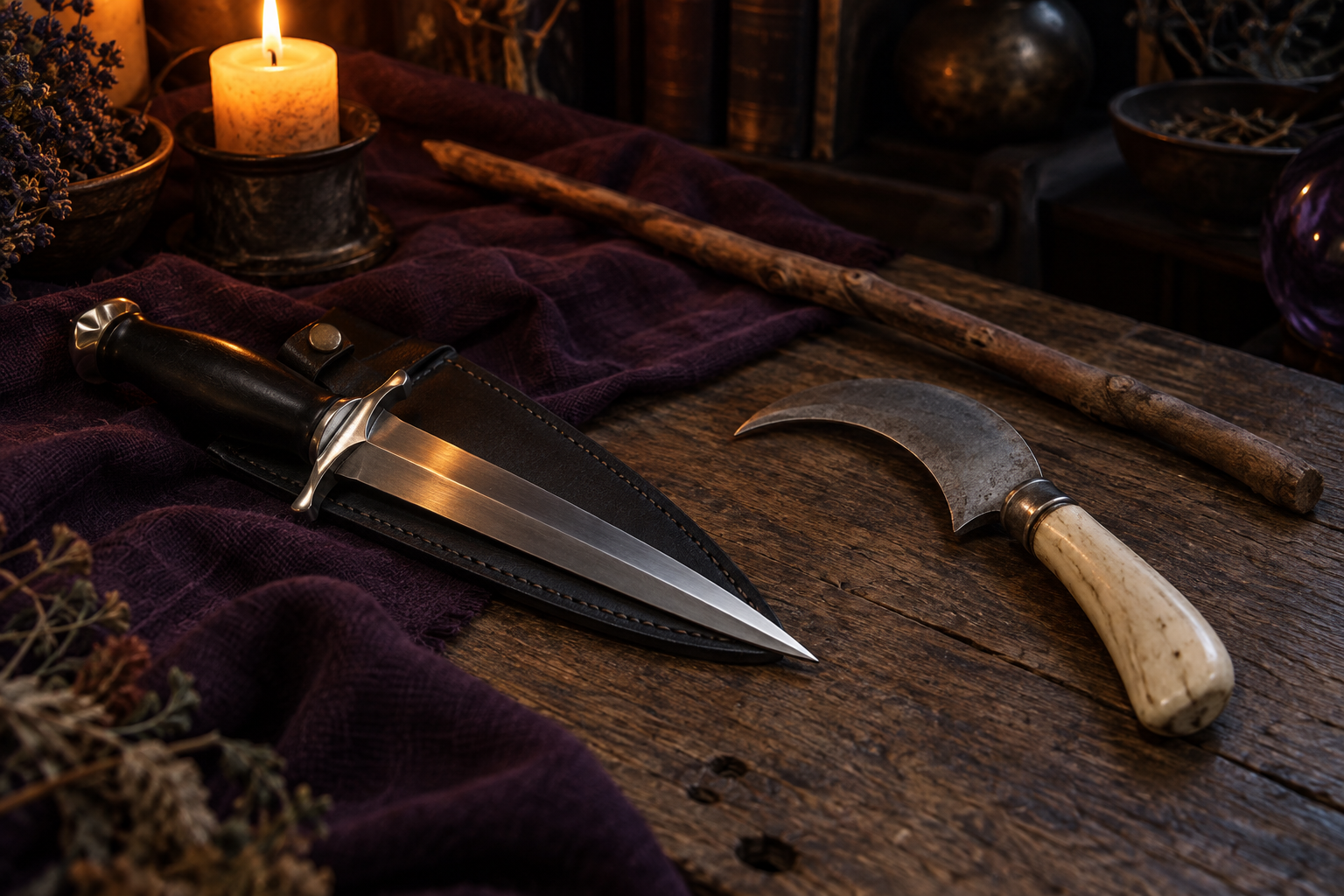
The black-handled knife lies sheathed beside the altar. It has an edge, but no herb will meet it. It resembles a weapon, but its most characteristic work is performed in open air: tracing a circle, directing a charge, opening a ritual boundary, or making a separation perceptible where no physical line exists.
This is the athame’s contradiction. In many forms of modern Wicca and witchcraft, it is reserved from ordinary cutting. Its visible capacity to divide transfers into symbolic space. The point directs. The edge distinguishes. The handle disciplines both.
Athame meaning is not “danger” or “power” in the abstract. It is jurisdiction sharpened into a gesture: here and there, within and beyond, invited and excluded, begun and ended. That meaning has a traceable modern history. It also changes by tradition, so no internet rule about color, element, sharpness, or pronunciation can replace the practice in which a particular blade serves.
01 / THE LIVING DEFINITION
An athame is a modern ritual knife, not every magical blade
In contemporary use, athame most often names the principal ritual knife of Wiccan-derived practice: frequently double-edged, often black-handled, used to direct power and cast or open the circle. Museum examples show resemblance without one compulsory pattern. Gerald Gardner’s surviving athame has a steel blade, wooden handle, brass guard, and faint inscriptions; another practitioner’s uses bog oak and plain brass.
Not every ritual knife is an athame. Blades appear in ancient religion, folk practice, ceremonial magic, sacrifice, divination, protection, oath, costume, cooking, and craft. Calling all of them athames erases their local names and purposes. The term belongs most securely to modern occult and Wiccan contexts, even where those contexts draw deliberately from older magical literature.
Likewise, an athame is not defined by being “a witch’s weapon.” For many practitioners it never touches a person, food, cord, or plant. Its resemblance to a weapon supplies the symbolic severity of division; ritual restraint determines what that severity is allowed to do.
02 / THE BLADE’S PAPER TRAIL
The grimoire knife and the Wiccan athame are related, not identical
The Key of Solomon offers an important ancestor to the modern imagination of ritual blades. In the Mathers edition assembled from manuscript witnesses, one chapter distinguishes a white-hilted knife, a black-hilted knife, sword, sickle, dagger, lance, wand, staff, burin, and needle. Their days of manufacture, inscriptions, fumigation, consecration, wrapping, and assigned tasks form an equipment system. Elsewhere, a knife or other consecrated steel implement marks the circle.
That archive does not present today’s athame under an older cover. The witnesses differ; notes identify material present only in particular manuscripts. “The grimoire tradition” is a family of textual decisions, not one frozen blueprint. Modern Wicca selected and reinterpreted elements from ceremonial magic alongside other influences.
Gardner’s 1949 novel High Magic’s Aid already placed the athame and a white-handled knife within an imagined witch religion; his later nonfiction and religious network helped make the athame a defining implement of Wicca. Contemporary scholarship treats this as creative synthesis, not proof of an unchanged medieval witch-cult. That does not cheapen the blade. It locates the moment when a literary, ceremonial, and religious object became newly alive.
The historical distinction
An early modern
black-hilted grimoire knife is evidence for that ritual system. A
Gardnerian athame is evidence for modern Wicca. Resemblance explains
influence; it does not erase transformation.
03 / WHAT THE ATHAME DOES
Direction, division, and permission are separate acts
To direct is to give movement a route. The point may carry attention toward a quarter, presence, or charged object. To divide is to distinguish sacred from ordinary, protected from exposed, active from resting. To grant permission is to create or close a crossing. One sweep can suggest all three, but practice must know which verb governs.
Circle casting demonstrates the distinction. The blade does not prove that an invisible wall has objectively risen. Within the rite, its path establishes jurisdiction: what the circle contains, who participates, what may enter, and how the space will reopen. A circle without terms is merely geometry. An athame can make those terms feel sharp enough to remember.
That logic becomes formidable when a curse is imagined as a structure with hidden returns. Following The Curse Turned Inside Out sends it back to its maker with every hidden strand revealed. The working fits an athame whose office is analytical as well as defensive: each connection is exposed before reversal makes the whole construction answer for itself.
04 / AIR, FIRE, AND THE DANGER OF FALSE UNIVERSALS
Elemental correspondence depends on the ritual map
One chart assigns the athame to air because a blade discriminates like thought. Another assigns it to fire because forging, will, and severity emphasize heat. Both can cohere inside their systems. Neither is universal.
Ceremonial texts may distinguish dagger and sword through reason, elements, planets, or initiatory grades. Wiccan traditions may organize the same form through another theology. Ask not “Which element is true?” but “What relationships must this blade maintain?” A correspondence is structural when moving it changes the system.
Handle color works similarly. Black is strongly associated with the athame in influential forms of Wicca, often contrasted with a white-handled working knife. Yet museum objects reveal variation in material, inscription, wear, and construction. Color signals tradition most convincingly when practice supplies the distinction it announces.
WORKED READING THE STUDIO THRESHOLD
One blade, three gestures, and a boundary that must still open
Suppose Mara shares a studio. She wants ritual privacy for one evening without treating her housemate as an intruder in their own home.
Mara first imagines tracing a sealed circle around the entire room. Yet the housemate’s desk, coat, and only path to the kitchen cross that field. Absolute enclosure would make symbolic protection contradict the household’s real permissions.
Direct
The athame points only to Mara’s temporary worktable, naming the actual ritual center.
Distinguish
Its sheathed edge traces a small field around chair and table, leaving the shared route outside.
Permit
A deliberate gap faces the agreed approach; a bell, not a barrier, signals a request to pause.
Release
The reverse gesture returns the table to shared ordinary space at the stated time.
THE BOUNDARY READ CORRECTLY
The athame does not turn ownership into occult sovereignty. It sharpens the smaller agreement Mara actually has standing to make. Direction locates her work; distinction preserves the common route; permission remains negotiated; release prevents temporary privacy from hardening into permanent claim.
05 / THE SYMBOL STILL HAS WEIGHT
A ritual blade remains a material object
Symbolic use does not cancel steel, weight, ownership, or another person’s response. A blunt blade can still alarm; an ornate knife can still fall. Physical custody should support the athame’s ritual office.
This becomes especially vivid beside The Body All Weapons Refuse. perform it to make blades, poison, and flame refuse to harm you. The spell imagines sovereign invulnerability; the altar must still respect the body as it presently is. A sheath, stable placement, clear gesture, and consent around shared space are not mundane embarrassments. They are the material grammar through which a blade can remain symbolic.
Some practitioners reserve an athame entirely for ritual; others use a wooden, ceramic, inherited, or symbolic substitute. A finger may trace the same route, but changes sensation and consequence. Know which quality—direction, distinction, lineage, or restraint—the rite needs.
06 / CHOOSING THE BLADE
Tradition, hand, office, and custody matter more than spectacle
Where a practitioner belongs to an initiatory tradition, its teaching governs the athame’s form and use. Outside that setting, begin with the office. Must the object direct from a distance, mark an edge, embody severance, or identify a ritual role? A compact sheathed object may serve a private altar better than an imposing dagger that cannot be handled or stored comfortably.
The hand should understand the object. Balance, guard, grip, sheath, and reach shape every gesture. Decoration matters when it carries a known name, relationship, or rule; symbols copied without comprehension turn the handle into noise. Age and dramatic provenance cannot replace a trustworthy physical condition.
Consecration can formally restrict the blade’s office. It may name what the athame will do, what it will never do, where it rests, who may handle it, and how it retires. Such limits create force because they make every later gesture legible. A tool forbidden from casual cutting accumulates the significance of every distinction it has been allowed to make.
What does an athame mean?
It means a knife has entered ritual and accepted a narrower, stranger office. Rather than cutting herbs or cord, it gives separation a visible body. It can trace jurisdiction, conduct intention, distinguish a sacred interval, and return that interval to ordinary space.
Its grimoire ancestry, Gardnerian development, museum biography, and diverse modern uses should remain distinguishable. Together they make the athame more interesting than a universal symbol chart ever could. The blade’s deepest meaning is not violence. It is the power to say where one condition ends and another may begin.