
Reginald Scot printed an English spirit catalogue inside a book attacking witchmongers. Its historical role lies between Weyer’s Latin appendix and later English Goetia witnesses.
- Weyer
- Latin, 1577 appendix
- Scot
- English, 1584 printing
- Later witness
- Lemegeton manuscripts
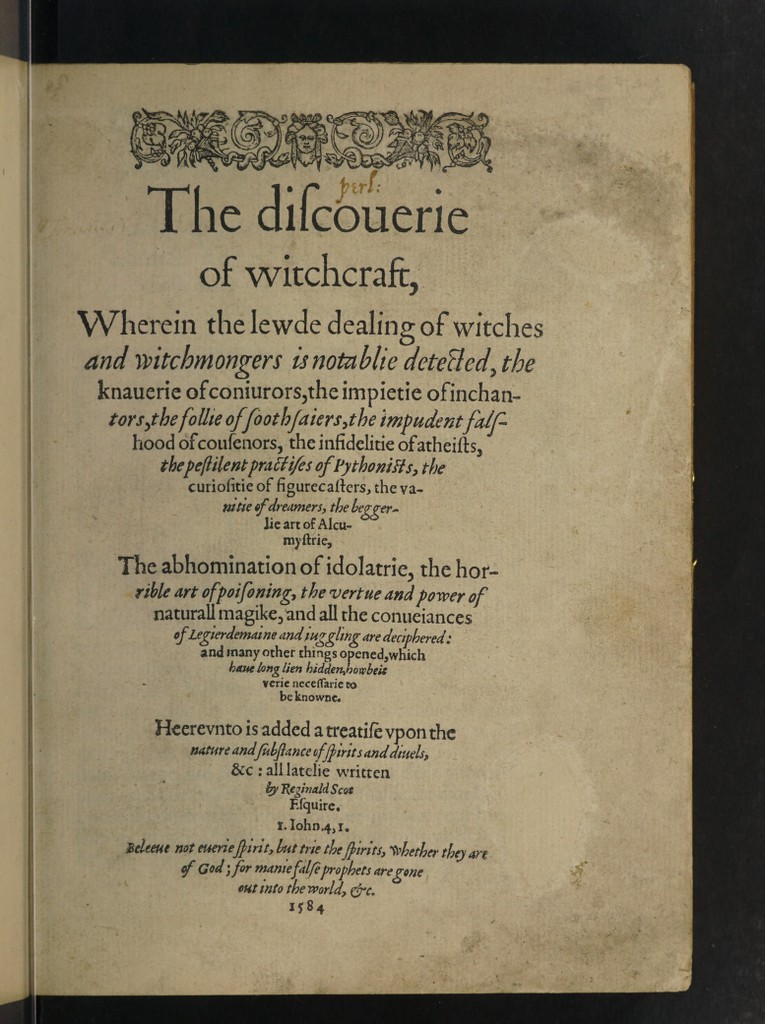
The 1584 book as an object
Wellcome Collection identifies its copy of The discoverie of witchcraft as a London printing by William Brome in 1584. Its detailed record gives the work’s wide scope: witches, conjurors, fortune tellers, and a concluding discussion of spirits and devils. The title page reproduced here is from that particular digitized copy, not a portrait of Weyer and not a page from Pseudomonarchia. Its Public Domain Mark permits reuse, and the source and canvas identifier appear in the caption.
Scot’s English readership encountered the spirit names within a polemical volume, not a standalone modern “demon encyclopedia.” That framing is important. The book’s descriptions document beliefs, textual borrowing, and skeptical controversy. They should not be presented as verified descriptions of beings or as instructions that work. The Wellcome digitization also makes the complete object inspectable, so the catalogue can be read against its surrounding argument.
The missing entry changes a complete office block
Weyer’s third, fourth, and fifth entries make the loss measurable. Marbas or Barbas is a great president over thirty-six legions, associated with secrets, disease and cure, mechanical knowledge, and transformation. Pruflas or Bufas follows as both prince and duke over twenty-six legions, associated with discord, war, quarrels, falsehood, and answers. Amon or Aamon then appears as a great marquis over forty legions, associated with past and future knowledge and reconciliation. Each record combines name variants, rank, appearance, office, and command count in the same catalogue grammar.
Scot preserves recognizable English versions of Marbas and Amon, including their ranks, principal offices, and legion counts, but places Amon immediately after Marbas. There is no damaged Pruflas spelling between them and no anonymous twenty-six-legion office that could silently preserve the record without its name. A whole structured entry has dropped out. The join is visible precisely because the records on either side remain detailed enough to identify.
Worked comparison: Pruflas disappears between Marbas and Amon
The later Goetia continues the absence but reorganizes the neighborhood. Marbas appears as number five and Amon as number seven, with Valefor between them; Pruflas has no counterpart. This is not Scot’s simple order carried forward unchanged. The shared omission travels alongside a newly arranged sequence, so it is evidence of textual relationship without proving that a surviving Scot copy was the sole direct exemplar for every Goetia witness.
Pruflas also shows why a name-only concordance is inadequate. Losing the name removes a prince-and-duke rank, a twenty-six-legion command, the Tower of Babylon and night-raven imagery, and an office centered on conflict and deception. Marbas and Amon keep different ranks and functions on either side. The chain therefore preserves two neighboring records while deleting the distinct administrative and narrative unit that separated them in Weyer.
The offices make the effect on the local sequence especially clear. Weyer moves from Marbas, whose entry joins hidden knowledge to illness, cure, craft, and bodily transformation, through Pruflas, whose entry concentrates quarrel, war, deceit, and discord, to Amon, who both discloses past and future matters and reconciles friends. That arrangement places an office of conflict immediately before an office of reconciliation. Scot’s omission makes reconciliation follow Marbas’s mixed healing and knowledge office instead. The evidence cannot establish why the entry vanished, but it does establish that the resulting English sequence presents a different progression of powers.
The counts rule out a subtler survival. Scot’s Marbas still commands thirty-six legions and his Amon still commands forty; neither absorbs Pruflas’s twenty-six. Their ranks also remain president and marquis rather than taking over the missing prince-and-duke title. If only the heading or one spelling had been lost, a twenty-six-legion conflict office might remain attached to a neighboring record. It does not. Name, rank, imagery, powers, and count disappear together, which is stronger evidence for the loss of a complete catalogue unit than the missing name alone.
| Record | Weyer’s printed catalogue | Scot’s 1584 English catalogue | Later Ars Goetia |
|---|---|---|---|
| Marbas / Barbas | No. 3; great president; 36 legions; secrets, disease and cure, mechanical arts, transformation | Present immediately before Amon; rank, main offices, and 36-legion count retained | Marbas, no. 5; president; corresponding core offices |
| Pruflas / Bufas | No. 4; prince and duke; 26 legions; discord, war, quarrels, falsehood, answers | Absent: no name variant and no equivalent 26-legion office between Marbas and Amon | Absent: no corresponding entry |
| Amon / Aamon | No. 5; great marquis; 40 legions; past and future knowledge, reconciliation | Present directly after Marbas; rank, main offices, and 40-legion count retained | Amon, no. 7; marquis; corresponding core offices |
Source records and editions
- Weyer, 1577 fifth edition, digitized book ↗
- Wellcome Collection, Reginald Scot, The discoverie of witchcraft (1584), public-domain scan ↗
- Joseph H. Peterson, edited comparison of Pseudomonarchia witnesses (copyrighted editorial work; link only) ↗
- Joseph H. Peterson, edited Goetia text and introduction (copyrighted editorial work; link only) ↗
- British Library, Sloane MS 3648 catalogue record ↗