
A small book built as a sequence
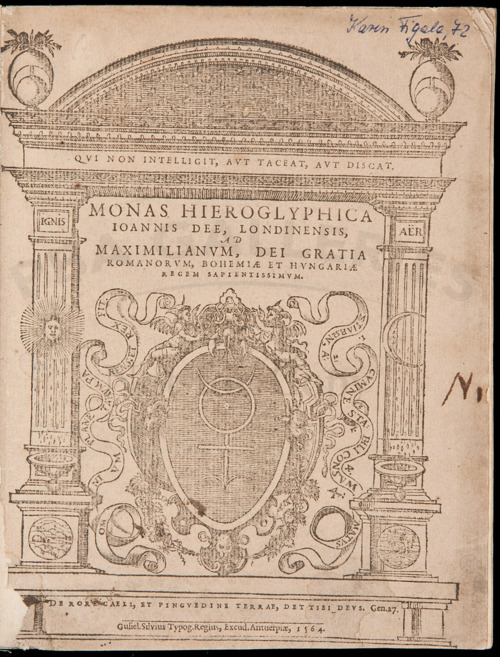
Wellcome Collection describes the Antwerp printing by G. Silvius as twenty-eight leaves in Latin, with a woodcut title page, illustrations, and diagrams. Salisbury Cathedral Library records another 1564 copy, names the printer as Gulielmus Silvius, and locates the colophon on leaf 28 recto. The abbreviated and expanded printer names identify the same edition. The book’s scale is compact, but its twenty-four numbered theorems require a fixed order: each diagram reuses forms introduced earlier.
The title-page Monad is therefore a visual synopsis rather than an isolated talisman. The printed argument repeatedly separates the glyph into point, straight line, circle, semicircle, cross, and horned base, then recombines those parts under geometrical, astronomical, numerical, and alchemical descriptions. The emblem stays materially the same while its components acquire new relations. Reading the leaves in sequence turns a static logo into a method of controlled decomposition and recomposition.
Theorems I–V: geometry becomes a celestial image
The first theorem begins with the straight line and circle as the simplest means of representation. The second adds a dependency: a circle and line require a point, and the circumference depends on its center. The third then assigns cosmological roles to that geometry. The central point signifies Earth, while the centered circle signifies the Sun and supplies an orbiting frame for the Moon and planets. Dee does not begin by naming a complete magical character; he builds the conditions under which one can appear.
The fourth and fifth theorems add the lunar semicircle above the solar circle. The Moon seems higher in the drawing, yet its light is described as received from the Sun; the geometry therefore encodes a relation of dependence rather than a simple ranking by vertical position. Crescent and circle together also evoke a cycle of disappearance and renewal. By theorem V, the first two celestial components have become one figure whose meaning lies in conjunction: lunar change is joined to solar completeness.
Theorems VI–XIV: the cross introduces elements and fire
Theorem VI places Sun and Moon on a right-angled cross. Dee counts the intersecting lines and center in several ways: two lines with their joining point can form a ternary, while four radiating segments and four right angles expose a quaternary and an octad. The next theorems give the four directions of the cross an elemental role and reduce the sequence one, two, three, four to ten. Geometry is doing several jobs at once: it displays spatial opposition, generates number, and gives the celestial pair a material support.
The horned Aries form added below the cross in theorems X and XI brings fire and the equinox into the same composite. Theorems XII through XIV then anatomize the conventional planetary signs into lunar, solar, elemental, and Aries-like parts. Mars can be read through Sun and Aries; Venus through Sun and the elemental cross; Mercury becomes a fuller recombination. The point is generative: one compact grammar is made to produce a family of celestial characters and an alchemical account of their interaction.
Theorems XV–XXIII: the glyph becomes an operation
The middle and later theorems turn the cross through alphabetic and numerical readings, drawing values from its equal and unequal parts and from forms resembling Latin letters. Theorem XVIII shifts to the philosophical egg, where celestial circles become a language for material transformation. In theorems XX and XXI, removing or relocating the central point changes a binary into a visible quaternary and the familiar components are inverted or redistributed. Analysis of the sign is presented as an analogue for separating and recombining matter.
Theorem XXII finds the outlines of vessels in rearranged segments of the Monad. Theorem XXIII then replaces suggestive resemblance with a measured construction: a base interval determines the vertical line, cross arms, solar circle, lunar crescent, and lower semicircles. The glyph can be engraved on a seal or ring only after those proportions are observed. The sequence has moved from elementary point and line, through symbolic anatomy and alchemical transformation, to instructions for producing the same figure at a controlled scale.
Worked reading: theorem XXIV closes the quaternary
Read the last theorem against the first. Theorem I begins with point, line, and circle; theorem XXIV explicitly recalls that beginning and follows the point outward through the linear “efflux” of the four elements into a circle compared with a twenty-four-hour equinoctial revolution. The ending therefore folds the completed glyph back onto its first construction. The circle now carries geometric origin, celestial motion, measured time, and the return of separated parts to unity.
The number twenty-four closes several systems at once. The natural quaternary permits twenty-four arrangements through the multiplication 1 × 2 × 3 × 4; the artificial quaternary’s complete additions also yield twenty-four; pure gold supplies the twenty-four-carat analogy; the treatise ends with its twenty-fourth theorem; and Revelation 4 supplies four creatures with six wings and twenty-four elders around the throne. Dee’s closure is not a dictionary definition of the glyph. It is a convergence in which quaternary matter, daily revolution, combinatorial change, metallic perfection, book structure, and scriptural praise all resolve into one number.
Source records
- Wellcome Collection, 1564 Monas hieroglyphica catalogue and Public Domain Mark ↗
- Wellcome Collection, digitized 1564 copy ↗
- Salisbury Cathedral Library, 1564 copy B14419 ↗
- Library of Congress, Monas hieroglyphica record ↗
- The twenty-four theorems in English, keyed to Dee’s diagrams ↗
- Wikimedia Commons, public-domain 1564 title page ↗