
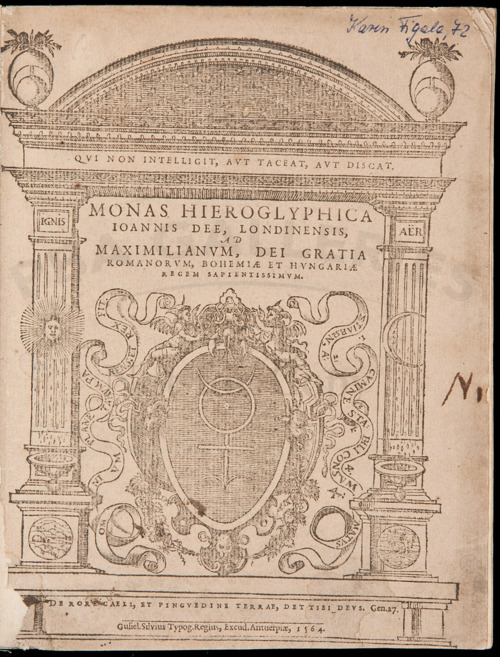
Dee’s Monas Hieroglyphica is a Latin book printed in Antwerp in 1564. Its composed sign appears in a sequence of diagrams and twenty-four theorems that connect geometry, celestial signs, and alchemical language.
The Wellcome Collection and Salisbury Cathedral Library catalogue surviving copies. These records anchor the printer, date, material form, and image before a modern interpretation begins.
The later Angelical alphabet, Sigillum Dei Aemeth, Holy Table, and Aethyrs belong to a different set of records. The comparison guide below shows where readers can check each source family.
- Work
- Latin printed treatise
- Imprint
- Antwerp, 1564
- Structure
- Twenty-four theorems
Choose a guide
What this archive answers
What does the glyph show? Which book printed it? How does it differ from the images now called Enochian? Each guide answers one question with named catalogue records and a digitized copy. The title-page image is credited as one public-domain witness rather than a universal emblem detached from its printed setting.
Continue to the Dee manuscript and object archive or the Enochian source guide for the later records.