The second book is easy to mistake for an extension of the seventy-two Goetic profiles. Its own arrangement, source history, and surviving copies point to a separate compilation problem.
What its catalogue actually arranges
Theurgia-Goetia describes chief spirits and their ministers in a directional framework. Some figures are characterized as good, some as evil, and some as mixed. Those moral descriptions belong to the book’s own classification; they are not independent observations about beings. The catalogued totals differ. Peterson counts 513 aerial spirits in the fuller text, while the title of Wellcome MS.3203 describes its two copied books as containing 336 spirits. The difference does not prove missing leaves: the totals may count chiefs and subordinates differently, describe different textual extents, or reflect a copyist’s title. They are numbers attached to distinct witnesses, not a single fixed census of the Lemegeton.
Trithemius is a source, not an identical ritual
Johannes Trithemius’s Steganographia supplies names and a small set of matching seals that a later compiler could adapt. The original setting was a work on concealed communication. Peterson’s side-by-side discussion identifies particular overlaps while stressing that Trithemius’s writing examples do not match the subsequent Theurgia-Goetia conjurations. The borrowed names and drawings took on a new role when the compiler placed them inside Theurgia-Goetia. An apparent one-to-one image match is strong evidence for graphic borrowing at that point. It does not establish that the entire second book was copied unchanged, nor that a ceremonial interpretation was Trithemius’s original purpose.
What Wellcome MS.3203 preserves
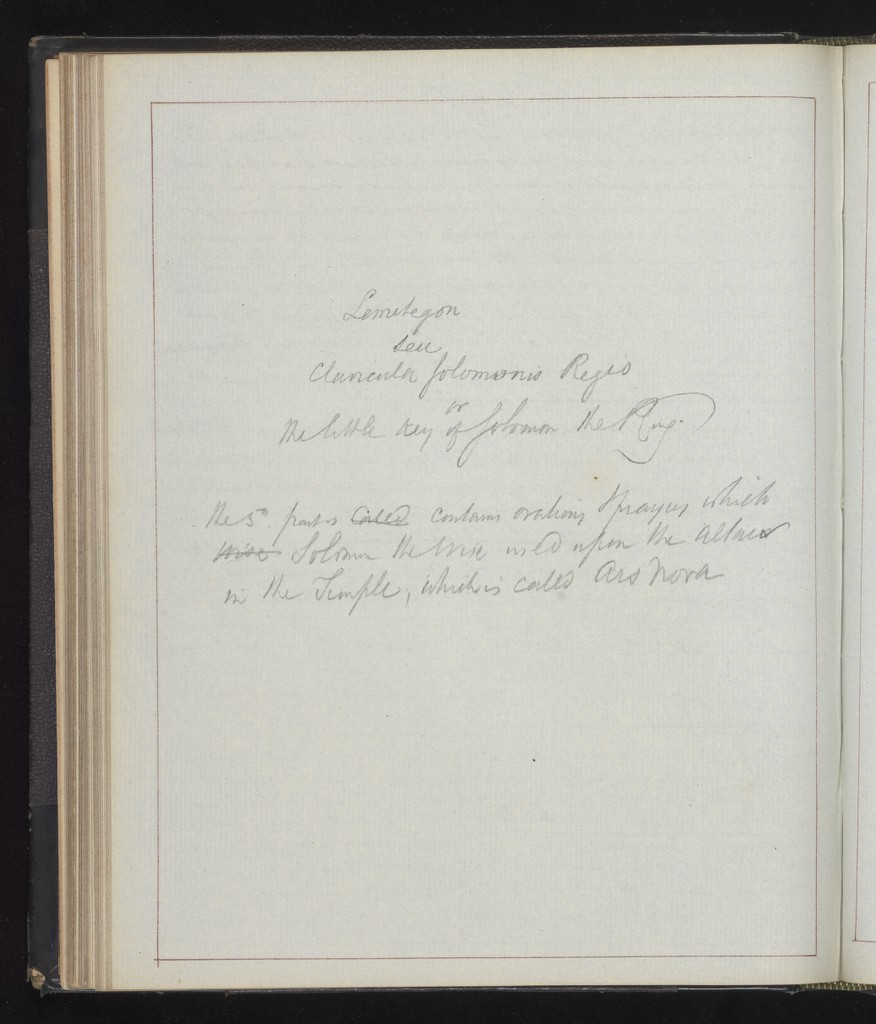
Wellcome’s catalogue identifies Henry Dawson Lea’s manuscript as a collection of five treatises made between 1843 and 1869. Its fourth treatise is explicitly titled as two Solomonic books, Goetia and Theurgia-Goetia. Frederick Hockley’s prefatory account describes earlier manuscripts he copied, making this volume a witness to nineteenth-century collecting as well as to an older textual tradition. The title leaf of MS.3203 belongs to that later object, not a seventeenth-century archetype. It illustrates how “Lemegeton” can label a manuscript unit even when the item contains only two of the five commonly named books. A catalogue title is not a guarantee of complete contents.
Worked comparison: one chief’s name and seal in Steganographia and Theurgia-Goetia
Usiel gives a more precise test of borrowing than a general resemblance between two spirit catalogues. In the Theurgia-Goetia transcription, Usiel is the eleventh chief in sequence and the third placed under the western emperor Amenadiel. His station is northwest; his court is divided into forty diurnal and forty nocturnal dukes. Four subordinate names receive special attention: Adan, Ansoel, Magni, and Abariel. Their seals are set apart before the longer day and night lists. The entry then assigns Usiel a distinctive office, claiming that his group can hide or disclose treasure more effectively than the other spirits in the book. Direction, daily cycle, hierarchy, and a practical claim now hold the borrowed material together.
Trithemius’s Steganographia, Book I, chapter 11 supplies the same chief and the same four subordinates with matching signs. That agreement is much narrower and stronger evidence than shared angelic endings such as “-iel.” Yet its context is different. Trithemius presents conjurations as examples in a work about transmitting concealed messages. The Theurgia-Goetia does not simply repeat those writing examples. It installs Usiel inside a compass-wide monarchy, expands his retinue, and gives the four signs a treasure function. The signs persist while the explanation of what they do changes.
The four selected dukes also cut across the entry’s own day and night division. Abariel and Magni occur in the diurnal list; Ansoel and Adan occur in the nocturnal list. The special group is therefore not a miniature copy of one side of Usiel’s court. It is a source-shaped cluster retained because those four names and signs arrived together from Steganographia, then set above the larger schedule that the new compiler constructed around them. The layout preserves the seam between borrowed unit and expanded catalogue.
This comparison also reveals an intermediate stage. Sloane MS 3824, “The Second Parte of the Art of King Solomon,” has the few seals that come from Trithemius but lacks the abundant individual spirit seals found in the fuller Theurgia-Goetia. The evidence therefore fits a layered construction: a compiler took a named group and graphic signs from Steganographia, recast them as part of a Solomonic spirit catalogue, and a later textual stage elaborated the system with many more seals. Usiel is a traceable transfer, not proof that the whole second book descended unchanged from Trithemius.
The physical presentation in Wellcome MS.3203 adds one more stage. Henry Dawson Lea copied Books I and II in the nineteenth century, and some drawings were pasted onto its pages as separate slips. That mounting belongs to Lea’s object rather than to the seventeenth-century source layer. Reading name, seal, office, and page construction together separates three questions: where an image first appears, how a compiler reinterprets it, and how a later copy preserves it.