
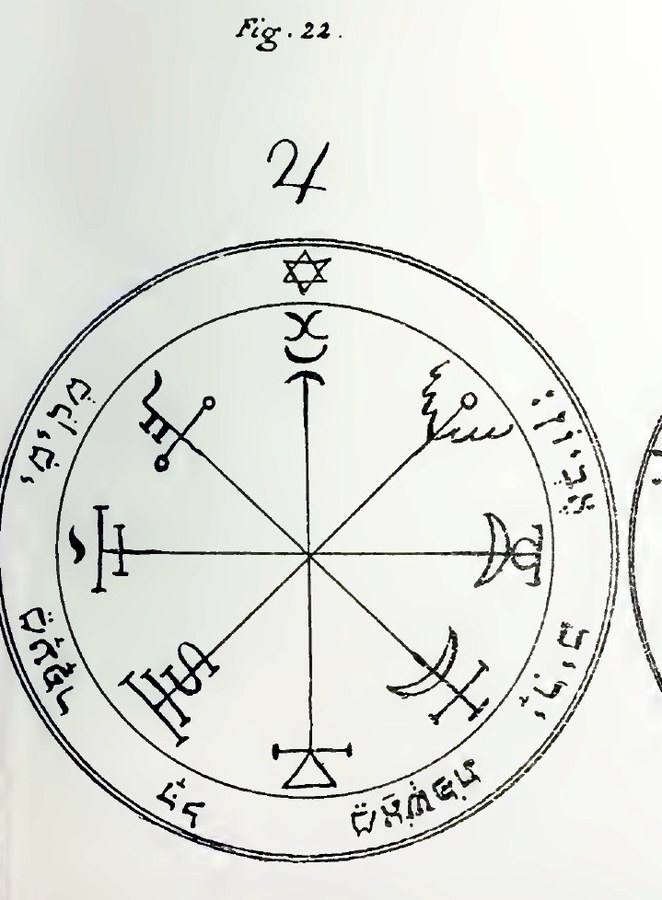
Mathers gives the last Jupiter figure power against poverty and against spirits said to guard treasure.
- Planetary group
- ♃ Jupiter
- Mathers figure
- 24
- Printed plate
- V
- Text anchor
- Psalm 113:7
Mathers assigns blue and tin to this planetary group. The crop documents his printed linework; it does not reproduce the color or material described elsewhere in the edition.
What Mathers’s caption claims
Mathers gives the last Jupiter figure power against poverty and against spirits said to guard treasure.
Within the Jupiter collection, this places figure 24 among themes of treasure, status, protection, visions, and relief from poverty.
Inscription, names, and script
Psalm 113:7: Lifting up the poor out of the mire, and raising the needy from the dunghill, that he may set him with princes.
Mathers identifies the internal marks broadly as mystical characters of Jupiter.
How the diagram is organized
The visible core is an open central hub. Around it, a radial wheel carries varied Jupiter characters. At the edge, the elevation-from-poverty verse surrounds the wheel.
Mathers plate and witness differences
Unlike the two hexagram figures, the editor offers no internal name transcription here. A faithful account therefore distinguishes a translated biblical border from characters he classifies but does not read.
Plate V is an artifact of Mathers’s 1889 arrangement. His preface and final note say that he compared differing manuscripts and restored difficult Hebrew and magical characters. Sloane 2731 and Lansdowne 1203 remain distinct manuscript objects; this printed crop should not stand in for either one.
WORKED EXAMPLE
A diagram reading of figure 24
Read the upward movement in the verse against the level spokes of the wheel. The caption’s economic theme comes from the border text, while the interior establishes planetary identity; neither layer alone contains the complete editorial meaning.
View this figure in sequence
The Jupiter collection contains 7 figures, numbered 18–24 in the 1889 edition.