
The grimoire treats objects as parts of an operating grammar. A circle controls distance, a pentacle asserts credibility, the conjured book carries a warrant, and humble offerings give each spirit call a material price.
- Boundary device
- Circle marked in charcoal, chalk, or holy water
- Portable warrant
- The book is exorcised so spirits will accept it
- Practical appendix
- Rare Secrets begins on printed page 48
| Object or material | Textual role | What the text claims it enables |
|---|---|---|
| Circle | A visible limit written with prohibitions and names | Presence at the boundary without entry into the operator’s space |
| Pentacle | A displayed warrant associated with Solomon | Truthful answers and obedience |
| Conjured book | A portable script and credential | Recognition of the reader’s commands in later operations |
| Lambskin and sealed paper | A prepared support and container | Protection and preservation of charged signs |
| Offerings | A spirit-specific price or departure gift | Attendance, cooperation, or safe release |
| Timed and purchased objects | A sequence lock | Correct order through first-found, new, or no-bargaining conditions |
The circle is a boundary with a sentence written into it
The circle pages do more than supply decorative geometry. Charcoal, blessed chalk, or holy water applied with wood from a blessed cross gives the boundary a material history. The operator writes prohibitions into the ring: the named spirit is called close and simultaneously forbidden to enter. Remaining holy water is kept as protection. In the book’s dramatic logic, the line does not imprison the spirit inside; it preserves a controlled distance from which command and answer can pass.
That makes the circle legible as a spatial contract. The operator claims the interior, assigns the exterior to the appearing figure, and invokes higher names as enforcement. Monday’s formula directed at Lucifer is especially blunt, but other weekday rings repeat the device with their own names. The geometry is simple compared with the verbal labor around it. Its power, as the text imagines power, lies in the conjunction of marked ground, sanctioned substance, exact inscription, and the operator’s protected position.
The pentacle serves as a credential, not another wall
The universal conjuration demands that the summoned presence appear in a beautiful human form and answer without deception. At the point where speech might fail, the operator displays what the book calls Solomon’s pentacle. It is treated as a sign that validates command and compels truth. The grimoire even points outward to an Agrippa edition, rather than establishing a self-contained ancient pedigree for the figure. That cross-reference exposes compilation: the printer borrows authority from another printed occult book.
Circle and pentacle therefore should not be collapsed into one generic magic symbol. The circle distributes bodies in space; the pentacle is shown like a warrant. One says where the respondent cannot go. The other says why the respondent should credit the operator’s demand. The dismissal, expressed through a Christian formula of going in peace, completes the exchange. Boundary, credential, interrogation, and release form a sequence of distinct jobs, even when modern illustrations display all the lines on one plate.
The book becomes the instrument it describes
Printed pages 22–24 exorcise the volume itself through the blood of Christ in the chalice and repeated Trinitarian language. Spirits are told to recognize the book, appear in human form, answer, teach, give what is requested, and spare the reader and companions from storm, noise, or hurt. A manual that merely records speeches would remain external to the rite. This manual claims to cross the boundary and become a participant: the completed object is presented as a reusable authorization.
Prepared surfaces deepen that material claim. Paper, host fragment, purple silk, lambskin, ink or blood, drying time, cutting, and burial turn writing into a chain of transformations. The object remembers its sequence. A sign written on ordinary paper would not be equivalent, within the text’s rules, to a sign made on a surface that has passed through the required days, substances, prayers, and enclosures. Matter stores order, and order is one of the grimoire’s main ways of representing control.
Small offerings and odd conditions act as sequence locks
The weekday calls attach different objects to different names: a mouse for Lucifer, the first stone found for Frimost, bread for Silcharde, a walnut for Béchard, burnt bread for Guland, and hair or fox hair for Surgat. Their diversity is more revealing than any single symbolic interpretation. The offerings distinguish one operation from another and give the encounter a price. Bread can mark departure, while the first-found stone makes chance and timing part of the qualification.
Other rules perform the same locking function. A knife must be new. An object must be bought without bargaining. A material must remain buried or dry for a stated interval. These restrictions prevent substitution in the world imagined by the book: not any knife, purchase, stone, hour, or surface will do. They also make success difficult to falsify within the narrative. If the promised effect fails, a missed condition can always be blamed. Precision creates authority while insulating the claim from ordinary testing.
Worked comparison: circle, pentacle, and Surgat’s stone do different jobs
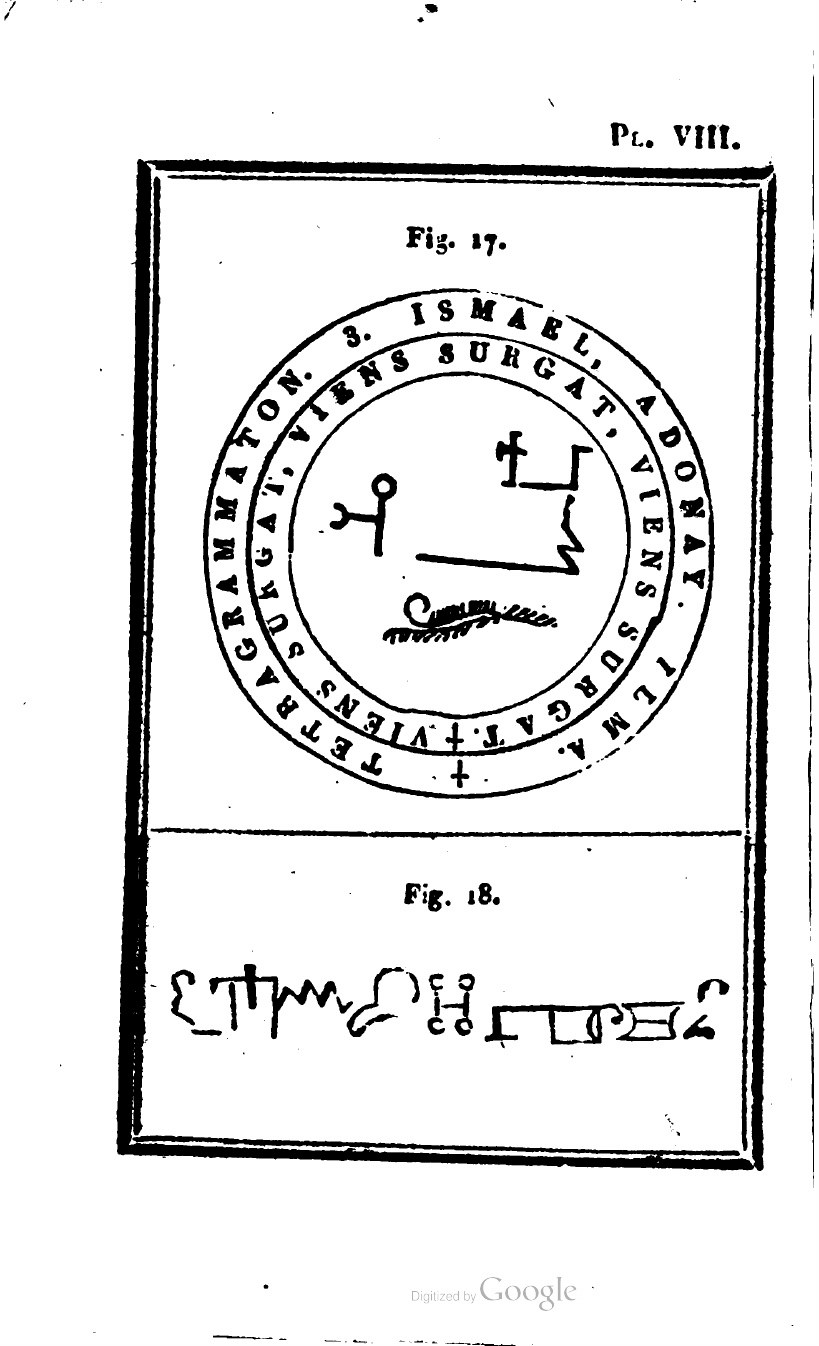
Follow Sunday’s Surgat operation as an object chain. First, two circles establish protected space and carry divine names alongside the repeated call “Come Surgat.” Hair is requested, with fox hair accepted as a substitute. The summoned figure is asked for treasure and for a stone that the text says will make its bearer unseen. The stone, if granted, would leave the ritual setting with the operator. It is the promised residue of an encounter rather than the device that makes the encounter safe.
The circle, pentacle, and stone occupy three different moments. The circle precedes and contains the exchange. The pentacle validates the operator’s speech during the exchange. The stone is supposed to preserve an effect after dismissal. Confusing them produces a flat inventory of magical objects. Reading them in order shows a more interesting architecture: boundary opens a controlled meeting, credential sustains a claim to obedience, and talisman exports the claimed result into ordinary movement.
The distinction also clarifies the book’s rhetoric. A circle can be inspected as ink or charcoal on a page or floor; a pentacle can be copied and displayed; a stone can be carried. Yet the asserted properties are not visible in those materials. The grimoire supplies a story that connects them, then presents the story’s sequence as proof of efficacy. Historical analysis can trace that sequence precisely while keeping every supernatural outcome in the grammar of what the text claims.
A modern invisibility theme remains historically separate
The modern Star & Sigil working “Make It Unseen” is a defensible adjacent link because Surgat’s stone is one of the clearest invisibility claims in this grimoire. The modern item belongs to a separate catalog and does not descend from the Sunday call. It does not authenticate the circles, offerings, spirit names, or claimed stone, and the historical page does not authorize the contemporary working.
The connection is thematic and transparent: two independently framed items use invisibility language. That limited relationship lets a reader move from close analysis of an old printed claim to a current experience without disguising one as the other.
The Rare Secrets appendix shifts scale from demons to daily hazards
At printed page 48 the Recueil des plus rares secrets de l’Art magique changes the book’s rhythm. Shorter recipes promise gaming luck, the extinguishing of a chimney fire, relief from fatigue, protection from weapons, knowledge of past or future, remedies, exorcism, and protection for livestock. The frontispiece itself advertises a sheep guard explained near the end. Demon conjurations and household anxieties are therefore parts of one commercial package, not separate high and low worlds.
The gaming charm combines a plant gathered before sunrise with a half-circle of names and crosses. The chimney-fire procedure uses charcoal to draw two small pentacles and repeats words three times. A much longer wealth story involving a serpent-like creature, a box, feeding, deposited money, and the phrase “I accept the pact” turns domestic husbandry into an imagined engine of multiplication. The book claims these effects; the surviving print proves only that such promises were packaged, illustrated, and sold. Their range explains the volume’s appeal more clearly than a demon list alone.