
The book invents a papal constitution, grants ordinary clergy reserved jurisdiction over spirits, and turns familiar rites into stages in manufacturing a commanding book. The famous pope’s name is only one component in this counterfeit ritual authority.
- Opening fiction
- A constitution attributed to Honorius III
- Liturgical frame
- Masses, offices, fasting, confession, and communion
- Key transition
- The finished book is itself exorcised and authorized
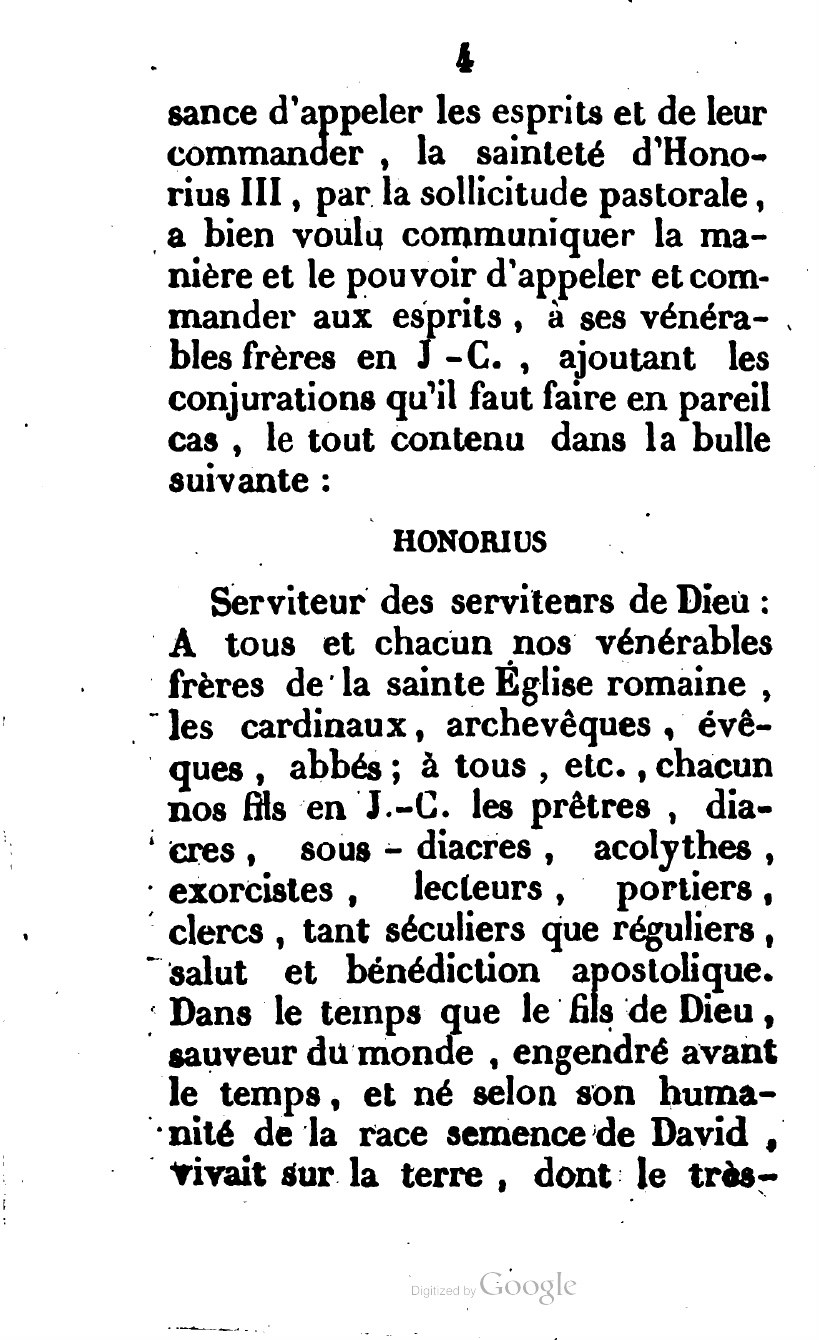
A forged constitution supplies the missing jurisdiction
The opening pages style themselves as the “Constitutions of Pope Honorius the Great.” Their argument begins with the keys given to Peter and moves immediately to a startling legal conclusion: the pope is said to possess authority over hell itself. The document addresses cardinals, bishops, abbots, priests, deacons, subdeacons, acolytes, exorcists, readers, porters, and the rest of the clergy. That long address is functional. It constructs a chain from apostolic keys to papal office and then down through the minor orders, so that a private operator can appear to act under delegated jurisdiction rather than personal daring.
The counterfeit bull claims that popes had kept this power to themselves until Honorius III chose to distribute it among ministers of the altar. This is the book’s first great fiction of access. The reader is not told that ritual skill alone defeats spirits; the reader is told that an exclusive institutional privilege has been released. The title page’s “Rome, 1760” and the papal voice reinforce one another. Both make a later French printed object look like an official instrument issued from the center of Latin Christendom, even though the surviving copy offers no evidence that a pope promulgated its constitution.
| Textual element | Ordinary clerical association | Function claimed by this grimoire |
|---|---|---|
| Papal constitution | Jurisdiction and discipline | Delegates command of rebellious spirits to lower clergy |
| Mass and consecrated host | Sacrament and communal worship | Authorizes the operator and supplies protected material |
| Office of the Dead | Prayer for the departed | Becomes a timed speech of protection during spirit raising |
| Exorcism | Expulsion or restraint of a troubling presence | Consecrates the book as a portable warrant of command |
The preparation turns worship into manufacture
The following sequence borrows the calendar and gestures of clerical life but gives them a new destination. A three-day fast, confession, communion, gradual psalms, and litanies prepare the operator. On the first Monday, a Mass of the Holy Spirit precedes a prayer for power over rebellious spirits. The operator keeps a consecrated host in the left hand. The next operations no longer read like ordinary preparation for worship: a black cock is killed, one feather is retained, parts of the body are dried and powdered, and the carcass is buried under a cross and marked signs.
On Tuesday the Mass of the Angels frames another workshop-like stage. The retained feather is cut with a new knife. Figures are written on the altar with what the French text calls the blood of Christ and then identifies parenthetically with consecrated wine. Paper, a fragment of the host, purple silk, and an offering are wrapped and sealed together. The religious forms therefore do not provide a devotional preface that can be separated from the magic. They supply substances, timing, authorization, and protective enclosures. Mass has become part of the book’s material production line.
An altered office makes the inversion audible
The eve of Thursday makes the redirection especially clear. The operator uses holy water and a pierced yellow wax candle, then recites Psalm 77 without the Gloria Patri. An Office of the Dead follows, but the familiar frame receives new verses asking for release from fear while demons are raised and commanded. The omission and substitution matter because they advertise control over the rite’s seams. The text does not discard Christian language. It edits that language at the points where a doxology or liturgical intention would normally define the action.
That is why “inverted liturgy” describes the structure better than the loose label black mass. The surviving pages do not simply reverse a Mass in theatrical mockery. They raid an entire clerical system: sacramental presence, office hours, vestments, blessing, burial, exorcism, psalmody, and the juridical voice of a papal constitution. Each borrowed form is assigned a new task inside a coercive private operation. Familiar words remain recognizable, yet their sequence now aims to fabricate authority over an imagined spirit encounter.
The lambskin carries a contested sacrificial logic
The lambskin preparation compresses the book’s theology into one object. After burial and sprinkling with holy water, the text invokes the Asperges me. Its prayer identifies the slaughtered lamb with Christ and asks that the skin become a surface able to preserve its user from the malice of demons. The skin is dried for eighteen days; the fleece is reduced and buried; signs are written or cut while psalms are spoken. A sacrificed animal, Christological language, written characters, and extended craft all meet on the same prepared membrane.
The claimed protection does not arise from a picture alone. It is accumulated through material origin, elapsed time, speech, burial, and analogy. The skin matters because the text has made it stand between sacrifice and writing. A later Monday Mass for the Dead, with the sequence omitted and the Gospel of John supplied elsewhere in the book, closes the long preparation. The result is a ritual technology whose parts are almost all borrowed from recognizable religious practices but whose purpose is the creation of a privately usable commanding apparatus.
Worked reading: from papal bull to conjured book
Read the opening constitution beside the conjuration of the book on printed pages 22–24. The constitution begins at the top of the imagined hierarchy: Christ gives keys to Peter, Peter’s successor holds jurisdiction, and Honorius releases that jurisdiction to clerics. The later conjuration addresses the physical volume through Christ’s blood in the chalice and repeated Trinitarian formulas. Spirits are ordered to accept the book as valid, to appear in human form, to answer without deception, and to protect the reader and company from storm, noise, and injury.
The second passage solves the practical problem created by the first. A false bull may claim that authority has been delegated, but a printed copy still needs to carry that authority into a future encounter. Exorcising the book turns it into the credential. The operator can hold and reopen the object after the originating Masses and preparations have ended. The sequence is therefore bull, ordained reader, prepared materials, and authorized volume. Papal jurisdiction descends into print, while print is made to behave like a reusable writ.
The word “exorcism” has also changed direction. Instead of only driving a presence out, it consecrates and compels an object that will summon presences in. The book claims to purify itself for coercive use. This reversal reveals the grimoire’s deepest architectural choice: institutional and liturgical forms are valuable because they can be converted into portable commands. The volume is simultaneously the script, the product of the script, and the warrant that spirits are told to recognize.
This Honorius is not the Honorius of the Sworn Book
The later French Grimoire du Pape Honorius is not the medieval Liber Juratus, commonly called the Sworn Book of Honorius. Liber Juratus is attributed within its own tradition to Honorius of Thebes, son of Euclid. Its manuscript history, oath-bound transmission, Seal of God, cosmology, angelic hierarchies, and vision of God belong to a different work. Royal MS 17 A XLII is one of the manuscript witnesses associated with that separate tradition, not an early copy of the French papal grimoire.
Confusion is easy because both titles join “Honorius” to ritual magic, but their authorizing stories point in different directions. The Sworn Book imagines a learned assembly and a perilous deposit of sacred knowledge. The French grimoire counterfeits papal legislation and bends clerical rites into a mechanism for demon command and practical secrets. Treating them as one continuous text would erase the very feature that makes this later book intelligible: its fantasy that Rome itself licensed the private operator.
Digitized copies and comparison record
- British Library copy of Grimoire du Pape Honorius, Google Books digitization ↗
- University of Wisconsin digital copy of Grimoire du Pape Honorius ↗
- Joseph H. Peterson, transcription of the British Library copy ↗
- British Library, Royal MS 17 A XLII catalogue record for the separate Liber Juratus tradition ↗
- WitchcraftDaily, Sworn Book of Honorius manuscript archive