
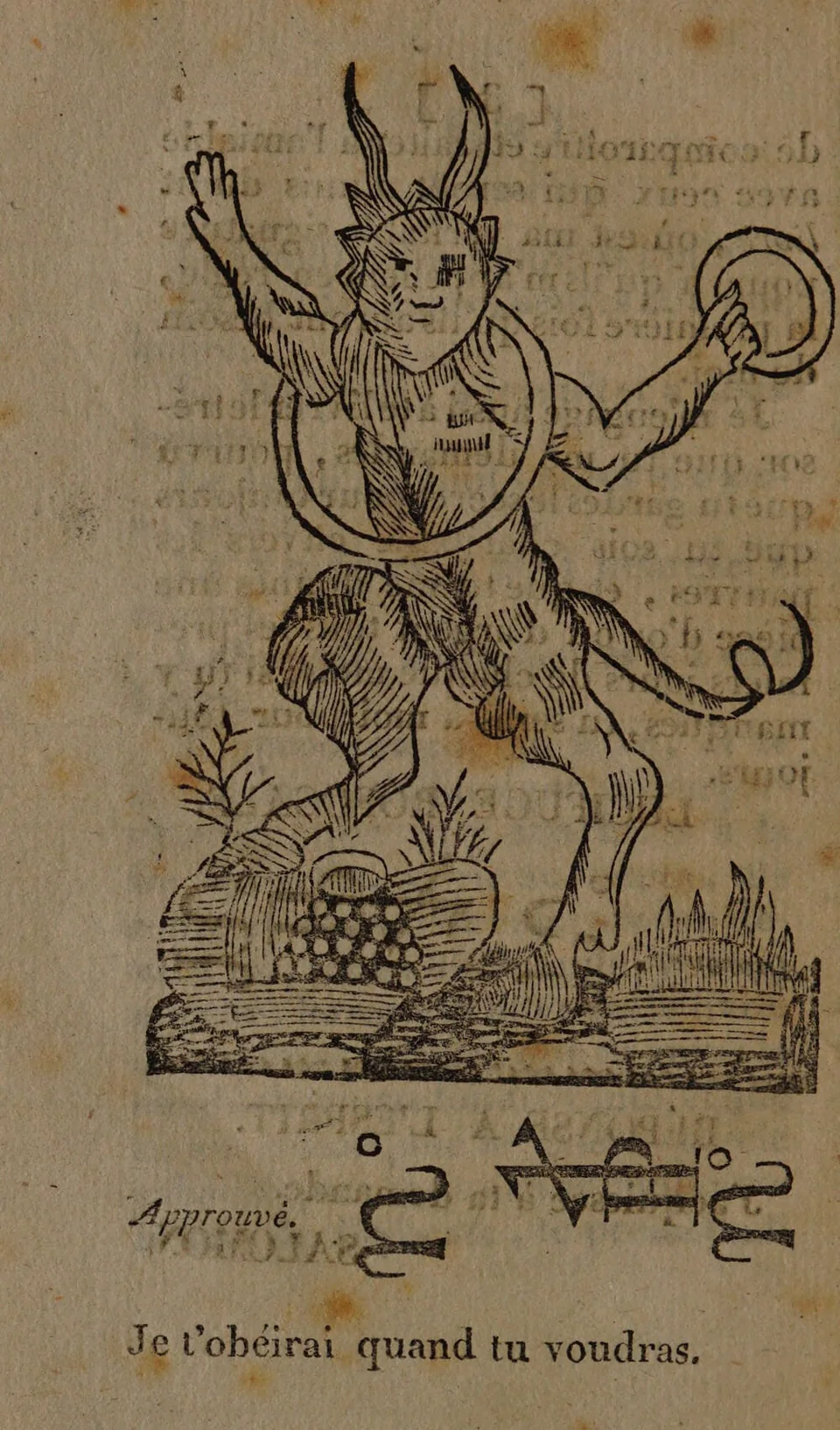
Lucifuge Rofocale is not the supreme ruler in this book. He is a minister inside a printed chain of command, and the hierarchy explains why the text assigns him a particular role.
- Rank in the text
- First minister
- Assigned domain
- Riches and hidden treasure
- Visual witness
- Wellcome scan 38, page 32
| Level | Names | Printed function |
|---|---|---|
| Ruling triad | Lucifer, Beelzebub, Astaroth | Emperor, prince, and grand duke |
| Senior officers | Lucifuge Rofocale, Satanachia, Agaliarept, Fleurety, Sargatanas, Nebiros | Ministers and military-style officers |
| Subordinates | Eighteen named spirits in grouped service | Specialized powers assigned under the officers |
Lucifuge is defined by an office inside the book
In the hierarchy analyzed by Papot-Libéral, Lucifer, Beelzebub, and Astaroth form the ruling triad. Lucifuge appears below them as the “first minister,” followed by figures given titles that sound like a court and an army: a general, lieutenant general, brigadier, and inspector general. The political vocabulary turns the infernal world into an administration. Authority descends through offices, and named subordinates are grouped beneath senior figures. The scheme is literary organization within the grimoire; it is not independent evidence for a historical institution or a universally shared demonology.
The text assigns Lucifuge control over riches and treasures, which makes him the central negotiator in the book’s pact narrative. Other officers receive different stated capacities: discovering secrets, completing work, opening locks, travel, invisibility, divination, or knowledge of natural materials. These are promises made by the printed work. Reading them as a catalogue of imagined offices reveals how the book routes each desire to a specialist. It does not establish that the promised capacities existed or that every edition describes them in exactly the same way.
The hierarchy is orderly on the page and inconsistent in detail
The hierarchy usually begins with three rulers and then names Lucifuge Rofocale, Satanachia, Fleurety, and Nebiros among the principal officers. Agaliarept and Sargatanas are introduced later, which makes the count uneven. Beneath them appear eighteen subordinate names: Baël, Agares, Marbas, Pruslas, Aamon, Barbatos, Buer, Gusoyn, Botis, Bathim, Pursan, Abigar, Loray, Valefar, Forau, Ayperos, Nuberus, and Glasyabolas. Spelling changes between printings, and several names also occur in other demonological lists.
Those overlaps can mislead. A shared name does not make the Grand Grimoire the same book as the Ars Goetia or the Grimorium Verum. Lists travelled between texts, printers regularized or damaged spellings, and later editors assembled material under marketable titles. The Grand Grimoire’s distinctive move is to place its offices inside a story of constrained bargaining, hidden treasure, and a written agreement. The hierarchy supplies the plot with an escalation path: higher rulers authorize or compel a minister, and the minister is made to answer the human speaker.
What the Wellcome figure contributes
Wellcome scan 38, numbered page 32 in the volume, places a horned figure above a small sign and a one-line statement of obedience. The woodcut is printed on the same aged page as the surrounding text visible through the paper. It is an illustration within a cheap book, not a portrait made from observation. Its gesture, horns, tail, ground line, and compact emblem give visual form to the submission that the narrative wants the reader to imagine.
The surrounding religious language complicates the modern shorthand “devil worship.” The operator in this literary script does not simply adore Lucifuge. Sacred names and Christian authority are invoked as instruments of constraint, while superior infernal rulers are called upon within the book’s own command structure. Historians of grimoires point to this unstable mixture of prayer, coercion, inherited names, and commercial print. The page is useful because it keeps image, claim, and material witness together; a detached redrawing would hide the edition that gave the figure its particular wording and place.
Worked comparison: Lucifuge across the Sanctum Regum seam
The Wellcome witness marks a decisive break. Page 41 closes the first book with thanksgiving and “Vale”; page 42 is blank; page 43 begins a new “Second Livre,” Sanctum Regum, on pact making. Lucifuge’s appearance, demands, agreement, treasure episode, dismissal, and religious closure are already complete. The second book restarts at a more abstract level.
Before the seam, hierarchy is experienced as dramatic escalation. Three appeals address Lucifer, superior names are invoked as pressure, and Lucifuge enters as the respondent to a particular demand. After the seam, the text lays out the ruling triad, six senior offices, and eighteen grouped subordinates, then supplies a model pact dialogue. Lucifuge is now legible twice: first as a character who resists and bargains, then as the first minister whose treasure office makes him the repeatable respondent in the second book’s template.
That change clarifies the purpose of the hierarchy. It is not an ornamental list inserted beside the pact. The list explains how a demand is routed and why the model dialogue calls higher rulers before it addresses Lucifuge. The first book gives the reader a story whose suspense depends on failed commands and revised terms; the second extracts the story’s command chain and contractual turns as a system. The seam converts narrative precedent into purported method.
| Feature | First book, through numbered page 41 | Second book, from numbered page 43 | What the seam changes |
|---|---|---|---|
| Book boundary | Narrative closes with dismissal, thanksgiving, and “Vale” | A fresh “Second Livre” title announces Sanctum Regum and the “true manner” of pacts | A completed episode becomes the source material for a new general method. |
| Authority | Three escalating appeals address Lucifer before Lucifuge answers | Ruling triad, six senior offices, and eighteen subordinates are classified before the model pact | The command chain is converted from narrative pressure into an explicit hierarchy. |
| Lucifuge’s role | Appearing respondent who bargains over a particular treasure demand | First minister for riches who speaks in a reusable model dialogue | The character in one encounter becomes an office that can be inserted into a template. |
| Price and enforcement | Demand, refusal, counteroffer, written agreement, and dismissal unfold as plot | The twenty-year condition and coercive answer recur inside the pact model | Repetition exposes the contract logic as the book’s organizing device. |
The repeated twenty-year condition exposes the book’s contract logic
The second-book dialogue returns to the same decisive price: Lucifuge will grant the demand only in exchange for a claim on body and soul after twenty years. Repetition of the twenty-year condition across the seam makes the term structural rather than incidental. Riches are never presented as a free consequence of naming the correct spirit. The book stages value through deferred payment, breach, coercion, and counterterms, borrowing the language of contracts to organize a supernatural fiction.
Lucifuge’s office and the pact sequence therefore interpret one another. “First minister” explains why he negotiates beneath the ruling triad; the repeated bargain shows what ministerial power means inside this book. The hierarchy assigns jurisdiction, while the dialogue turns jurisdiction into exchange. Later summaries that isolate the horned image or the treasure label lose the editorial design visible across pages 41–43 and in the renewed dialogue around numbered page 61.
Catalogue records and research
- Wellcome Collection, Le véritable dragon rouge (work qss4ugsf) ↗
- Wellcome Collection IIIF manifest, b33030169 ↗
- Bibliothèque nationale de France, Le grand grimoire catalogue record ↗
- Mélanie Papot-Libéral, Le Dragon Rouge: éditions et réception (2017) ↗
- Owen Davies, Grimoires: A History of Magic Books (Oxford University Press) ↗