
Scot prints “seventie and nine” before the inventory, yet Nicholson counts 68 entries in the list. The mismatch belongs to the printed evidence; no normalized total resolves it.
- Scot’s introductory claim
- “seventie and nine”
- Nicholson’s list count
- 68 entries
- Weyer / later Goetia
- 69 / 72 entries
The number before the inventory
In Book XV, chapter 1 of The Discoverie of Witchcraft, Scot introduces people who profess to command spirits and says that they have “seventie and nine” principal devils at their disposal. Chapter 2 then begins the named inventory with Baell, Agares, and Marbas. The nearby heading promises names, shapes, powers, government, and effects. This is the immediate setting of the number: a hostile account of conjurors’ claims, before the reader has arrived at the catalogue itself.
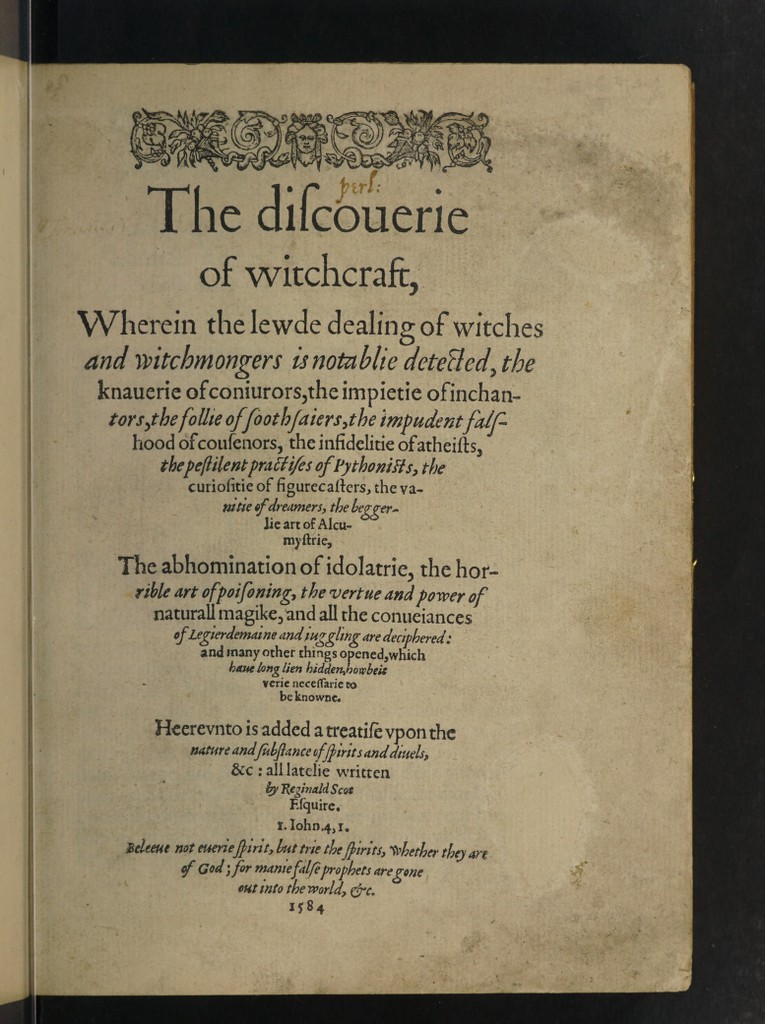
The online Project Gutenberg text used here is Brinsley Nicholson’s annotated 1886 reprint of the 1584 first edition, not a page image of the first edition. The 1584 Wellcome copy supplies a separately identified image of the original title page. Treating those two digital objects as the same kind of witness would hide Nicholson’s nineteenth-century editorial voice inside Scot’s sixteenth-century prose.
What Nicholson counted
Nicholson’s note attached to the phrase “seventie and nine” says the inventory has 68 entries and identifies an entry accidentally omitted relative to Weyer. He also considers other named figures outside the inventory and offers a possible source for the unexplained 79. That suggestion is his hypothesis, not an explanation established by the 1584 page itself. Our count panel therefore names its author: “Nicholson’s count,” rather than presenting 68 as a number that Scot printed above his list.
Weyer’s 1577 Pseudomonarchia has 69 entries, including Pruflas in fourth place. Scot moves directly from Marbas to Amon; the Pruflas entry does not appear. The later Ars Goetia has 72 numbered entries. Its familiar 72 should not be used to silently repair Scot’s 79, since the Goetia is a later catalogue and has its own additions and order. The numbers 79, 68, 69, and 72 answer different questions about different textual objects.
The T. R. note after the list
Scot’s printed text places another clue immediately after Stolas, the final entry in its inventory. It says that this was the work of one “T. R.”, written on parchment in red and black letters in 1570. The initials and the claim about a 1570 object need careful interpretation. They do not by themselves identify a surviving manuscript that can be collated against Scot, or prove a simple one-step path from Weyer’s 1577 printing to Scot’s 1584 book.
Nicholson argued from this note and translation differences that Scot may have used an intermediary. His argument is worth reading in the notes to the reprint, but it remains an editorial reconstruction. Our concordance therefore records visible presence, absence, and sequence in named printed witnesses. It does not pretend to reconstruct the lost exemplar, decide who T. R. was, or assign an exact point in the chain at which Pruflas disappeared.
Four numbers from different books
Scot writes “seventie and nine” before the list. Nicholson counts 68 entries in his annotated reprint. Weyer’s 1577 appendix has 69, including Pruflas, while the later Goetia catalogue numbers 72. These are four features of different textual objects, not four competing counts of one unchanged inventory.
The spirit profiles in this collection follow the Goetia order. Their numbers identify positions in that catalogue, not universal identities. The table below shows examples of names that change position or appear in one printed list but not another. Spelling, numbering, and surviving manuscript variants prevent a simple one-to-one alignment of all entries.
Printed texts and images
- Scot, The Discoverie of Witchcraft (1584), 1886 annotated reprint, Book XV, chapters 1–2 ↗
- Wellcome Collection, 1584 Scot copy and Public Domain Mark ↗
- Weyer, De praestigiis daemonum, fifth edition (1577), digitized volume ↗
- Indiana University, catalogue record for the 1577 fifth edition ↗
- Mathers/Crowley, The Book of the Goetia of Solomon the King (1904), numbered catalogue ↗
- Joseph H. Peterson, modern Weyer/Scot/Goetia comparison (copyrighted edition; link only) ↗