
Sigil of Cimejes
At a glance
- Entry
- 66 of 72
- Rank
- Marquis
- Legions
- 20 in the text
- Also written
- Cimeies, Kimaris
Description in the text
Cimejes is said to teach grammar, logic, and rhetoric and to locate things lost or hidden, including treasure. The text also says he rules spirits in parts of Africa.
Read entry 66 on page 43 of the 1916 edition
Appearance
A valiant warrior riding a black horse.
Topics attributed to this entry
- Grammar and rhetoric
- Lost things
- Treasure
Reading this entry
Cimejes, also Cimeies or Kimaris, appears as an armed warrior riding a black horse. The passage says he rules spirits in parts of Africa, a geographical claim made by the grimoire rather than a historical description of the continent. His attributed offices are teaching grammar, logic, and rhetoric and recovering lost or hidden things, including treasure. The named verbal disciplines make this a focused educational entry despite the martial image.
The marquis has 20 legions and a seal. No animal hybrid, human transformation, or special voice is supplied. The printed alternatives in name are useful when comparing catalogues, while the number keeps the identity fixed in this edition. The reference to Africa is a claim inside the historical text rather than a factual map of spiritual territory.
Read entry 66 on page 43 of the 1916 edition or compare the 1904 transcription.
A closer reading of entry 66
What the numbered text says
Cimejes is named with two alternate spellings and appears as a warrior on a black horse. The entry joins the three classical language arts; grammar, logic, and rhetoric; to finding lost or hidden things and treasure. It also gives a geographic claim of rule over spirits in parts of Africa, without naming those parts or explaining the boundary. That imprecision should remain visible in a reference page. Nothing in the passage supports assigning Cimejes a particular African nation, language, or historical kingdom.
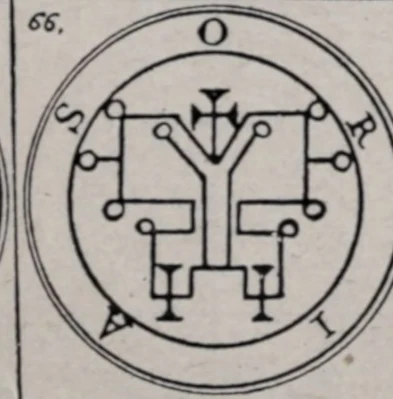
About the printed seal
Seal 66 is on the fourth frontispiece. The numbered crop identifies the edition’s sign, not the geographic reach claimed in the prose. There is no map or legend in the seal image to make “parts of Africa” more specific than the passage does.
Compare another entry
Compare entry 70: Seere. Seere also reports on hidden treasure, but its narrative centers very rapid movement and carrying objects across distance. Cimejes teaches language arts and makes a broad regional claim. Treasure is one shared task, not the defining feature of both portraits.