
Bune, also headed Bimé in the 1916 printing, is the twenty-sixth spirit of the Ars Goetia. His entry describes a three-headed dragon and lists offices involving the dead, riches, eloquence, and answers. It then does something unusually helpful for a reader of sigils: it acknowledges more than one seal.
- Textual evidence
- Entry 26 says there is another seal and prefers the later of two.
- Image on this site
- One numbered crop from the 1916 printed plate, figure 26.
- Secure conclusion
- The text recognizes alternatives; this crop documents one printed form.
The two-seal sentence belongs to the text
The 1904 Mathers/Crowley transcription and the 1916 de Laurence entry both place the alternative after Bune’s thirty legions. The passage first points to a seal, then says Bune has another, calling the first of the two an alternative while preferring the last. That establishes a textual variant claim inside these printed witnesses. It does not supply a catalogue of every manuscript form.
This distinction matters when a single result in image search is labeled “Bune’s true sigil.” A name and ordinal locate the entry, but they cannot turn one drawing into the only recorded version. Nor does the text tell a modern reader which anonymous SVG or redrawn tattoo design follows its first or last form. Identifying one requires a particular historical image, its position on a page, and a traceable reproduction.
The 1916 plate prints one numbered image
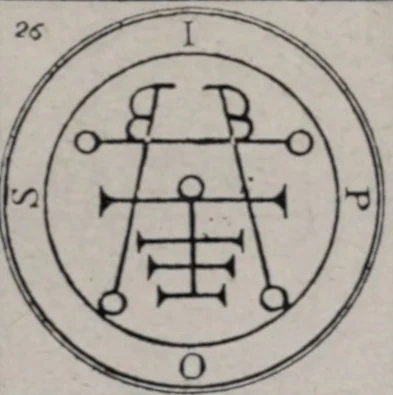
The image above preserves the printed number and enclosing ring. The seventy-two-seal gallery presents the same crop alongside the other numbered figures. The local identifies its source plate, crop coordinates, and file hash. These checks show what was reproduced; they do not establish that the plate image is the preferred “last” seal of Bune’s prose. The plate is not labeled “first” or “last” there, so that assignment remains open.
The printed frontispiece groups figures by plate layout, not by a single continuous numerical row. Bune’s number 26 sits on plate 4 with several other disjoint runs of numbers. A crop detached from that plate can conceal this context. The link above lets readers inspect the whole sheet and compare the typography, numbering, and neighboring figures before reusing the image.
A later manuscript is a separate witness
Wellcome Collection MS.3203 is a nineteenth-century manuscript copied by Henry Dawson Lea, catalogued as a volume containing five treatises. Its fourth treatise is described as two books called Goetia and Theurgia-Goetia, with names, offices, circles, and seals. This catalogue record proves that a later handwritten seal witness survives and can be inspected; it does not identify the Bune seal in the digitized leaves, adjudicate the 1904 editor’s preference, or make the manuscript an ancestor of the 1916 plate.
That is the limit of a catalogue-level comparison. A real variant collation would locate Bune’s entry in the manuscript, record the leaf, inspect both drawings at adequate resolution, and compare them against the 1904 and 1916 printed pages. Until that work is done, it is accurate to link the manuscript as a potential comparison source, and inaccurate to claim its Bune design matches either printed alternative.
Bune names across printings
The entry appears under related forms including Bune, Buné, Bimé, and Bim in these printed witnesses. Spelling changes do not by themselves establish a different spirit or a second sigil. The 1904 and 1916 texts recognize an alternative seal, while the displayed 1916 frontispiece documents one numbered image without identifying it as the first or last form.
The Bune profile describes the entry and its attributed offices. The edition comparison follows the difference between the numbered text and the printed images.
Printed witnesses and image credit
- Mathers/Crowley, The Book of the Goetia of Solomon the King (1904), entry 26 — source for the textual alternative.
- de Laurence, The Lesser Key of Solomon (1916), entry 26 — parallel printed wording.
- 1916 frontispiece 4, complete numbered plate — source of the displayed seal crop.
- Project Gutenberg ebook 72679 — bibliographic record and public-domain status in the United States.
- Wellcome Collection MS.3203 — catalogue of a later manuscript with Goetia and Theurgia-Goetia.
Historical source reference. The grimoire’s attributed effects are reported as textual claims, not verified events. The local image is a mechanical crop of the Gutenberg edition, which Gutenberg marks public domain in the United States.