
Sigil of Belial
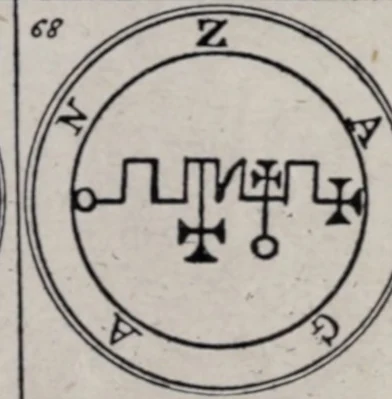
At a glance
- Entry
- 68 of 72
- Rank
- King
- Legions
- 50 in the text
Description in the text
Belial is said to distribute offices and appointments and gain favor from friends and enemies. The entry presents him as powerful but unreliable in his answers unless compelled, and describes offerings as part of its ritual setting.
Read entry 68 on page 44 of the 1916 edition
Appearance
Two beautiful angels sitting in a chariot of fire.
Topics attributed to this entry
- Appointments
- Favor
- Kingship
Reading this entry
Belial is a king who appears as two beautiful angels in a chariot of fire. The passage says he was created soon after Lucifer and gives him a self-reported story of a fall from a higher order. His offices are granting appointments and senatorial positions, winning favor from friends and foes, and providing familiars. The elaborate origin and civic offices place him among the catalogue’s most socially elevated figures.
The text also portrays Belial as unreliable: it demands gifts in its ritual scenario, then warns that truthful answers are short-lived without further constraint. A modern summary should not treat the pleasing voice and angelic image as a guarantee of honesty. Belial governs 50 legions and has a seal. The entry’s beauty, political power, and explicit warning about truthfulness are all essential to its internal tension.
Read entry 68 on page 44 of the 1916 edition or compare the 1904 transcription.
A closer reading of entry 68
What the numbered text says
Belial’s image is two beautiful angels in a fiery chariot, although the name denotes one numbered spirit. The passage gives a speech about precedence among fallen beings, then turns to appointments, favor, and familiars. It is unusually explicit that its answers are unreliable and tied to offerings and coercion in the ritual story. Those details should be presented as textual conditions, not recommendations for practice. The closing brass-vessel legend separately names Belial among four chiefs and says he alone remained in an image after the spirits escaped.
About the printed seal
Belial’s numbered seal 68 is on frontispiece 4. The two-angel image is a verbal appearance, not two separate plate signs. The later vessel story is another textual layer; neither it nor the seal proves the chronology Belial claims about himself.
Compare another entry
Compare entry 55: Orobas. Orobas is described as faithful and protective in his answers. Belial’s entry stresses the instability of truthful answers despite royal status. The source assigns opposite assessments to these figures, a point lost if both are grouped as powerful diviners.