
Three different manuscripts are routinely collapsed into one online “Icelandic grimoire.” Their contents, page sequences, and stave operations show three different ways of organizing magical writing.
- Stockholm Galdrabók
- ATA Ämb 2, F 16:26; parchment; multiple hands
- Galdrakver
- Lbs 143 8vo; skin; one hand; 1670
- Huld
- ÍB 383 4to; paper; Geir Vigfússon; 1860
Galdrabók can be a label or this Stockholm codex
In ordinary Icelandic, galdrabók means a book of magic. Scholars and publishers also use Galdrabók as a short title for the specific Stockholm manuscript ATA Ämb 2, F 16:26. Context decides which meaning is intended. The Stockholm codex is a different physical object from the manuscripts now held in Reykjavík: its parchment support, layered handwriting, Copenhagen acquisition note, and present repository define this particular book.
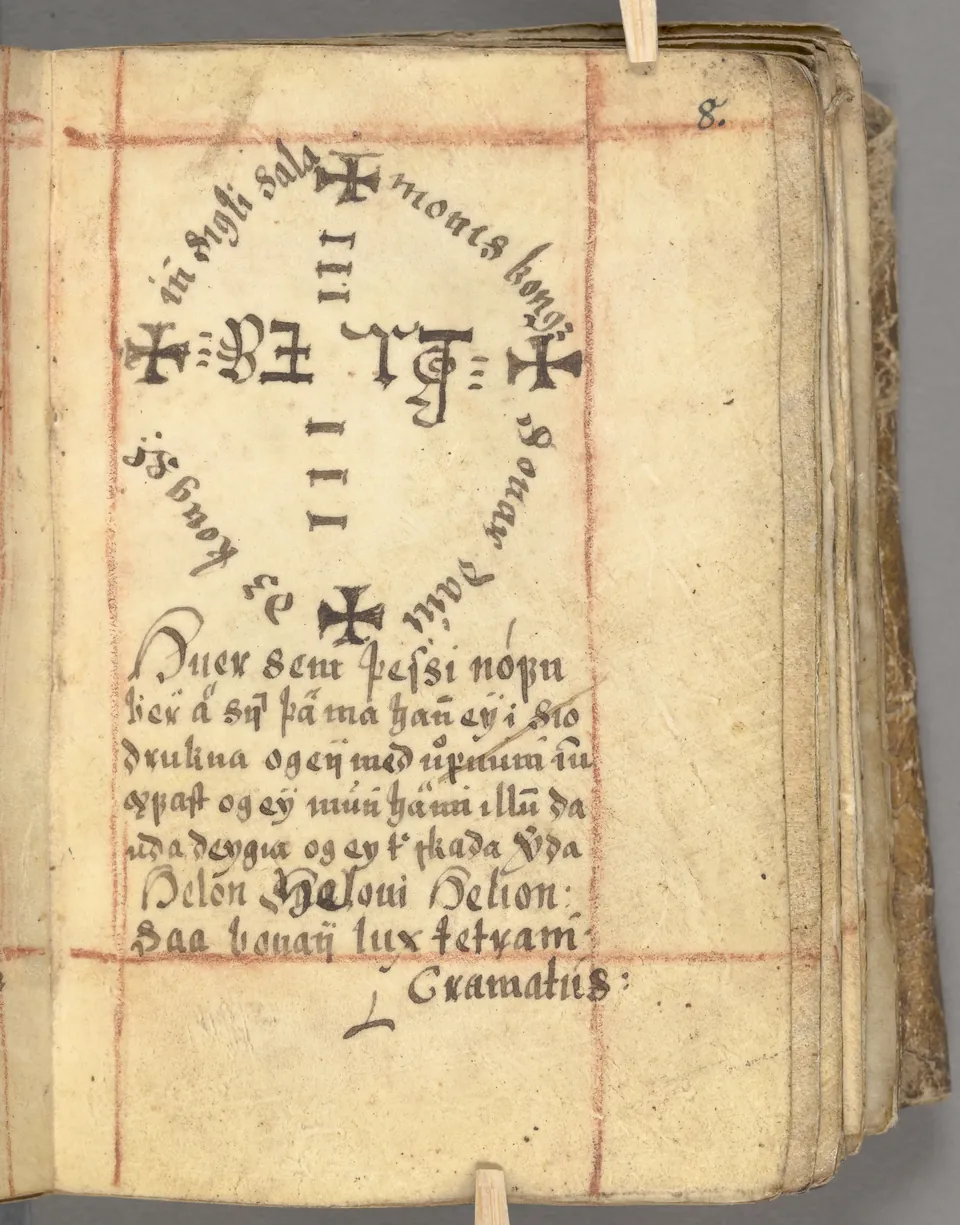
The Stockholm book has thirty-two parchment leaves and four writing layers extending from the late sixteenth into the seventeenth century. Its forty-seven entries include long protective prayers, prose recipes, calendrical material, names, circles, and branching signs. That variety is its internal structure: additions accumulate rather than advance through a single doctrine. One entry can make repeated sacred names and prayer carry the operation, while another gives most of the work to a drawn figure embedded in a short direction. The four hands preserve several ritual grammars inside one cover.
The circular figure in Alvin scan 17 belongs to this object. Similar-looking signs recur elsewhere, but their strokes, words, scale, and surrounding text can change. The photograph preserves red ruling, handwriting, and adjacent prose that disappear from a modern redrawing. The page therefore argues through arrangement as well as shape: words form the boundary of the circle, short rows occupy its interior, and prose resumes below. A crop of the center would remove the sequence that makes the figure part of an entry.
Lbs 143 8vo is the 1670 Galdrakver
Handrit.is describes Lbs 143 8vo as a skin codex from Iceland, dated 1670, containing twenty-seven leaves between added flyleaves. It records one hand and says the language is Icelandic with some Latin. This is the manuscript often called Galdrakver, meaning a small magic book. Its clean, spacious pages and well-known form of Ægishjálmur have helped its images circulate far beyond the catalogue record. Both are skin books, but their leaf counts, scribal layers, and current repositories differ.
The contents also have a different shape. Pagani notes that the book begins with an epistle attributed to God and conveyed by an angel to Pope Leo III, followed by signs called the rings of Charlemagne. The Ægishjálmur appears on folio 11r, an IHS form on 12r, the Seal of the Holy Spirit on 13v, and a Seal of Solomon on 14r. The sequence places the staves inside Christian, Carolingian, and Solomonic claims to inherited authority. A short stave entry may compress an operation, but the neighboring leaves still supply a larger learned frame.
Lbs 143 and the Stockholm Galdrabók therefore overlap in genre and motifs without being duplicate copies. One is a single-hand booklet whose early leaves group named signs within an authority-bearing sequence; the other is a layered anthology in which several hands alternate prayers, recipes, and figures. Their shared labels are evidence of transmission. Their different order and page design show that each compiler made the received material serve a new collection.
Worked figure comparison: Ægishjálmur in Stockholm and Lbs 143
Pagani’s figure 6 places two Ægishjálmur forms from the Stockholm Galdrabók beside the form on folio 11r of Lbs 143 and groups them by the same stated aim of frightening enemies. All three are radial, but the agreement stops at that broad grammar. The Stockholm arms end in forked forms that differ even from one another. The Lbs 143 figure adds a central circle, crosses every arm with three short strokes, and gives its terminal forks another profile. The name and purpose remain recognizable while the drawing is remade.
The brief note beside the Lbs 143 figure also shows how its ritual logic works. It joins a named material, inscription, bodily placement, and the anticipated encounter: the stave is associated with lead, the forehead, and the moment before meeting an enemy. The figure is therefore one part of a compact conditional sequence. Its radial shape does not operate as a map whose arms are decoded separately; the manuscript connects the complete sign to material, body, timing, and a claimed effect.
The Stockholm witnesses cannot simply inherit that exact sequence because their surrounding entries and drawings differ. Treating the Lbs 143 wording as the universal instructions for every Ægishjálmur would erase precisely what the figure comparison establishes. The bounded result is smaller and more useful: early modern Icelandic scribes could preserve a functional label and radial family while changing central geometry, terminal strokes, and the amount of verbal apparatus around the sign.
Huld is a paper manuscript made in 1860
The Huld manuscript is ÍB 383 4to in the National and University Library of Iceland. Its catalogue record identifies one scribe, Geir Vigfússon, twenty-seven paper leaves, and the date 1860. The Museum of Icelandic Sorcery and Witchcraft describes its large collection of alphabets and a later section of thirty magical staves. It is separated from the Stockholm book by material, repository, handwriting, and roughly two centuries.
The division between those parts gives Huld an explicit collecting logic. Tables of runic, cipher, and invented alphabets occupy the first portion; the later portion numbers thirty staves and pairs them with titles and short explanations. That movement from character repertory to applied signs differs from both the Stockholm book’s layered accumulation and Lbs 143’s opening chain of legendary and sacred authorities. Huld looks back on a tradition and orders it as an antiquarian collection in a single careful hand.
Vegvísir on folio 26v supplies a concrete limit. Its note associates carrying the sign with avoiding loss of direction during storms or bad weather on an unfamiliar way. It does not describe a needle, north point, shipboard instrument, or method for reading individual arms. That logic differs from the Lbs 143 Ægishjálmur: one entry links a complete figure to travel under bad conditions, while the other joins a complete figure to material, bodily placement, and an anticipated human encounter. Calling either one a timeless “Viking compass” replaces two manuscript operations with a modern visual category.
The three witnesses now answer different questions. Stockholm shows how several writers accumulated verbal and graphic operations; Lbs 143 shows a single scribe placing a stave within a learned sequence and a compact material action; Huld separates alphabets from a numbered stave collection and preserves a late travel charm. Dates and shelfmarks identify the objects, but contents and internal order explain why their signs cannot be exchanged.
Archive records and scholarship
- Alvin, Stockholm Galdrabók catalogue record (ATA Ämb 2, F 16:26) ↗
- Alvin manuscript image, scan 17: circular sign within the text ↗
- Handrit.is manuscript record, Lbs 143 8vo ↗
- Handrit.is manuscript record, ÍB 383 4to (Huld) ↗
- Museum of Icelandic Sorcery and Witchcraft, Icelandic magic manuscripts ↗
- University of Iceland Web of Science, oldest known Icelandic grimoire overview ↗
- Roberto Luigi Pagani, The Mediterranean Origin of the Galdrastafir (Gripla) ↗