
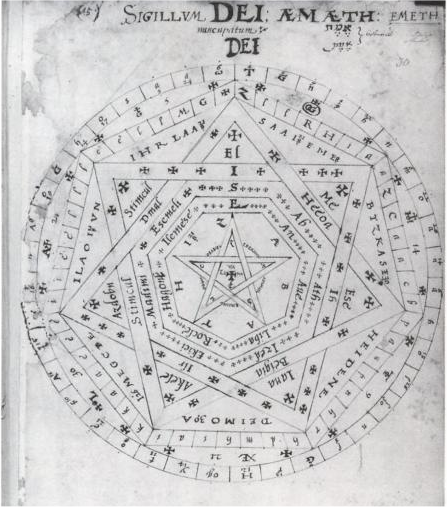
Dee’s Sigillum is dense because it stores several operations on one surface. The outer circumference combines letters with numbers that direct a reading path. Nested seven-sided bands hold names derived during later stages of the record. A pentagram and a compact central cross organize another set of seven names. Reading the diagram as a layered index explains more than treating it as a poster of fixed correspondences, and it makes visible the corrections that a polished modern chart often suppresses.
- Witness
- Sloane MS 3188 drawing
- Visible structure
- Circles, heptagons, pentagram
- Text issue
- Corrections and variants
Read four registers from the border inward
The widest band contains forty compartments, not a continuous motto. Many compartments pair a letter with a small number placed above or below it; a few letters have no number and terminate a reading path. Inside that band, repeated heptagonal lines create seven sides and seven angles for named groups. The pentagram holds five names around its points, while the small cross at the center carries the final name Levanael in divided form. These regions were not all supplied at once. The circumference comes first, the seven names extracted from it follow, and a separate forty-nine-letter square generates names assigned farther inward. Geometry therefore marks different textual jobs: the circle is an addressable sequence, the heptagons distribute sevenfold names, and the pentagram and central cross place another group. The monochrome Sloane image shows this hierarchy without the planetary colors imposed by some later teaching charts.
Worked reading: the y/14–y/15 correction on the outer ring
Start with the transcript’s explanation of one numbered path: a number above a letter directs a count to the right, while a number below directs it to the left. From T with 4 above it, Dee counts four compartments to the right and reaches h/22; twenty-two farther right reaches A/11. The next a has 5 beneath it, so direction reverses and the count proceeds left to o/10, then left again to t/11, and finally to an unnumbered h that stops the sequence. Dee first writes a doubled a and reads “go” where the later correction requires one a to be withheld and “og” to be read in the opposite order; the resulting name is regularized as Thaoth. This worked path shows why the nearby y numeral matters. In the earlier transmission, t/11 is moved to the second place and y with 15 beneath it is put before it, creating og–y/15–t/11. The completed Sloane drawing and the large wax disc instead show y/14. Because a lower numeral tells the reader how many compartments to count left, 14 and 15 encode different next addresses if that square is entered. Transcript-led reconstructions consequently print 15, while artifact-led reproductions retain 14. Calling 15 a “correction” reports the transcript’s state; it does not make the visible 14 disappear from the drawing or wax.
Two derivations feed different zones
The circumference’s seven principal names are generated by the numbered movement rule. The record lists Galas, Gethog, Thaoth, a fourth name written with a compact or divided sequence, Innon, Aaoth, and Galethog after correcting order and a miscount in the last name. The interior uses a second mechanism. A seven-by-seven table yields seven angel names including Zabathiel, Zedekieil, Madimiel, Semeliel, Nogahel, Corabiel, and Levanael. Their letters are then assigned to the innermost heptagon, the five outer points of the pentagram, and the central cross. The repeated number seven links the layers, but it does not make them one derivation. One set is navigated around a forty-cell circumference; the other is read from a forty-nine-cell square and redistributed into geometry. A redrawing that gives the names without these routes preserves vocabulary while losing the diagram’s method.
The drawing records decisions as well as design
Corrections occur at several levels: the scryer omits a reported compartment, Uriel changes number quantities and whether numbers sit above or below letters, Michael corrects reading order, and Dee later draws a perimeter that does not agree with the y/15 line. Those are evidence of production, not blemishes in an otherwise fixed design. The Sloane folio records Dee’s completed graphic state; the British Museum wax records an engraved object state; the John Dee Publication Project plate reconstructs the transcript as an orderly modern diagram. Each answers a different question. The manuscript shows Dee’s page, the wax shows material execution, and the transcript-led reconstruction exposes verbal instructions. Crowley and Golden Dawn spellings add later editorial layers. A disputed letter, numeral, or compound sign can therefore be correct for one state and absent from another.
Sources and witness notes
- British Library, Sloane MS 3188 ↗Catalogue of Dee’s 1581–83 conference record; distinguishes it from his later Sloane MS 3191 compilation and notes Ashmole’s copy.
- Mysteriorum Liber Secundus, John Dee Publication Project ↗Transcript and reconstructed plate used to check the outer-ring sequence, the y/15 instruction, the numbered-letter extraction rule, and the later completed diagram.
- Sloane MS 3188, edited Mysteriorum Libri Quinque contents ↗Modern navigation/transcription identifies March 1582 seal discussions, corrected letters, seven names, and forty-nine-letter tables; editorial text is linked, not republished.
- Wikimedia Commons, Sloane 3188 Sigillum diagram ↗Dee’s historical drawing is marked public domain and free of known restrictions; source image is a 447 × 507 reproduction.
- British Museum, magical disc 1838,1232.90.a ↗Large engraved wax disc, 23.2 cm diameter. Curator compares the inscription with Dee’s diagram and explicitly cautions that manufacture in Dee’s lifetime is uncertain.
- Burns and Moore, “John Dee and Edward Kelley’s Great Table, Part II” ↗Later close reading that isolates the y/15 transcript against the y/14 manuscript drawing and wax inscription. Its 440/441 arithmetic is identified as a modern interpretation, not Dee’s stated explanation.
- Aleister Crowley, Liber Chanokh (Liber LXXXIV) ↗Twentieth-century primary witness to later presentation of the seal and wider Angelical corpus; not a source for Dee’s original wording.