
The “Seven Ensigns of Creation” are seven small lettered signs or tables in John Dee’s angelic papers. They are associated with the sevenfold Heptarchic material and the Holy Table. They are not the four directional Watchtowers, the thirty Aethyrs, or seven separate surviving museum objects. Their earliest dated sequence appears in the early conference book, Sloane MS 3188.
- Earliest record
- Sloane MS 3188 · 28–29 April 1582
- Later handbook
- De Heptarchia Mystica · Sloane MS 3191
- Surviving view
- 1659 printed Holy Table engraving
What does “Ensigns of Creation” name?
The name appears in Dee’s later Heptarchic compilation as an answer to his question about seven small tables “like arms.” In the account, the speaker identifies them as signs of creation. The wording belongs to a reported conversation in a sixteenth-century devotional and ceremonial text; it does not establish that a material object possessed a supernatural property. It tells us what Dee called the group and how he placed it within his own scheme.
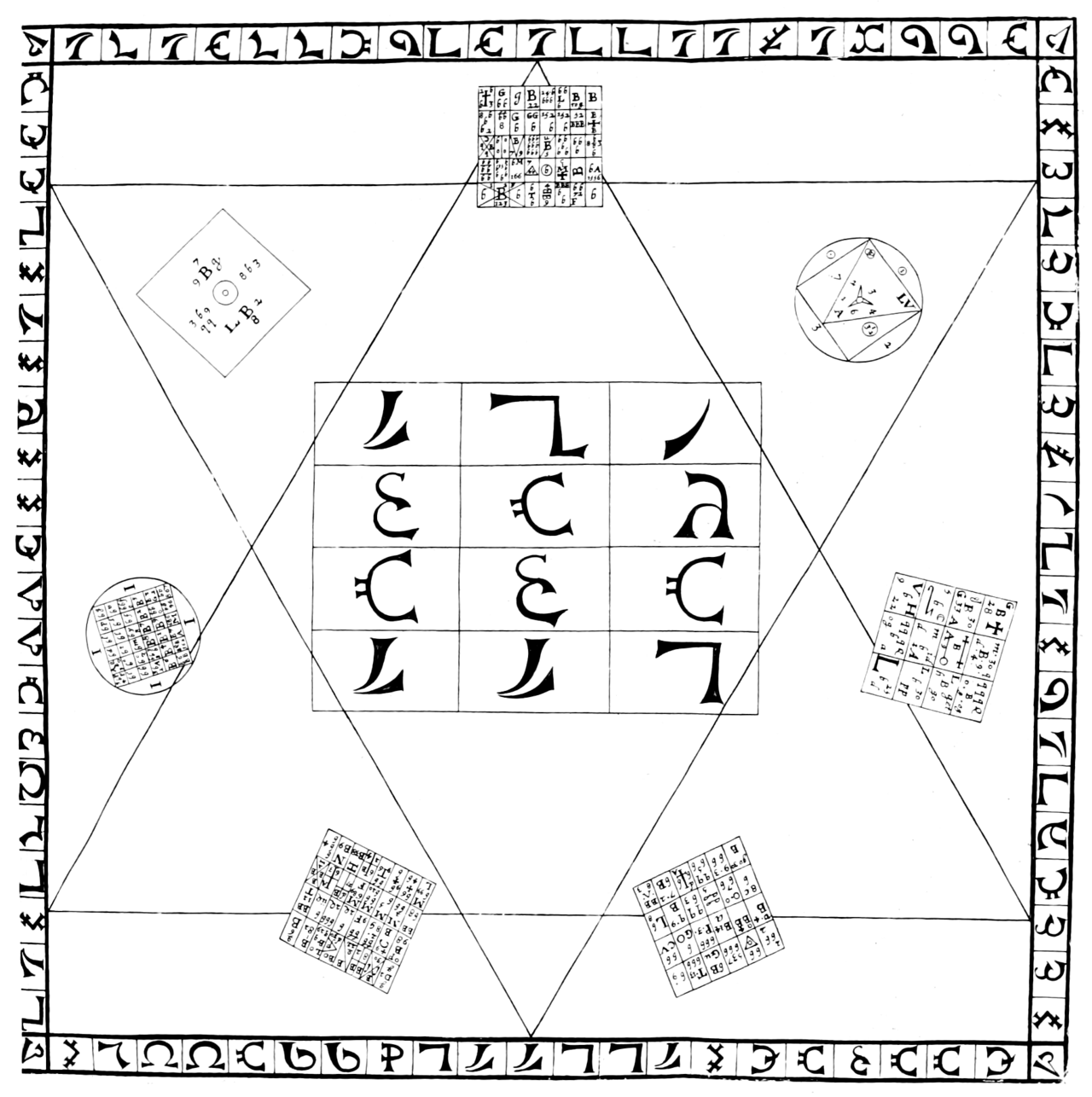
“Ensign” means a distinctive mark or emblem here. It is easy to miss the small group in a modern image of the elaborate Holy Table. A printed plate invites the eye toward the central seal and the surrounding lettered border, while the seven smaller signs have their own earlier documentary sequence. Keeping a count of seven does not make these the seven planets of an astronomical calculator or the seven kings themselves. The text, printed plate, and later reconstruction preserve different kinds of evidence about the sevenfold hierarchy.
The earliest dated sequence
The early conference book’s third part is headed as the book of the seven Ensigns. Its twelfth action, dated 28 April 1582, introduces the first; a later action on the same day gives the remaining six. On 29 April the narrative turns to seven tables of the mystical Heptarchy, angelic offices, and a list extracted from those tables. Those are adjacent records, not an invitation to call every sevenfold table by the same name.
A later Dee handbook gathered material from these sessions into a more organized presentation. The shift from a dated session to a compiled handbook changes what a reader can infer. A copied diagram, an instruction in a compendium, and a later print are all historical witnesses; none should silently replace the notebook. The 1582 record guide traces that difference in detail.
Where do the signs sit on the Holy Table?
A later comparison of Dee’s instructions describes seven small signs placed around the central Sigillum Dei Aemeth. Accounts also mention alternatives: separate tin plates and signs painted on the table. The variation matters because a single engraved image can make one arrangement look inevitable. Dee’s original wooden Holy Table has not survived; Oxford preserves a later marble copy. The placement guide distinguishes the central seal, seven signs, tabletop, and later copy.
The image above is from the 1659 printed Relation. It shows how the arrangement circulated after Dee, but it is not a photograph of Sloane MS 3188 or of the lost wooden table. The manuscript and image history traces the design from dated records into print and later reconstruction.
Why this is not the Great Table
The four-quadrant Great Table and its Watchtower tradition belong to another documentary strand, associated with the later 1584 records and subsequent reworkings. The seven Ensigns are already present in the 1582 early conferences and sit in a sevenfold Heptarchic setting. A shared use of lettered diagrams is not evidence that the two structures have the same date, purpose, or layout.
The Great Table guide covers the lettered quadrants, while the Heptarchic name table covers the weekly kings and princes. A reconstruction that combines all three belongs to a later interpretive system rather than one unaltered Dee manuscript.
Sources and witness limits
- British Library · Sloane MS 3188 ↗The catalogue identifies Dee’s early conference books, 1581–83. It does not authenticate a modern reconstruction of an individual ensign.
- Mysteriorum Libri Quinque · contents and dated actions ↗Joseph H. Peterson’s copyrighted edition identifies Liber III and the actions of 28–29 April 1582. Its edited prose and diagrams are not reproduced.
- British Library · Sloane MS 3191 ↗The later Dee-hand volume includes De Heptarchia Mystica at ff. 32r–51r, distinct from the earlier Sloane MS 3188 conferences.
- Dee · Compendium Heptarchiae Mysticae, edited text ↗A later Dee compendium calls the seven small tables ensigns of creation and distinguishes their role from the central Sigillum. Consult folio markers in the edition.
- Wellcome Collection · A True and Faithful Relation (1659) ↗Public-domain seventeenth-century print, used here as a later visual witness rather than a facsimile of the 1582 notebook.
- History of Science Museum · marble copy of the Holy Table ↗Museum object history for a later copy of the lost wooden table; it cannot verify the exact form of Dee’s original plates.
- Wikimedia Commons · 1659 Holy Table engraving ↗The already-held site image has a Public Domain Mark. Its caption identifies the printed edition, not a manuscript photograph.
Reported angelic speech is treated as a historical claim in Dee’s record, not as a verified account of an external event.