
A modern name or word maps onto the 21 recorded Angelical letter names. The result exposes a letter sequence, not an English-to-Enochian translation.
DIRECT MAPPING · VISIBLE NORMALIZATION
Transliterate a name
The output names each character from Dee’s twenty-one-entry register. It does not translate the word.
View the 21 direct mappings
What the transliterator actually does
The recorded alphabet pairs twenty-one named signs with Roman counterparts. That is enough to make a controlled substitution tool: A maps to Un, B to Pa, C to Veh, and so on through the historical register. It is not enough to translate a modern sentence into the language of the Calls. Translation needs vocabulary, grammar, and a known relationship between source and target clauses; transliteration only replaces one written sign with another representation.
This page outputs the names
The tool reads its twenty-one direct mappings from the same data used by the site’s alphabet register. The register keeps the source order of three groups of seven; the input tool rearranges those mappings temporarily for lookup. Both presentations are useful, but they answer different questions.
Why J, K, V, W, and Y need special treatment
Twenty-one direct counterparts leave five letters of the present English alphabet unmatched. Early modern writing also did not always separate I from J or U from V in the modern way. For practical name lookup, the tool exposes four normalizations: J and Y use the I counterpart Gon, K uses the C counterpart Veh, and V uses the U counterpart Van. Each substituted character is marked in the output so the decision remains visible.
W is different. Treating it automatically as U-U, V-V, or another combination would add a rule that the twenty-one-entry register does not state. The tool therefore flags W as unsupported. A visitor can decide whether to revise the spelling, consult a particular editor’s convention, or leave the unresolved letter visible. This is more useful than returning a smooth result built on a hidden guess.
Punctuation and spaces are retained as separators and do not receive letter names. Digits and other unsupported characters are reported rather than discarded. The purpose is auditability: every part of the input should either have a direct mapping, carry a labeled normalization, or remain visibly unresolved.
Worked names and what can be inferred
Consider “JOHN KELLY.” J becomes Gon through the stated J-to-I normalization; O becomes Med; H becomes Na; N becomes Drux. K becomes Veh through K-to-C, while E, L, L map directly to Graph, Ur, Ur, and final Y becomes Gon through Y-to-I. The sequence is reproducible because each choice is displayed. It still says nothing about how Kelley would have pronounced the result.
“JOHN DEE” uses the same J normalization, then maps D directly to Gal. “WALSINGHAM” begins with an unresolved W, followed by direct or normalized mappings for the remaining letters. The error is informative: a twenty-one-letter register cannot silently answer every modern orthographic question.
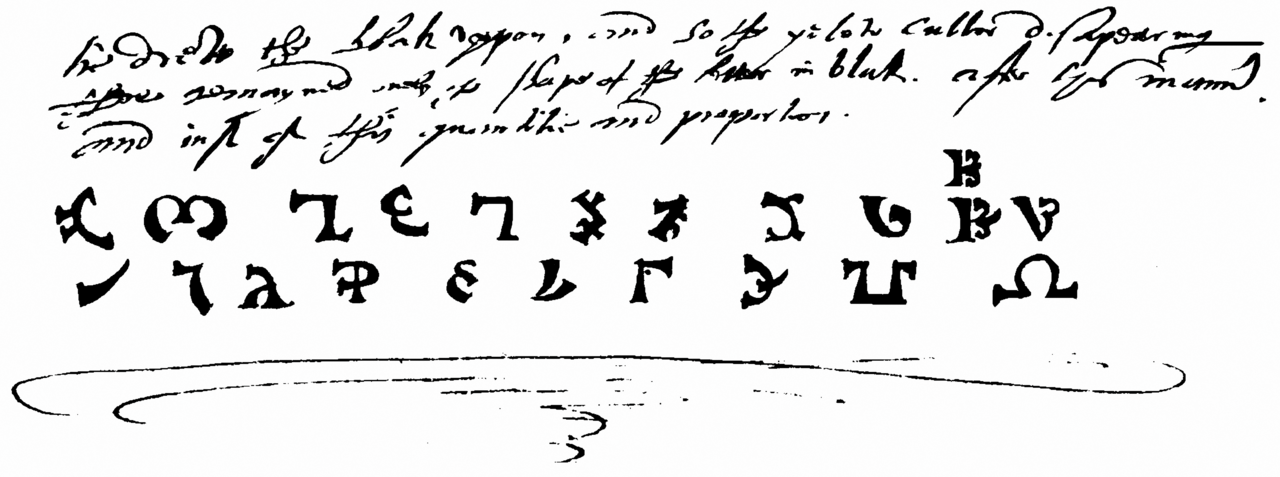
Dee’s 26 March 1583 record supplies the names and order usually used for this mapping. The well-known manuscript detail dated 6 May shows handwritten character forms in a separate moment of the same early conference book. Keeping those moments distinct prevents a common visual shortcut: treating a clean modern font chart as if it were the complete manuscript evidence for spelling, sound, and language structure.
Transliteration, pronunciation, and translation are separate layers
A character name is not automatically a phoneme. The surviving record does not give a comprehensive pronunciation system that tells us how every sign behaves in every Angelical word. Later practitioners developed speaking conventions, and editions sometimes regularize difficult clusters. Those systems can be studied on their own terms, but they should not be backdated into the 1583 alphabet list without explanation.
Likewise, replacing English letters with character names does not produce Angelical grammar. The Calls include recurrent roots and patterned expressions, yet the corpus is small and the parallel English is often much longer than the Angelical line. The grammar guide shows the strongest repeatable patterns and the points where regular rules fail. The phrase concordance keeps translations attached to their actual Calls.
Use the output as a manuscript-aware index into the alphabet. For historical forms, compare it with the image and source-order table below. For words in the Calls, use the concordance rather than spelling modern English through the alphabet.