
The Great Table is often reproduced as four colored elemental squares, but its historical force lies in how a position generates a chain of names and offices. Dee’s records connect four Watchtower fields with a Black Cross; Casaubon’s 1659 engraving preserves a related four-house hierarchy; Crowley’s 1912 Liber Chanokh redraws the material as an elemental syllabus with a separate central Tablet of Union. Those witnesses share a fourfold scheme while making different arguments about how its parts fit together.
- Evidence type
- Diagram history
- Date
- Dee records, 1584–1587; Crowley printing, 1912
- Anchor record
- Sloane MS 3191 · The Equinox I:7
From four guarded houses to a letter hierarchy
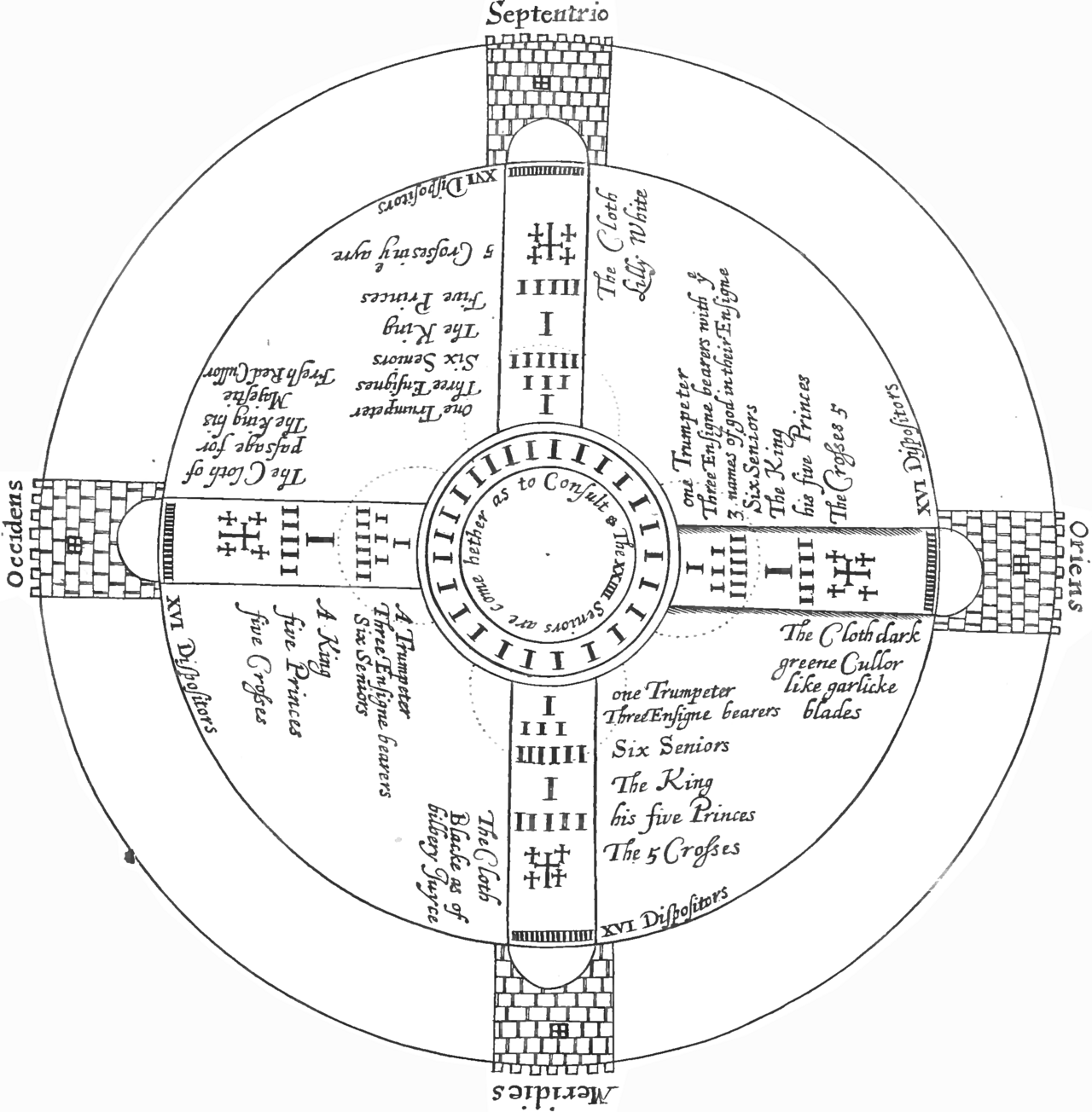
Casaubon’s engraving arranges fortified gates at Septentrio, Occidens, Oriens, and Meridies around a central circle. Within the quarters it names ranks; King, five Princes, six Seniors, ensign bearers, trumpeters, and crosses; so the image reads as an administration of guarded regions rather than as four decorative emblems. The Great Table in Sloane MS 3191 gives that fourfold idea a different material form: four twelve-by-thirteen letter fields are joined by a Black Cross, and names are extracted from fixed lines and groups of cells. Crowley’s 1912 explanation makes the nesting especially explicit. In each elemental field, two central vertical files and the seventh horizontal line form a Great Cross, dividing the field into four subelemental lesser tables; each lesser table contains a ten-square Calvary Cross. The layout therefore encodes rank by scale. Names taken from the whole field govern it, names taken from the Great Cross hold senior authority, and names taken within a lesser angle address a narrower office. Position is the table’s grammar.
Worked reading: Water from divine names to a lesser angle
Crowley demonstrates the method with the Water tablet. Its central horizontal line yields three names of three, four, and five letters; MPH, ARSL, and GAIOL. A turn around the centre yields RAAGIOSL, the Great Elemental King, while the three arms of the central cross yield six seven-letter Seniors: SAIINOV, SOAIZNT, LAOAZRP, LIGDISA, SLGAIOL, and LSRAHPM. The text says these groups govern the whole tablet before attention narrows to a subelement. In the Water-of-Water lesser angle, the vertical of its Calvary Cross reads NELAPR, described as calling forth that angle’s powers; its horizontal reads OMEBB, described as compelling the force. Four cells above the bar then supply rotating forms of TDIM for the next rank. The worked sequence shows why a transcription error is structural: changing one cell can alter a divine name, a senior, and a lower office depending on which path crosses it. It also shows the ritual logic as descent through a hierarchy, from tablet-wide authority to one bounded subangle, rather than as the free selection of an attractive name from a grid.
Witness comparison: Black Cross and Tablet of Union
The manuscript and later synthesis organize the connector differently. In the Sloane MS 3191 Great Table, the Black Cross runs between and joins the four Watchtower fields. Liber Chanokh acknowledges that bordering arrangement in its general plate, then prints the same material separately as the Black Cross or “Table of Union,” attributed to Spirit. Its elemental plates add named Air, Water, Earth, and Fire quarters, while the prose assigns pyramid faces to planets, Tarot decans, Sephiroth, and elemental combinations. Those overlays make the table teach a late nineteenth- and early twentieth-century initiatory curriculum. They are not visible in Casaubon’s four-castle engraving, and the separate Tablet of Union changes the visual argument: an integrated connector becomes a fifth, central spiritual unit. The witnesses should therefore answer different questions. The 1659 engraving shows how four guarded regions and offices were pictured in print; Sloane MS 3191 preserves the tabular manuscript organization; the 1912 plates show how a later occult school made that archive systematic and teachable.