
Meric Casaubon’s A True & Faithful Relation appeared in London in 1659, decades after Dee’s death. The volume does more than reproduce conversations: it surrounds them with a theological preface, Dee’s apology, an editorial table of 138 numbered “Actions,” letters, and engraved diagrams. Those layers repeatedly tell the reader how to judge the material before and while reading Dee’s dated record.
- Evidence type
- Printed edition
- Date
- London, 1659
- Anchor record
- Folger Shakespeare Library · 1659 edition
How Casaubon turns a diary into an argument
Casaubon’s preface states two aims that pull in different directions. He treats the record as evidence that spirits are real, opposing readers who deny apparitions, yet he also presents it as a warning about false inspiration and dangerous credulity. The printed arrangement serves that argument. Dee’s first-person notes and speaker marks remain inside the transcript, but Casaubon places his own preface and a long analytical contents table before them. That table reduces stretches of dialogue to numbered “Actions” and often appends a verdict. The result is neither a neutral facsimile nor a conventional grimoire arranged as a list of operations. It is a polemical edition in which documentary detail proves the reality of the encounters while editorial commentary disputes the authority of the beings encountered. The book asks readers to believe that something happened and to distrust the explanations offered within the conversations.
Worked reading: Action LXX before the conversation
The contents rubric for Action LXX, directing readers to page 171, previews the Table’s furniture, earthly governors, the Book of Enoch, mystical words, and crosses. In the same summary Casaubon interrupts with judgments: he calls one use of the “line of the Holy Spirit” a profanation and qualifies the promised reach of Solomon’s knowledge with open skepticism. The diary record itself proceeds differently. Dee marks his own interventions with a delta, records Kelley’s reported sights and voices, asks practical or theological questions, and notes prayers, doubts, corrections, and delays. Casaubon’s rubric converts that unstable exchange into a compact cautionary verdict before the reader reaches it. Comparing rubric and transcript reveals the edition’s method: the documentary form is preserved closely enough to appear evidentiary, while the navigation around it supplies the editor’s theological interpretation.
Worked object comparison: instruction, engraving, and copy
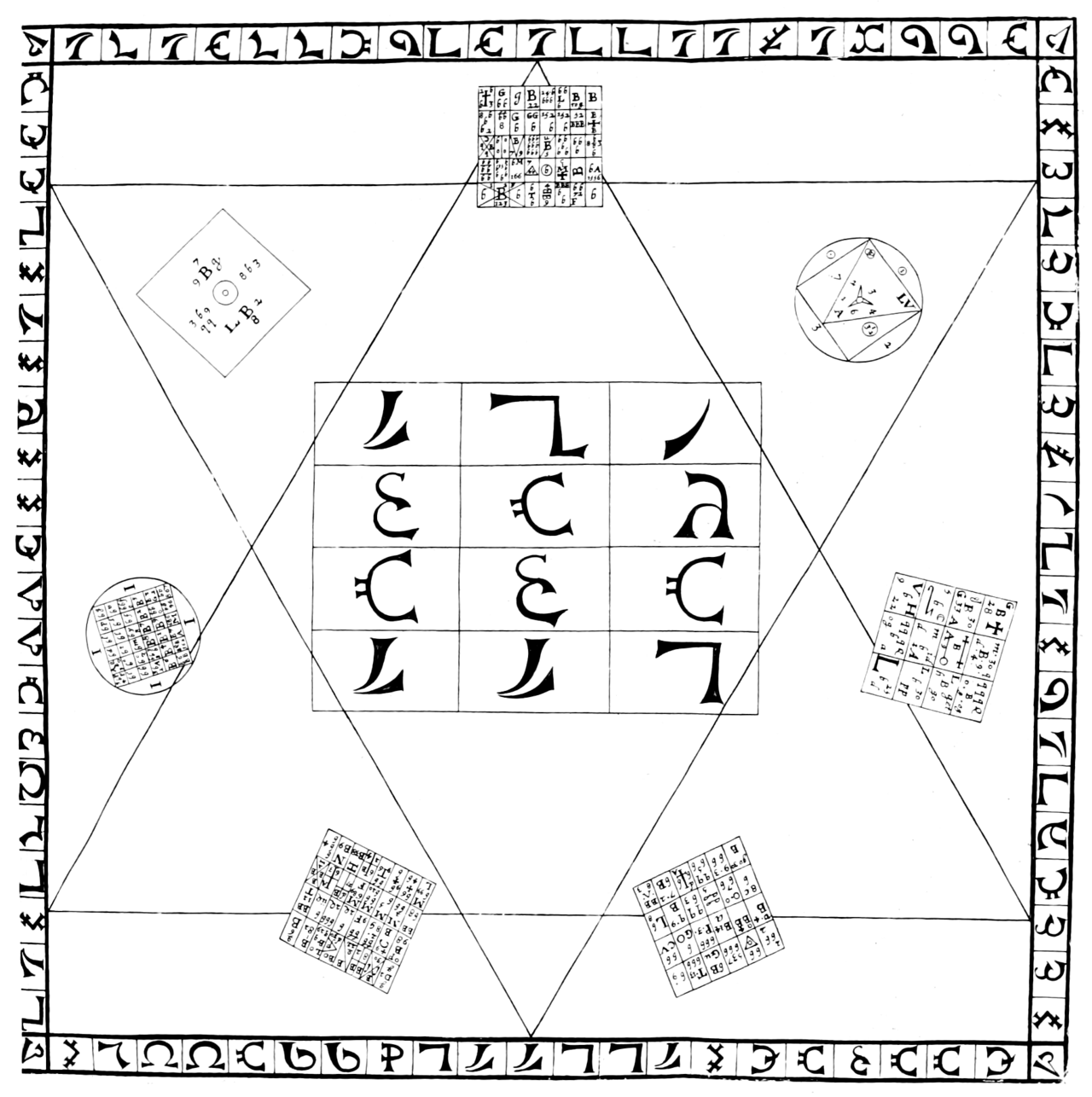
The Holy Table also changes form across the evidence. Dee’s manuscript drawing functions as a sequencing diagram: Roman letters show where characters belong, and the accompanying instructions describe their inward orientation, colored lettering, cloth, seals, and scrying stone. Casaubon’s engraved plate fixes that mobile arrangement as a clean black-and-white object on a printed page. The surviving marble table at Oxford was copied in the mid-seventeenth century from the 1659 engraving, while Dee’s painted wooden original is lost. The chain therefore runs from written directions and a working sketch to a formal print, then from print to a durable display object. The marble copy confirms the engraving’s influence; it is not independent evidence that every proportion, color, or letter on the lost table matched the plate. Text and image preserve different parts of the operation: sequence and furnishing in the record, geometry in the engraving.
Sources and records
- Folger Shakespeare Library: 1659 edition catalogue ↗
- Cornell Digital Witchcraft Collection: digitized edition ↗
- Wikisource: 1659 preface, Table of Actions, and transcript ↗
- History of Science Museum: marble Holy Table copy ↗
- Esoteric Archives: Dee drawing and Casaubon Holy Table compared ↗
- Wikimedia Commons: Holy Table engraving and public-domain record ↗