
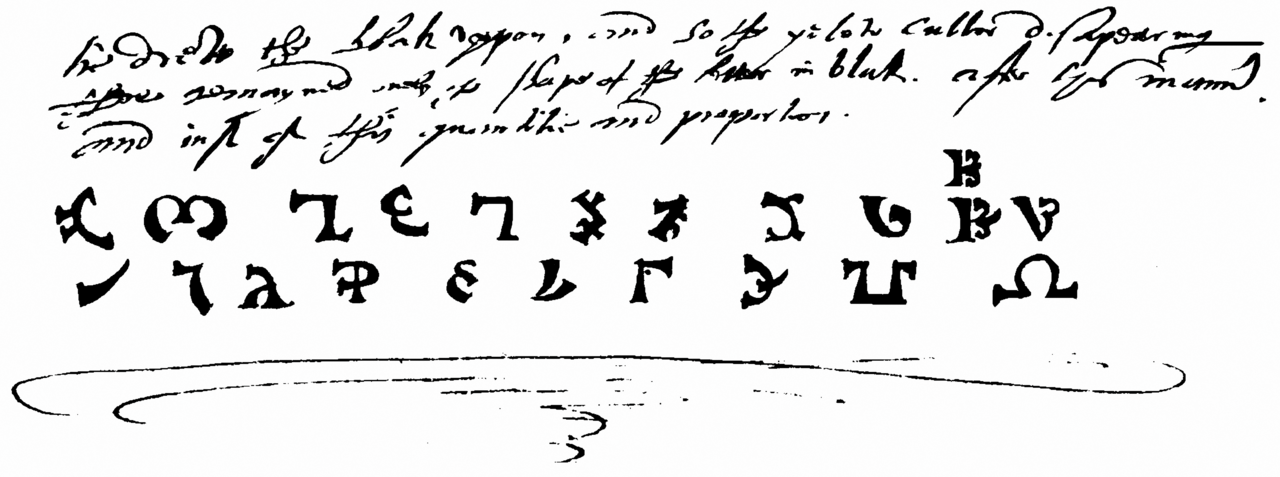
The characters commonly presented as the “Enochian alphabet” enter Dee’s diary as part of a changing procedure, not as a detached font chart. Sloane MS 3188 records an alphabet with twenty-one named signs, instructions for placing those signs around ceremonial furniture, and finally the forms copied on 6 May 1583. Reading those entries together shows what the script was expected to do inside the record; and what the familiar image of folio 104 cannot establish by itself.
- Evidence type
- Manuscript detail
- Date
- 6 May 1583
- Anchor record
- British Library · Sloane MS 3188, f. 104
How twenty-one signs become a working alphabet
The diary material gives each sign three linked identities: a drawn form, a spoken letter-name, and a Roman value. The sequence begins Pa–B, Veh–C, Ged–G, Gal–D, and Or–F; it continues through names such as Un–A, Graph–E, and Mals–P before ending with Van–U, Fam–S, and Gisg–T. That three-part structure matters. A chart that pairs only a glyph with a modern letter drops the named unit by which the entries discuss and transmit the signs. Twenty-one signs also warn against assuming a simple modern twenty-six-letter substitution alphabet. Within Dee’s record, the script participates in a larger account of an “Adamical” or holy language, but the sign list is not itself a grammar, dictionary, or translation of the letter tables. It identifies components and gives them handles; meaning still depends on the words, grids, directions, and editorial choices in which those components appear.
Worked comparison: mapping, placement, and finished form
Three diary moments give the alphabet three different jobs. The 26 March material associates shapes with names and Roman equivalents, answering “which sign is this?” On 28 April, the discussion turns to placement: twenty-one characters are assigned to each side of the Holy Table, beginning on the side Dee calls in fronte Tabulae, proceeding from right to left, with the heads of the letters turned toward the centre. That answers “where and in which direction does it go?” The 6 May note answers “what form was finally copied?” Dee reports that Kelley remained at work on the tables while Dee went to London; when Kelley could not reproduce a character, a light-yellow outline reportedly appeared on the paper, was traced in black, and then disappeared. The claim belongs to the diary’s visionary narrative, while the uneven black forms are the surviving material result. A left-to-right digital font can preserve an approximate Roman value yet reverse the stated table direction, regularize the strokes, and omit the inward-facing orientation. The three records therefore cannot be collapsed into a single neutral type specimen.
Witness comparison: diary alphabet and Liber Loagaeth grids
Sloane MS 3188 is the diary witness for the early conferences and the folio 104 alphabet image. The bulk of Liber Loagaeth survives separately as Sloane MS 3189 in large letter grids. The edited transcript of the production record describes a changing method: at first Kelley supplied letter-names one by one and Dee wrote them; later Roman letters shortened the process; eventually Kelley wrote much of the tabular material directly. That history explains why an alphabet image cannot serve as a turnkey decoder for the book. A glyph may be identifiable while a grid’s row divisions, direction, corrections, and intended reading remain uncertain. It also explains why manuscript variation is evidence rather than mere noise: the list records equivalences, the table records spatial relations, and the diary records revisions to the act of copying. The later label “Enochian” groups these materials conveniently, but it should not erase their distinct manuscripts and procedures.
Sources and records
- British Library: Sloane MS 3188 ↗
- University of Birmingham: Whitby transcription of Sloane MS 3188, volume II ↗
- Edited transcript: Mysteriorum Libri Quinque and early alphabet forms ↗
- Edited transcript: Liber Loagaeth production and grids ↗
- Wikimedia Commons: manuscript alphabet image and public-domain record ↗
- British Library: Sloane MS 3189, Liber Loagaeth ↗