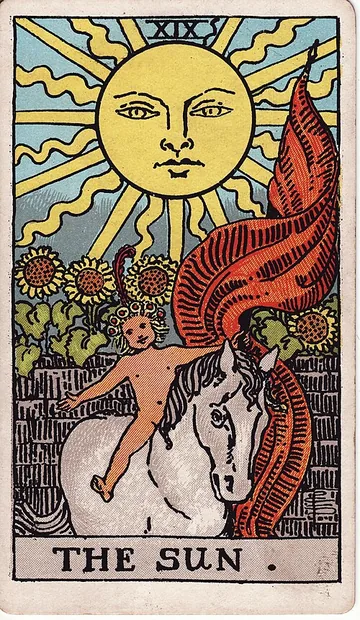
The Sun tarot card can bring a real success, clearer understanding, or shared pleasure into view. Upright, it may favor celebrating what has worked and using the clarity to move forward. Reversed, a modern reading may ask why a good result feels incomplete or whether cheerful appearances hide an unfinished task. Pamela Colman Smith shows a child on a white horse beneath a large sun, carrying a red banner before a wall lined with sunflowers. The card does not guarantee that every outcome will be favorable. Its sharper question is what good result you can name, who helped create it, and what remains visible once the bright moment has passed.
Look at the child, horse, and wall
A child rides a white horse beneath a sun with a face and alternating straight and wavy rays. A large red banner streams behind, and four sunflowers rise beyond a low wall. Waite described the child emerging from a walled garden and emphasized a simplicity that can meet the light openly. Smith's picture is exuberant, but it still has a setting: the wall, flowers, horse, and path of travel make this more than a yellow circle promising luck. Look for what is actually visible. Who can share in the moment, what has grown behind the wall, and what must be carried forward once the rider passes? The sunflowers are part of the image; Waite did not give them a fixed, separate doctrine.
Upright: name the good result
Upright, The Sun can favor clarity, enjoyment, and progress you can point to. Waite's historical divinatory list included material happiness, contentment, and fortunate marriage. In a present reading, that might mean a completed project, a misunderstanding finally cleared, or a chance to enjoy time with someone without bracing for the next problem. Be specific: what changed, who helped, and how do you know? Celebration does not need to wait until every task is finished. It also should not erase the labor behind the result. If a plan is now working, make its conditions visible so others can learn from them. Confidence is strongest when it can describe its evidence and make room for shared credit.
Reversed: a dimmed joy or an incomplete result?
A modern reversed Sun reading may point to satisfaction that feels muted, a delay in recognition, or a result that looks better from outside than it feels to those involved. Waite's own reversed list was “the same in a lesser sense,” not an announcement of catastrophe. Ask which part of the good news is solid and which part still needs attention. Perhaps the launch succeeded but the team is exhausted; perhaps a relationship is warmer but one conversation remains. It is also possible to have a real success and feel little joy because other pressures have not lifted. The card does not require you to perform happiness. It invites an accurate view of both the light and the unfinished work.
The Sun in love and relationships
In love, The Sun can bring ease, openness, and shared delight into focus. Upright may favor enjoying what two people have built and saying plainly what feels good. It can also support an honest conversation that clears up a recurring misunderstanding. Reversed may ask whether a cheerful public picture matches the private relationship, or whether a genuine improvement is being overlooked because everything is expected to be perfect. The card does not guarantee marriage, pregnancy, or a partner's affection. Notice how you treat each other when the celebration ends: are needs discussable, boundaries respected, and ordinary responsibilities shared? Warmth becomes more trustworthy when it survives daylight as well as a special moment.
The Sun in career and work
At work, The Sun can fit a visible achievement, a useful presentation, or clearer agreement about what success requires. Upright may favor showing your work, sharing the result with collaborators, and learning which process made it possible. Reversed may suggest that praise is arriving before the numbers or workload have been checked, or that useful work remains unseen. A card cannot promise a promotion or profit. Record the outcome, costs, and contributions; then decide what should continue, change, or stop. If you are choosing between opportunities, ask which one has terms you can actually inspect rather than assuming the brightest pitch is the best. Recognition is valuable when it tells the truth about what was achieved.
The Sun as feelings or as a person
Asked how someone feels, The Sun may suggest warmth, relief, openness, or your wish for a clear answer. It cannot report another person's private thoughts. As a person card, it can evoke someone who is candid, playful, or comfortable being seen, regardless of age or gender. The child in the picture is an image, not a rule that the card must refer to a child or a future parent. Look at observable behavior: does the person speak clearly, include you in their plans, and respect what you say? If the relationship matters, a direct conversation gives more reliable information than treating a bright card as proof of affection. Joy is most useful when both people can name it for themselves.
Does The Sun mean pregnancy?
The child and sunflowers can bring fertility or family to mind, especially if that is already the subject of a reading. They do not establish that a pregnancy exists or will occur. Waite wrote about the child's simplicity and spiritual light; he did not turn Smith's image into a medical test. In many readings the child may be more useful as a prompt about unguarded enjoyment, a project newly able to grow, or the wish to be seen without fear. If a literal pregnancy is the question, use an appropriate test and health advice rather than a card draw. No one needs to become a parent for this image to matter. Its visible delight belongs to many kinds of lives.
Is The Sun a yes or no card?
The Sun can lean toward yes when the question concerns a positive step whose conditions are clear and within reach. “Should we share the finished work?” is different from “Will everyone love it?” Upright may favor a well-supported action and honest celebration; reversed may suggest checking a cost or missing detail before making the announcement. Neither position controls another person's choice or guarantees a future result. Name what is already known, what must still be verified, and who will carry the next step. If the answer depends entirely on someone else's private feelings, ask them. The card's brightness is most helpful when it illuminates a real decision rather than replacing one.
A reading example: a successful launch
Imagine a small team launches a new product and receives enthusiastic reviews. The owner draws The Sun upright and wants to expand immediately. The red banner suits a celebration: thank the people who built and supported the launch, share the feedback, and enjoy the moment. Then review orders, margins, and the team's hours before promising a larger release. A reversed Sun might highlight that the reviews are real but the current schedule is exhausting, or that the team has not had time to recognize its achievement. Neither orientation predicts the next sales cycle. The reading helps the owner celebrate a genuine win and make the conditions for another one visible.
Questions to ask
- What good result can I name and verify?
- Who deserves credit for making it possible?
- What remains to be done after the celebration?