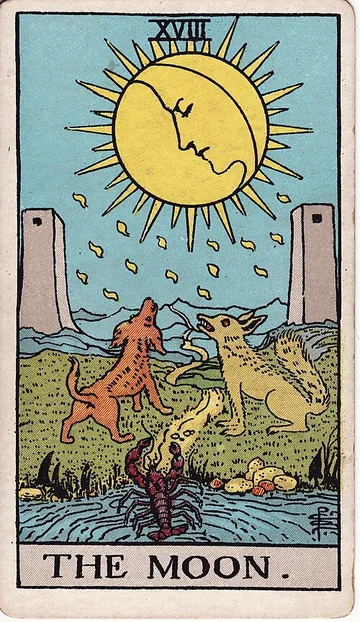
The Moon tarot card points to a moment when feelings are strong but the whole picture is hard to see. In Pamela Colman Smith's image, a dog and wolf face a moonlit sky while a crayfish rises from water and a path winds between two towers. Upright, the card can invite you to explore a dream, a worry, or an unanswered question without pretending it is settled. Reversed, it may suggest that confusion is easing or that you are forcing an answer too soon. Neither position proves a secret, a betrayal, or a prediction. The useful move is to name what you know and what you still need to ask.
Look at the image
The crayfish has barely emerged from the pool when the path begins. Farther on, a dog and a wolf lift their heads toward the same sky, one familiar and one wild. Two towers frame a road that continues past them into hills the viewer cannot inspect. Above, the Moon has a face, pointed rays, and small golden drops falling through the scene. This is not a picture of total darkness: there is light, but it is reflected light, and distance makes shapes harder to judge. A. E. Waite described the path between the towers as an exit into the unknown. Smith makes that idea concrete by placing the viewer at the water's edge, before the journey has supplied its answers. The image asks which part of a situation is visible now and which part you are filling in from hope or fear.
Upright: stay curious in uncertain light
Upright, The Moon often appears when impressions are vivid but evidence is incomplete. You may sense tension in a conversation, feel drawn toward a creative idea, or remember a dream that seems to echo a waking concern. Those experiences are worth noticing; they do not by themselves tell you what another person thinks or what will happen next. Let intuition suggest a question rather than dictate the answer. If the decision matters, identify one fact you can check and one step that can wait. If the question is artistic, ambiguity may be useful: sketch, write, or explore before deciding what the work means. The Moon favors attention and a measured pace, especially when a dramatic interpretation would be easy but hard to undo.
Reversed: is the picture clearing?
Reversed, The Moon can describe confusion beginning to lift. A conversation may put a vague worry into words, or a new detail may show which concern was justified and which was imagined. It can also point the other way: someone may be pressing for a neat conclusion because not knowing feels uncomfortable. The reversal alone cannot tell you that a hidden truth has been exposed. Compare the card with the question and the surrounding cards. What changed since the uncertain moment began? Did you receive new information, or only a stronger feeling? If you can name the actual point of uncertainty, you can ask about that point directly. If nothing new has emerged, allow the answer to remain provisional instead of turning an anxious guess into a verdict.
The Moon in love and relationships
In a love reading, The Moon may bring attention to mixed signals, unspoken expectations, or the story you tell yourself between conversations. If someone replies less often, you may feel unsettled; the card does not reveal whether they are distracted, withdrawing, or hiding something. Upright, it can favor a gentle, specific question about pace, availability, or commitment. Reversed, it may suggest that an honest exchange is beginning to clear the air, or that both people are still avoiding a subject. In an established relationship, notice whether an old fear is coloring a new event. In a new connection, leave room for the other person's own words. A reading can help you prepare for a conversation; it cannot replace consent, trust, or direct knowledge of another person's feelings.
The Moon in career and money
At work, The Moon can fit a role with an unclear brief, a promising offer with missing terms, or a team navigating rumors instead of decisions. Upright, ask for the scope, pay, dates, and decision maker in writing before making a costly commitment. Reversed, a revised agreement or candid meeting may make the path easier to see; it can also expose an assumption that everyone had been quietly making. The card is not proof that a colleague is deceptive or that an opportunity is doomed. In creative work, its imaginative quality can be an asset while ideas are still forming. Give exploration its own time, then use ordinary checks before you spend money or promise a result. The difference between inspiration and a contract matters here.
Dreams, intuition, and the unknown
Because the scene feels dreamlike, The Moon is often linked with dreams and intuition. A remembered image may be emotionally revealing without being a literal message about tomorrow. Consider what feeling stayed with you, what recent experience might have shaped it, and whether the image opens a useful question. The same care applies to a hunch while awake. It may notice a real inconsistency before you can explain it, or it may repeat a familiar fear. Neither possibility requires you to dismiss the feeling. Give it a place in the reading, then look for a conversation or observation that could test your interpretation. The Moon's strength is its ability to hold mystery without treating mystery as evidence.
Is The Moon a yes or no card?
The Moon rarely gives a useful unconditional yes or no. If the question is “Should I agree before I know the terms?”, the practical answer is to pause and ask for the terms. If the question is “Should I explore this idea?”, a small reversible step may be reasonable even without certainty. Upright can signal missing information; reversed may show either emerging clarity or a rush to end discomfort. Neither orientation guarantees a particular outcome. Instead of asking whether a person is secretly lying, ask what you need to know and how you could learn it without making an accusation. A more precise question turns the card's uncertainty into an action you can actually take.
A reading example: the unclear offer
Imagine you have been offered a new position, but the salary range is verbal and the duties have changed twice. You draw The Moon upright. The winding path matches your interest in the opportunity, while the towers and reflected light describe the limits of what you can see. The card does not tell you to reject the role or accuse the employer of bad faith. Ask for a written offer, the reporting line, the first three months of responsibilities, and the date by which you must decide. If those details arrive and match what you were told, the picture changes. If they remain vague, that is information too. A reversed Moon in the same spread could mark either the arrival of clarity or your wish to stop asking; the facts distinguish them.
Questions to ask
- What have I observed, and what have I imagined?
- What information would change my next step?
- Can I make a reversible choice while the picture is unclear?