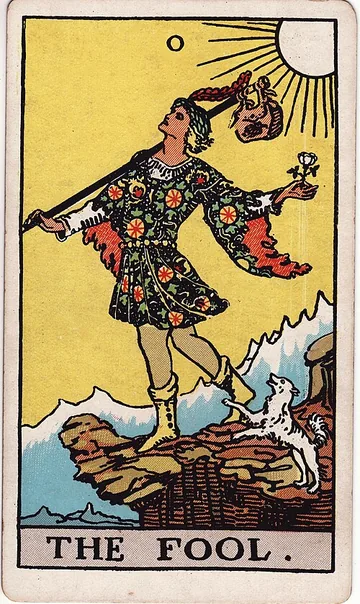
The Fool can signal a new beginning, but it does not promise that every risk will pay off. Upright, this tarot card invites curiosity and a first step into unfamiliar territory. Reversed, it can ask whether you are rushing past a warning or waiting for certainty that will never arrive. In Pamela Colman Smith's image, a traveler pauses beside a cliff with a dog, a rose, and a small bundle. The useful question is not simply whether to jump. It is what you want to explore, what you need to know, and how far you can go before making a larger commitment.
Look at the image
The traveler is paused at the cliff's lip, not pictured in midair. Smith gives the scene a bright sky and wide mountains, yet the drop remains plainly visible. A white dog springs nearby; it could be a delighted companion or a timely warning, depending on the question. The rose and embroidered bundle add more detail than a simple tale of foolishness allows: this person carries something, even while traveling lightly. Follow the direction of the feet and the lifted face. The tension between where the traveler looks and where the path ends makes the image useful for thinking about hope, attention, and the edge of what is known.
Upright: a beginning with open eyes
Upright, The Fool often speaks to a beginning whose outcome has not yet been tested: a first date, a course, a move, or a creative experiment. Its openness is most useful when you can still observe and adjust. What can you try before you must commit fully? What would a beginner need to ask? Enthusiasm is real information about what attracts you, but it is not the same as evidence that a particular plan will work. The figure at the cliff's edge suggests a moment to notice both the horizon and the ground underfoot. An upright reading favors movement with room to learn.
Reversed: haste or hesitation?
Reversed, The Fool can point in two opposite directions. You may be moving so quickly that you have missed a cost, a boundary, or a person who needs to be consulted. You may also be circling a safe first step because you want a guarantee before beginning. The question and nearby cards help distinguish those patterns. If money or a promise is involved, check the terms before acting; if the risk is a small conversation or application, ask what truly prevents it. Look again at the traveler and the cliff: does the moment call for a closer look at the ground, or for finally taking one manageable step?
The Fool in love and relationships
In a love reading, The Fool may describe the freshness of meeting someone or seeing an existing relationship differently. Upright, it can favor an honest invitation, shared curiosity, and the freedom to discover whether interest is mutual. The card cannot tell you what another person secretly feels or promise that attraction will become commitment. Reversed, consider whether a rapid start is outrunning a conversation about expectations, or whether fear of embarrassment has kept you from making a respectful approach. The question is not whether to surrender judgment for romance. It is whether both people can choose a next step with clear information and room to say no.
The Fool in career and money decisions
At work, The Fool can appear when a new role, skill, or venture is appealing before its demands are fully known. An upright reading may encourage an application, a small project, or a conversation with someone who does the work. Reversed, it may draw attention to unread conditions, an optimistic budget, or a promising idea that never leaves the notebook. Check pay, time, training, and obligations before a major change. If the choice feels all or nothing, look for a limited trial that teaches you more. A week of actual work, or a careful conversation about the offer, can reveal whether the enticing horizon matches the path in front of you.
Is The Fool a yes or no card?
The Fool is often read as a tentative yes to exploring, especially when the next step is small and reversible. It is not an unconditional yes to signing a contract, leaving a job, or trusting a stranger. If you draw it upright, try asking, "What could I do now that would help me learn?" A reversed Fool may suggest checking a missing fact or admitting that caution has become delay; it is not automatically a no. Yes-or-no readings compress a complex choice into one word. This card becomes more useful when you name the size of the risk and the point at which you will pause to reassess.
A reading example: a new creative venture
Suppose you ask, "Should I leave my job for a creative venture?" and draw The Fool. The image's open horizon speaks to the appeal of beginning, while the cliff asks what a sudden departure would cost. A useful first move might be to price the work, calculate the time and money available, and offer one paid pilot while keeping your current income. If that test brings honest feedback, you will have more to work with than excitement alone. If you draw the card reversed, ask whether you have skipped those checks or used preparation to avoid any trial at all. Either way, the experiment gives your next decision firmer ground.
Questions to ask
- What can I explore before making a larger commitment?
- Am I overlooking a real risk or waiting for impossible certainty?
- What evidence would help me decide after a small first step?