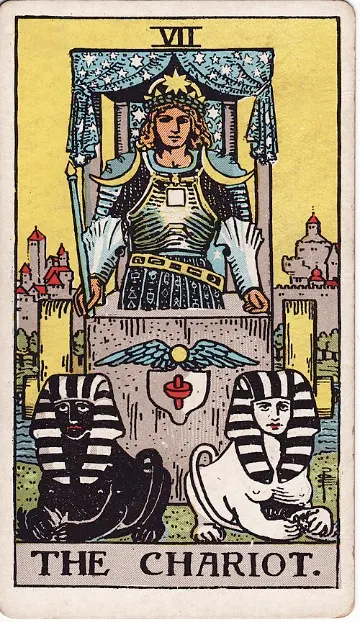
The Chariot tarot card can suggest a determined move toward a chosen goal, but its image is more thoughtful than a command to go faster. Upright, it may favor direction, coordination, and a pace you can sustain. Reversed, it may ask whether the aim is unclear or the effort has become forceful enough to work against itself. Pamela Colman Smith shows an armored figure under a starry canopy, with a black and a white sphinx resting before the vehicle. There are no visible reins and no open road shown. The useful question is how you will steer competing demands, and what would tell you to change course.
Look at the image
An armored charioteer stands beneath a canopy patterned with stars. The city is behind him; two sphinxes, one dark and one light, rest in front of the stone vehicle. Smith shows no visible reins and no open road stretching into the distance. The scene is poised rather than already speeding toward victory. A. E. Waite explained that he adopted the two sphinxes from an earlier tarot interpretation and described the card as outward triumph. The contrasting animals can invite a reading about different demands, but the picture does not show them pulling against each other. Notice the pause before movement: if the charioteer cannot simply tug a rein, what kind of attention will a journey require? That is more useful than treating the card as proof that sheer will can control every person or obstacle.
Upright: choose a destination and a pace
Upright, The Chariot can favor determined action when the destination is specific and the people or resources involved can move with you. Name the goal, then choose a near checkpoint rather than trying to win everything at once. If two commitments compete, decide which has priority for this stage and what you will do with the other. Discipline can mean protecting time, practicing regularly, and noticing when the plan needs correction. It does not require pretending the sphinxes are already running in perfect harmony. Waite's historical divinatory list includes triumph but also presumption and trouble, a reminder that visible momentum is not the same as wise direction. A good upright reading pairs resolve with feedback: what sign would show you that the route is working?
Reversed: stalled, scattered, or pushing too hard?
In a contemporary reversed reading, The Chariot can suggest a stalled start, an aim that keeps changing, or an effort so forceful that it damages cooperation. Those call for different repairs. If you have not chosen a destination, clarify the next milestone. If a plan is overloaded, remove one task or ask for help. If you are overriding someone else's wishes, pause and listen; their independence is not an obstacle to defeat. Waite's own reversed list emphasizes quarrel, dispute, and defeat rather than a modern slogan about lost self-control. The card alone cannot tell you which problem is present. Look at the real friction and the surrounding cards. A deliberate stop may be better steering, not failure, if it lets the people and resources involved move together again.
The Chariot in love and relationships
In love, The Chariot can raise a question about direction: are two people choosing a shared next step, or is one person setting the pace and calling it progress? Upright may favor a direct conversation about plans, distance, time together, or a decision both have postponed. A relationship can move forward without both people becoming identical; the dark and light sphinxes are a useful image for distinct needs held in view. Reversed may suggest that a disagreement is being treated as something to win, or that repeated delays have left the destination unclear. The card does not reveal a partner's feelings or guarantee reconciliation. Ask what each person wants, what they can consent to now, and what milestone would show that the plan belongs to both of you.
The Chariot in career and projects
At work, The Chariot can fit a deadline, a job search, or a project that requires several people to coordinate. Upright, choose the result that matters most, assign the next actions, and set a date to check whether the effort is producing it. A visible win can be satisfying, but it may cost too much if the team is exhausted or essential work is being ignored. Reversed can point to competing instructions, unclear ownership, or pressure to accelerate without enough resources. It does not promise a promotion or say that a setback is inevitable. Compare the aim with the actual calendar, budget, and authority to make decisions. If those do not fit, renegotiate the route before demanding more speed from everyone involved.
What does victory mean on this card?
The Chariot is often called a victory card, yet Waite's account makes a useful distinction: the charioteer has conquered an outward challenge, but that does not mean he has understood every inner question. A completed project, an accepted offer, or a difficult conversation can be a real achievement without solving every problem that surrounds it. Smith's stationary sphinxes make room for that nuance. The figure looks prepared to proceed, but the next movement is not pictured. Ask which result would count as a genuine win and which costs would make that label feel false. This keeps the card from becoming a promise of inevitable success or a demand for constant motion. Sometimes victory is keeping enough control of the process to change course before a small problem becomes a larger one.
Is The Chariot a yes or no card?
The Chariot can lean toward yes when the question is about taking a defined step toward a goal with the resources and consent to pursue it. “Should I submit the application I have finished?” differs from “Will I certainly get the role?” The card may encourage the first action without predicting the second answer. Upright can favor commitment to a route and a checkpoint. Reversed may suggest that you need to resolve a conflict, slow the pace, or make the goal less vague before proceeding. Neither orientation overrides another person's choice or guarantees a result. A useful yes names the destination, what you can do now, and the point at which you will reconsider if the evidence changes.
A reading example: two goals at once
Imagine you want to apply for a new role while finishing a demanding course. The application closes soon, but the course project also has a deadline. You draw The Chariot upright. The two resting sphinxes resemble demands that need coordination, not enemies to conquer. Choose one short block of time to finish the application, protect the course work that cannot wait, and set a checkpoint after submission to review your energy and remaining tasks. The card does not say you will get the job or complete both efforts effortlessly. If it appeared reversed, you might reduce the application scope, ask about an extension, or reconsider whether the role fits now. The practical reading is a route that can be steered, not a vow to push harder at every obstacle.
Questions to ask
- Which destination matters most in this stage?
- Whose needs must move with the plan?
- What checkpoint would make me revise the route?