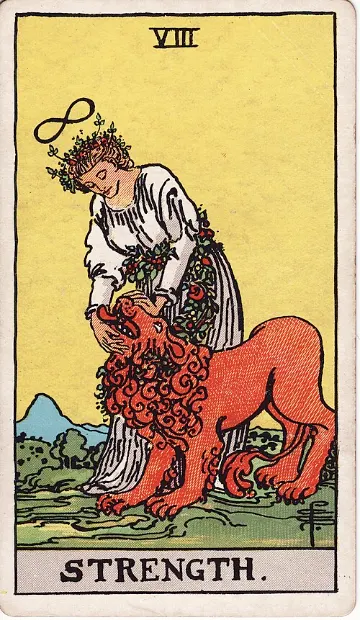
Strength tarot can describe courage expressed through patience, a firm boundary, or the choice not to escalate a difficult moment. Upright, it may favor steady action rather than a show of force. Reversed, a modern reading may ask whether anger is being suppressed, energy is running low, or power is being used harshly. Pamela Colman Smith shows a woman in white with her hands at a lion's jaws, a flower garland, and an infinity sign above her head. The card does not ask you to tolerate harm or guarantee that gentleness will change another person. It asks what response is both humane and strong enough for the situation.
Look at the image
A woman in white stands beside a lion, her hands at its jaws. A wreath and a line of flowers connect them, and a horizontal figure-eight floats above her head like the sign above The Magician. There is no weapon or metal chain in Smith's scene. A. E. Waite described her as closing the lion's mouth and called the floral link a chain of flowers; he saw the animal as already subdued. That is his reading of the picture, not a command to tame every difficult person in your life. The scene's quiet contact makes the card different from a battle won by force. It leaves the viewer to ask whether gentleness is chosen from a position of safety and agency, or whether it is being demanded from someone who needs support or distance.
Upright: courage without a show of force
Upright, Strength may favor a response that is deliberate rather than loud. You can prepare for a difficult conversation, keep practicing a demanding skill after a poor attempt, or admit that you need help before the pressure grows. Waite's older divinatory list includes courage, energy, action, and magnanimity; none requires a person to win through intimidation. The card's gentleness is active because it involves timing, judgment, and a limit you are prepared to hold. Ask what you can influence and what belongs to someone else. If a calm request is likely to help, make it specific. If the situation is harmful, the strong action may be to leave or seek support. The image offers a model of composed contact, not a measure of how much discomfort you can silently carry.
Reversed: depleted, doubtful, or using force?
A contemporary reversed Strength reading may describe exhaustion, self-doubt, anger pushed underground, or a demand to appear calm while the real problem goes untouched. It can also point toward force replacing persuasion. Those possibilities need different responses. Rest might help one person; another needs a clear boundary or a change in the conditions around them. Waite's historical reversed list includes abuse of power, weakness, and discord, so the modern burnout reading should not be mistaken for his only meaning. Look at the question and surrounding cards before deciding which theme fits. Reversed does not prove that someone is dangerous or that you have failed to be patient enough. It asks where strength is being drawn from, whether it is being misused, and what support would make a better response possible.
Strength in love and relationships
In love, Strength can describe patience that makes honest conversation possible. Upright, it may favor naming a difficult feeling without turning it into an attack, listening to the other person's reply, and keeping a boundary you both understand. Reversed may raise a question about suppressed resentment, repeated conflict, or one person being told to stay gentle while the other never changes. The card cannot disclose a partner's feelings or guarantee repair. Notice what happens after a calm request: is there curiosity, responsibility, and a change in behavior? A disagreement that both people can address is different from a situation where someone feels unsafe. No reading requires you to remain in harm's way for the sake of proving patience. Respect and safety are conditions for gentleness, not prizes earned by enduring more.
Strength in career and work
At work, Strength may fit a demanding presentation, feedback you would rather avoid, or a team strained by a recurring problem. Upright, it can favor preparation, a measured response, and persistence that still leaves room to learn. Reversed may suggest that a request for endless resilience has replaced adequate staffing or a clear decision. The card does not promise a promotion because you keep your composure, nor does it mean every conflict should be handled alone. Identify the task you can do, the help or authority you need, and the point at which the plan must change. Sometimes a strong response is to ask for a revised deadline or document a concern. The lion is not a reason to accept every burden placed before you.
Why do the flowers matter?
The floral link is easy to miss beside the lion, yet it changes the scene. Waite called it a chain of flowers and used it to express a gentle form of fortitude. Smith does not show a metal restraint, a sword, or a triumphant crowd. The woman's hands and the animal's head remain close enough that the encounter matters in the present moment. In a reading, that can suggest influence through attention, practice, and a relationship to the force involved. It does not mean a soft approach will always work. If the lion stands for a feeling you have, perhaps the question is how to acknowledge it without letting it decide everything. If it stands for another person, the question includes whether contact is welcome and safe. The flowers invite nuance, not self-sacrifice.
Is Strength a yes or no card?
Strength can lean toward yes when the question is about taking a difficult but manageable action within your control, such as asking for help, practicing again, or stating a boundary calmly. It is not a promise that another person will agree or that a conflict will resolve on your preferred schedule. Upright may favor acting with preparation and support. Reversed may suggest pausing to assess exhaustion, anger, or the pressure to perform courage for someone else's benefit. It is not an automatic no. Ask what a safe first step would be and what sign would tell you to stop or seek more support. A binary answer is less useful than a plan that protects your agency while leaving room for new information.
A reading example: speaking up in a meeting
Imagine a colleague repeatedly interrupts you in planning meetings. You want to address it but dread making the room tense. You draw Strength upright. The woman and lion need not mean that you should smile through another interruption. Before the next meeting, ask the facilitator to keep turns clear; if it happens again, use a short sentence such as “I would like to finish this point.” Notice the response and decide whether a private conversation or further support is needed. A reversed Strength might highlight how tired you are of managing the problem alone, or the temptation to answer with the same sharpness. Neither orientation diagnoses the colleague. The useful reading is a response that protects your voice without making your endurance the whole solution.
Questions to ask
- Which response protects my agency without escalating?
- Where do I need a boundary or support?
- Am I choosing patience, or being asked to absorb harm?